

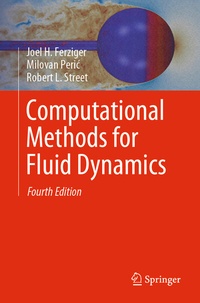
Computational Methods for Fluid Dynamics
4th Edition
Published on 16. August 2019
XVIII, 596 pages
978-3-319-99693-6 (ISBN)
Description

This book is a guide to numerical methods for solving fluid dynamics problems. The most widely used discretization and solution methods, which are also found in most commercial CFD-programs, are described in detail. Some advanced topics, like moving grids, simulation of turbulence, computation of free-surface flows, multigrid methods and parallel computing, are also covered. Since CFD is a very broad field, we provide fundamental methods and ideas, with some illustrative examples, upon which more advanced techniques are built. Numerical accuracy and estimation of errors are important aspects and are discussed in many examples. Computer codes that include many of the methods described in the book can be obtained online. This 4th edition includes major revision of all chapters; some new methods are described and references to more recent publications with new approaches are included. Former Chapter 7 on solution of the Navier-Stokes equations has been split intotwo Chapters to allow for a more detailed description of several variants of the Fractional Step Method and a comparison with SIMPLE-like approaches. In Chapters 7 to 13, most examples have been replaced or recomputed, and hints regarding practical applications are made. Several new sections have been added, to cover, e.g., immersed-boundary methods, overset grids methods, fluid-structure interaction and conjugate heat transfer.
More details
Series
Edition
Fourth Edition 2020
Language
English
Place of publication
Cham
Switzerland
Publishing group
Springer International Publishing
Product notice
Reflowable
Illustrations
XVIII, 596 p. 209 illus., 43 illus. in color.
ISBN-13
978-3-319-99693-6 (9783319996936)
DOI
10.1007/978-3-319-99693-6
Schweitzer Classification
Other editions
Additional editions
Joel H. Ferziger | Milovan Peric | Robert L. Street
Computational Methods for Fluid Dynamics
Book
08/2019
4th Edition
Springer
€74.89
Shipment within 10-15 days
Persons
Joel H. Ferziger, Dept. Mechanical Engineering, Stanford University, Stanford, CA, USAJoel passed away in 2004; he taught numerical methods in engineering and CFD over many years at Stanford and is widely known for his pioneering work on large-eddy simulation methods.
Milovan Peric, Faculty of Engineering, University of Duisburg-Essen, and CoMeT Continuum Mechanics Technologies GmbH, Erlangen, GermanyMilovan taught CFD and fluid dynamics at universities in Erlangen and Hamburg for 15 years and then spent 12 years at CD-adapco (now part of Siemens PLM), working on the development of commercial CFD software. He is currently consultant to Siemens PLM and industrial users of CFD-software and also teaching Applied CFD at the University of Duisburg-Essen.
Robert L. Street, School of Engineering, Stanford University, Stanford, CA, USABob has taught fluid mechanics, numerical methods and turbulence modeling coursesat Stanford for the past 56 years; his research focuses on numerical simulation of geophysical flows. In recent years, he has worked on turbulence models for large-eddy simulation of the atmospheric boundary layer and of cloud formation and evolution.
Content
Basic Concepts of Fluid Flow.- Introduction to Numerical Methods.- Finite Difference Methods.- Finite Volume Methods.- Solution of Linear Equation Systems.-Methods for Unsteady Problems.- Solution of the Navier-Stokes Equations.- Complex Geometries.- Turbulent Flows.- Compressible Flows.- Efficiency, Accuracy and Grid Quality.- Special Topics.
