

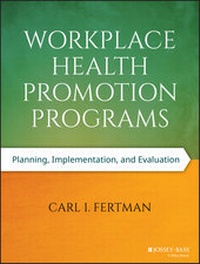
Workplace Health Promotion Programs
Description

Reviews / Votes
"This is an excellent book for all you need to know about workplace health promotion programs. It is a very comprehensive overview on planning, implementing, and evaluating effectiveness and efficiencies of such programs and provides systematic evidence-based approach in doing so. The author, Carl I. Fertman, PhD,MBA, MCHES, is a thought leader in evidence-based programs for work place health promotion programs with deep knowledge of challenges facing small,mid-size, or large employers in planning, implementing, and evaluating health and wellness initiatives for their employees. (...) This book is a great resource for a diverse group of readers from government, nongovernment, academia to business professionals interested in workplace health promotion programs, students, occupational medicine, human resource, and benefits professionals. Work place health and wellness program administrators or consultants can benefit tremendously from the content of this publication." - Fikry Isaac, MD, MPH, Johnson and Johnson Services Inc, New Brunswick, United StatesMore details
Other editions
Additional editions
Person
Content
Figures, Tables, Boxes, and Exhibits xvii
Preface xxi
Acknowledgments xxvix
About the Author xxxi
Part One: Foundation 1
Chapter 1 Workplace Health Promotion Program Foundations 3
What AreWorkplace Health Promotion Programs? 3
Historical Context for Workplace Health Promotion 5
Impact of the Patient Protection and Affordable Care Act on Workplace Health Promotion 13
Workplace Health Promotion Controversies and Pitfalls 16
Summary 20
For Practice and Discussion 21
Case Study: What Is a Workplace Health Promotion Program?-WhatWould You Do? 22
Key Terms 23
References 23
Chapter 2 Health Promotion Approaches, Theories, and Models Applied toWorkplace Health Promotion 27
Workplace Health Promotion Approaches 27
Health Theory's Role in Workplace Health Promotion Programs 36
Workplace Health Promotion Program Planning Models 40
Guidelines for Choosing Approaches, Theories, and Models 45
Summary 50
For Practice and Discussion 50
Case Study: Using Health Approaches, Theory, and Models-WhatWould You Do? 50
Key Terms 51
References 52
Chapter 3 Human ResourceManagementMakes Health a Priority 53
Human Resources, the Workplace Health Promotion Program's Gatekeeper 53
Human Resource Management and Human Resource Departments 54
Human Resource ProfessionsWith Responsibilities for Workplace Health Promotion 57
Health Insurance Benefits and Providers 63
Four Human Resource Management Actions for Quality Workplace Health Promotion Programs 66
Summary 71
For Practice and Discussion 72
Case Study: Strategic Human ResourceManagement-What Would You Do? 73
Key Terms 74
References 74
Part Two: Planning 77
Chapter 4 Program Planning and Initial Actions 79
Workplace Health Promotion Program Planning Elements and Management 79
Data Gathering Equals Needs Assessments 84
Workplace Health Readiness 88
Workplace Capacity for Health 93
Summary 99
For Practice and Discussion 99
Case Study: Program Planning Needs Assessment Challenges-WhatWould You Do? 100
Key Terms 101
References 102
Chapter 5 Assessing the Strength of Workplace Health Promotion Champions, Advocates, Culture, and Climate 105
Champions and Advocates for Workplace Health Promotion 105
Health PromotingWorkplace Culture and Climate 106
Importance of Workplace Health Policy and Procedures 113
Legal Issues in Health Policies and Procedures 117
Summary 125
For Practice and Discussion 126
Case Study: Finding Champions and Advocates-What Would You Do? 127
Key Terms 127
References 127
Chapter 6 Assessing Workplace Health Promotion Teams, Partnerships, and Collaborations 129
Teams, Partnerships, and Collaborations: A Socioecological Approach to Promote Employee and Employer Health 129
Workplace Teams 130
Partnerships: What to Look For 138
Collaborations Work at the Regional, State, National, and International Level 143
Summary 146
For Practice and Discussion 146
Case Study: Newly Promoted National Health and Safety Director-WhatWould You Do? 148
Key Terms 148
References 149
Chapter 7 Assessing Employee Health Needs and Transition to Implementation 151
Employee Health Needs Assessment Data and Sources 151
UseNeeds Assessment Results to Support andMake Program Decisions 159
What to Expect to Have and to Know at the Conclusion of the Planning Process 170
Summary 172
For Practice and Discussion 172
Case Study: Employee Participation in HRA and Biometric Screening-What Would You Do? 173
Key Terms 174
References 174
Part Three: Implementation 177
Chapter 8 Workplace Health Promotion Program Implementation Health Priority: Physical Health 179
Program Implementation: Physical Health Priority 179
Evidence-Based Physical Health Policies, Practices, Interventions, and Services 180
Factory Floor- and Office-Level Evidence-Based Physical Health Interventions and Practices 189
Physical Health Priority Implementation Challenges 191
Advocacy and Resource Partnerships and Organizations 194
Summary 196
For Practice and Discussion 196
Case Study: Walmart Corporation Health Centers-What Would You Do? 197
Key Terms 198
References 198
Chapter 9 Workplace Health Promotion Program Implementation Health Priority: Mental and Behavioral Health 201
Program Implementation: Mental and Behavioral Health Priority 201
Evidence-Based Mental and Behavioral Health Policies, Practices, Interventions, and Services 202
Factory Floor- and Office-Level Evidence-Based Mental Health Interventions and Practices 212
Mental and Behavioral Health Priority Implementation Challenges 213
Advocacy and Resource Partnerships and Organizations 216
Summary 217
For Practice and Discussion 218
Case Study: Employer and Employee Mental Health Promotion-WhatWould You Do? 219
Key Terms 220
References 220
Chapter 10 Workplace Health Promotion Program Implementation Health Priority: Physical Activity 223
Program Implementation: Physical Activity Priority 223
Evidence-Based Physical Activity Policies, Practices, Interventions, and Services 224
Factory Floor- and Office-Level Evidence-Based Physical Activity Interventions and Practices 231
Physical Activity Priority Implementation Challenges 233
Advocacy and Resource Partnerships and Organizations 236
Summary 238
For Practice and Discussion 238
Case Study: Encouraging Employees'PhysicalActivity-What Would You Do? 239
Key Terms 240
References240
Chapter 11 Workplace Health Promotion Program Implementation Health Priority: Nutrition 243
Program Implementation: Nutrition Priority 243
Evidence-Based Nutrition Policies, Practices, Interventions, and Services 244
Factory Floor- and Office-Level Evidence-Based Nutrition Interventions and Practices 252
Nutrition Implementation Challenges 254
Advocacy and Resource Partnerships and Organizations 256
Summary 258
For Practice and Discussion 259
Case Study: Nutrition Program Implementation-What Would You Do? 260
Key Terms 261
References 261
Chapter 12 Workplace Health Promotion Program Implementation Health Priority: Physically Healthy and Safe Environments 265
Physically Healthy and Safe Workplace Environments Priority 265
Evidence-Based Physically Healthy and Safe Workplace Environment Policies, Practices, Interventions, and Services 267
Factory Floor- and Office-Level Evidence-Based Physically Healthy and Safe Workplace Interventions and Practices 273
Physically Healthy and Safe Workplace Environment Priority Implementation Challenges 274
Advocacy and Resource Partnerships and Organizations 279
Summary 282
For Practice and Discussion 282
Case Study: Safety Inspector Career Guidance Unit-What Would You Do? 284
Key Terms 285
References 285
Chapter 13 Workplace Health Promotion Program Implementation Health Priority: Psychologically Healthy and Safe Environments 287
Program Implementation: Psychologically Healthy and Safe Workplace Environments Priority 287
Evidence-Based Psychologically Healthy and Safe Environment Policies, Practices, Interventions, and Services 288
Factory Floor- and Office-Level Evidenced-Based Psychologically Healthy and Safe Workplace Interventions and Practices 295
Psychologically Healthy and Safe Workplace Environment Priority Implementation Challenges 296
Advocacy and Resource Partnerships and Organizations 301
Summary 303
For Practice and Discussion 303
Case Study: Sexual Images and Videos on Employee Computer-What Would You Do? 304
Key Terms 305
References 305
Chapter 14 Workplace Health Promotion Program Implementation Health Priority: Health Education in an eHealth Environment 309
Program Implementation: Health Education Priority in an eHealth Environment 309
Evidence-Based Health Education Policies, Practices, Interventions, and Services in an eHealth Environment 311
Factory Floor- and Office-Level Evidence-Based Health Education Interventions and Practices 317
Health Education Priority Implementation Challenges in an eHealth Environment 320
Advocacy and Resource Partnerships and Organizations 324
Summary 325
For Practice and Discussion 325
Case Study: Union and Employee eHealth Concerns-What Would You Do? 326
Key Terms 327
References 327
Part Four: Evaluation 331
Chapter 15 Best Practices in Workplace Health Promotion Program Evaluation 333
Population Health Management Evaluation Framework 333
Two Main Purposes of Program Evaluation: Improvement and Accountability 336
Economic Evaluations Including Return on Investment 339
Feasible, Scalable, Sustainable, and Scientific Workplace Evaluations 346
Strategic Alignment, Innovation, and Business Intelligence and Knowledge Management 348
Summary 349
For Practice and Discussion 350
Case Study: Patient Protection and Affordable Care Act Program Evaluation Influence-WhatWould You Do? 351
Key Terms 352
References 352
Chapter 16 Big Data,Health Information Management,Health Informatics, and Workplace Health Promotion 355
Big Data forWorkplace Health Promotion 355
Health Information Management and Health Informatics Professionals: Big Data Professional Fields 360
How Big Data Can Enhance the Impact and Sustainability of Workplace Health Promotion Programs 363
Workplace Health Promotion Big Data Evaluation Challenges 364
Big Data Applications and Services forWorkplace Health Promotion 367
Summary 370
For Practice and Discussion 370
Case Study: Getting the Data You Need and Can Use-What Would You Do? 371
Key Terms 372
References 372
Part Five: Workplaces 375
Chapter 17 Small and Midsized Employers and Health Promotion 377
How Small and Midsized Employers Promote Employee Health 377
HowtoWorkWith Small and Midsized Employers to Promote Worker Health 383
Challenges and Opportunities for Small and Midsized Employer Health Promotion Programs 386
Small and Midsized Employer Workplace Health Promotion Tools and Resources 389
Summary 393
For Practice and Discussion394
Case Study: Small Business Exhaustion-WhatWould You Do? 395
Key Terms 395
References395
Chapter 18 Hospital Employee Health Promotion Programs 399
How Hospitals Promote Employee Health 399
How toWorkWith Hospitals to Promote Employee Health 401
Challenges and Opportunities for Hospital Employee Health Promotion Programs 410
Hospital Employee Health Promotion Tools and Resources 412
Summary 415
For Practice and Discussion 416
Case Study: Hospital Worker Sleep Hygiene Program-What Would You Do? 416
Key Terms 417
References 417
Chapter 19 Federal Government Employee Health Promotion 421
How the Federal Government Promotes Employee Health 421
How to Work With the Federal Government to Promote Employee Health 427
Challenges and Opportunities for Federal Employee Workplace Health Promotion Programs 432
Federal Government EmployeeWorkplace Health Promotion Tools and Resources 435
Summary 438
For Practice and Discussion 438
Case Study: Getting a Job Working at FedStrive-What Would You Do? 439
Key Terms 440
References 440
Chapter 20 School and UniversityWorkplace Employee Health Promotion 443
How Schools and Universities Promote Employee Health 443
How to Work With Schools and Universities to Promote Employee Health 447
School and UniversityWorkplace Employee Health Promotion Program Challenges and Opportunities 454
Schools and UniversityWorkplace Employee Health Promotion Tools and Resources 458
Summary 460
For Practice and Discussion 461
Case Study: Innovative Teacher and Staff Health Promotion Program Recruitment-What Would You Do? 461
Key Terms 462
References 462
Index 465
Figures, Tables, Boxes, and Exhibits
Figures
1.1 Railroad Fatalities 1900 to 2000 1.2 Workplace Health Determinants 1.3 Socioeconomic Factors and Challenges 1.4 Health Care Market a Consumer Faces When Selecting Health Care 1.5 Dangerous Occupations Based on National Statistics 2.1 Integrated Employee Health Management- NASA Employee Total Health Management 2.2 Using a Coordinated Health Approach to Address Obesity in the Workplace 2.3 PRECEDE-PROCEED Model 2.4 Centers for Disease Control and Prevention Workplace Health Model 2.5 SafeWell Integrated Management System (SIMS) 2.6 Interactive Approaches, Theories, and Models to Create Workplace Health Promotion Programs 3.1 Human Resource Activities 3.2 Human Resource Professional Credible Activist Competency Pyramid With the Six Competencies 4.1 Employer and Employee Data Sources for Workplace Health Promotion Program Planning and Decision Making 4.2 CDC Worksite Health ScoreCard Organizational Support Question Sample 4.3 Safety and Health Management eTool Action Areas for Each Component 5.1 New Zealand Safety Culture Snapshot 5.2 EPA Indoor Air Quality Management Framework 6.1 Teams, Partnerships, and Collaborations Linking the Levels of Promoting Employee and Employer Health 6.2 Organizational Size Health Promotion Teams' Support and Resource Balance 7.1 Medical Claim Codes 7.2 Injury Occurrence Associated With Routine and Nonroutine Work Tasks 7.3 Injury Cause 7.4 Employee Assistance Program Service Utilization 11.1 Dole Corporation Headquarters Cafe Menu 12.1 OSHA Safety and Health Management Systems eTool 13.1 Psychologically Healthy and Safe Workplace Environment Priority Program Implementation 13.2 Blurry Boundaries Among Person-Specific Employment Practices 15.1 Population Health Evaluation Framework 15.2 Population Health Management Evaluation Feedback Loop 15.3 Drivers or Determinants of Health and Health Costs 16.1 Big Data for Workplace Health Promotion Program Evaluation 16.2 Recent Changes and Trends Have Created the Opportunity to Use Big Data in Workplace Health Promotion Programs 17.1 Partnership for Prevention/The WorkCare Group Small and Midsized Employer Tool 18.1 Hospital Employee Health and Wellness Offerings 18.2 Hospitals as Part of Larger Health Care Systems in the 1990s 19.1 Federal Government Organizational Chart 20.1 University of Michigan Employee Health Promotion Program 20.2 School Leadership 20.3 Union Membership and Union Share of the Total Public School Workforce 20.4 Whole School, Whole Community, Whole Child (With Employee Wellness Component)
Tables
1.1 Phase Two- Examples of Programs and Services to Encourage Healthier Individual Behavior 1.2 Early (1990s) Return on Investment (ROI) Studies 2.1 Total Worker Health Approach 2.2 Interventions Consistent With Total Worker Health 2.3 Health Promotion Theories: Focus and Key Concepts 2.4 Using Theory to Plan Multilevel Workplace Interventions 2.5 WELCOA Small Business Health Promotion Model 3.1 Human Resource Professions With Responsibilities for Workplace Health Promotion 3.2 Workplace Health Promotion Programs, Services, and Equipment Providers 3.3 Health Insurance Workplace Health Promotion Professionals 3.4 Health Promotion Program Vendor Staff 3.5 Top Five Health Insurance Companies in the United States 3.6 Health Insurance Package Types and Characteristics 3.7 Workplace Health Promotion Professional Codes of Ethics 4.1 Publicly Available Secondary Health Data Sources 4.2 Workplace Health Readiness Elements 4.3 Workplace Health Readiness Element Transition Related to Diagnostics, Informatics, and Health Metrics 5.1 Some Examples of Reasonable Accommodations for Persons as Required by the Americans with Disabilities Act 5.2 Health Promotion Programs Inclusive of, and Accessible to, Diverse Groups of Employees 6.1 Models of Partnerships 6.2 Patchwork Quilt of Local Partnerships for Workplace Health Promotion 7.1 Examples of the Employee Health Needs Data, Source, Scope, and Specificity 7.2 Potential Indicators of Health Claims Data Related to Workplace Health Promotion 7.3 Risk Data Analysis Report 7.4 Chronic Condition Prevalence 7.5 Participation and Adherence Comparison 7.6 Utilization by Care Delivery Platform 7.7 Lost Time at Work Due to Incidental Absences, Short-Term Disability, and Workers' Compensation 7.8 Examples of the Health Promotion Program Staff Decision-Making Implications Drawn From Health Needs Data, Source, Scope, and Specificity 8.1 Workplace Primary Care Center Services 8.2 Tailored Disease Management Program Content 8.3 Models of Value-Based Benefits With Associated Examples 8.4 High- and Low-Value Services 9.1 Employee Assistance Program Services 9.2 Ten Largest EAP Vendor Organizations 9.3 Features of a Family/Work-Life Program 9.4 Features of a Stress Management Program 9.5 Features of a Depression Prevention and Treatment Program 9.6 Beyond Blue National Workplace Program to Prevent Depression 10.1 Total Weekly Amounts of Aerobic Physical Activity 10.2 Partnering With Your Community Recreation Associations and Organizations 10.3 What Americans Do 11.1 Healthy Vending Machine Snack Option Comparison 12.1 Compliance Assistance Quick Start: General Industry 12.2 Step 1: OSHA Requirements That Apply to Most General Industry Employers 12.3 Occupational and Environmental Professional Organizations 13.1 Psychosocial Protective and Risk...
