

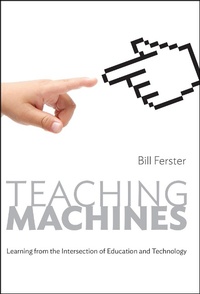
Teaching Machines
Learning from the Intersection of Education and Technology
Published on 12. January 2015
216 pages
978-1-4214-1541-3 (ISBN)
Description

Technology promises to make learning better, cheaper, faster-but rarely has it kept that promise.
The allure of educational technology is easy to understand. Classroom instruction is an expensive and time-consuming process fraught with contradictory theories and frustratingly uneven results. Educators, inspired by machines' contributions to modern life, have been using technology to facilitate teaching for centuries.
In Teaching Machines, Bill Ferster examines past attempts to automate instruction from the earliest use of the postal service for distance education to the current maelstrom surrounding Massive Open Online Courses. He tells the stories of the entrepreneurs and visionaries who, beginning in the colonial era, developed and promoted various instructional technologies. Ferster touches on a wide range of attempts to enhance the classroom experience with machines, from hornbooks, the Chautauqua movement, and correspondence courses to B. F. Skinner's teaching machine, intelligent tutoring systems, and eLearning.
The famed progressive teachers, researchers, and administrators that the book highlights often overcame substantial hurdles to implement their ideas, but not all of them succeeded in improving the quality of education. Teaching Machines provides invaluable new insight into our current debate over the efficacy of educational technology.
The allure of educational technology is easy to understand. Classroom instruction is an expensive and time-consuming process fraught with contradictory theories and frustratingly uneven results. Educators, inspired by machines' contributions to modern life, have been using technology to facilitate teaching for centuries.
In Teaching Machines, Bill Ferster examines past attempts to automate instruction from the earliest use of the postal service for distance education to the current maelstrom surrounding Massive Open Online Courses. He tells the stories of the entrepreneurs and visionaries who, beginning in the colonial era, developed and promoted various instructional technologies. Ferster touches on a wide range of attempts to enhance the classroom experience with machines, from hornbooks, the Chautauqua movement, and correspondence courses to B. F. Skinner's teaching machine, intelligent tutoring systems, and eLearning.
The famed progressive teachers, researchers, and administrators that the book highlights often overcame substantial hurdles to implement their ideas, but not all of them succeeded in improving the quality of education. Teaching Machines provides invaluable new insight into our current debate over the efficacy of educational technology.
More details
Series
Language
English
Place of publication
Baltimore
United States
Illustrations
31 s/w Photographien bzw. Rasterbilder, 12 s/w Abbildungen
12 Illustrations, black and white; 31 Halftones, black and white
File size
4,88 MB
ISBN-13
978-1-4214-1541-3 (9781421415413)
DOI
10.1353/book.36140
Copyright in bibliographic data and cover images is held by Nielsen Book Services Limited or by the publishers or by their respective licensors: all rights reserved.
Schweitzer Classification
Other editions
Additional editions
Book
01/2015
Johns Hopkins University Press
€37.00
Article not available at the moment
Person
Bill Ferster is a research professor at the University of Virginia's Curry School of Education and the director of visualization for the Sciences, Humanities & Arts Technology Initiative (SHANTI). He is the author of Interactive Visualization: Insight through Inquiry.
Content
Preface
1. Introduction
2. Sage on the Stage
3. Step by Step
4. Byte by Byte
5. From the Cloud
6. Making Sense of Teaching Machines
Notes
Index
1. Introduction
2. Sage on the Stage
3. Step by Step
4. Byte by Byte
5. From the Cloud
6. Making Sense of Teaching Machines
Notes
Index
