

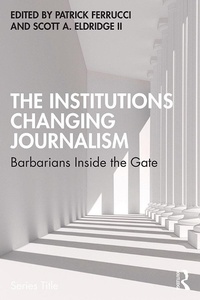
The Institutions Changing Journalism
Barbarians Inside the Gate
1st Edition
Published on 21. July 2022
218 pages
978-1-000-61570-8 (ISBN)
Description

Bringing together original contributions from a worldwide group of scholars, this book critically explores the changing role and influence of institutions in the production of news.
Drawing from a diverse set of disciplinary and theoretical backgrounds, research paradigms and perspectives, and methodologies, each chapter explores different institutions currently impacting journalism, including government bodies, businesses, technological platforms, and civic organisations. Together they outline how cracks in the autonomy of the journalism industry have allowed for other types of organizations to exert influence over the manner in which journalism is produced, funded, experienced and even conceptualized. Ultimately, this collective work argues for increased research on the impact of outside influences on journalism, while providing a roadmap for future research within journalism studies.
The Institutions Changing Journalism is an invaluable contribution to the field of journalism, media, and communication studies, and will be of interest to scholars and practitioners alike who want to stay up to date with fundamental institutional changes facing in the industry.
Drawing from a diverse set of disciplinary and theoretical backgrounds, research paradigms and perspectives, and methodologies, each chapter explores different institutions currently impacting journalism, including government bodies, businesses, technological platforms, and civic organisations. Together they outline how cracks in the autonomy of the journalism industry have allowed for other types of organizations to exert influence over the manner in which journalism is produced, funded, experienced and even conceptualized. Ultimately, this collective work argues for increased research on the impact of outside influences on journalism, while providing a roadmap for future research within journalism studies.
The Institutions Changing Journalism is an invaluable contribution to the field of journalism, media, and communication studies, and will be of interest to scholars and practitioners alike who want to stay up to date with fundamental institutional changes facing in the industry.
Reviews / Votes
"This outstanding volume provides timely and thought-provoking insights into the constantly evolving nature of journalism, the fluid definitions and overlapping roles of occupational outsiders and insiders, and the existential questions practitioners face in navigating between tradition and change. Every chapter offers a fresh perspective on the "received wisdom" of journalism studies about challenges and challengers. Some authors provide unusual takes on the usual suspects, from audiences to native advertisers; others investigate such unexpected "barbarians" as ideological editors, foundations, even academics. Just what is journalism today, and who is a journalist? The answers suggested here are more nuanced, and more interesting, than you might think." - Professor Jane Singer, Professor of Journalism and Innovation, City, University of London"This collection of essays grapples with a curious but highly consequential fact: since the advent of professional journalism at the turn of the twentieth-century, there has never been more news produced than today, and never less of it by journalists. Over eleven wide-ranging chapters, the authors investigate what happens when journalists who once were able to patrol the boundaries of their field now find themselves cheek-to-jowl with political activists, advertisers, nonprofits, university newsrooms, the "people formerly known as the audience," and technologists, among others. The result is an incisive exploration of how and why the institution of journalism has blurred in the twenty-first century. A must-read for anyone interested in the future of news and the role journalism might play in that future." - Professor David Ryfe, Professor of Journalism and Mass Communication, University of Iowa
More details
Edition
1. Auflage
Language
English
Place of publication
London
United Kingdom
Publishing group
Taylor & Francis Ltd
Target group
College/higher education
Illustrations
6 Tables, black and white; 6 Line drawings, black and white; 6 Illustrations, black and white
ISBN-13
978-1-000-61570-8 (9781000615708)
Copyright in bibliographic data and cover images is held by Nielsen Book Services Limited or by the publishers or by their respective licensors: all rights reserved.
Schweitzer Classification
Other editions
Additional editions
Patrick Ferrucci | Scott A. Eldridge II
The Institutions Changing Journalism
Barbarians Inside the Gate
Book
07/2022
1st Edition
Routledge
€60.10
Shipment within 15-20 days
Patrick Ferrucci | Scott A. Eldridge II
The Institutions Changing Journalism
Barbarians Inside the Gate
Book
07/2022
1st Edition
Routledge
€206.20
Shipment within 15-20 days
Persons
Patrick Ferrucci (PhD, University of Missouri) is an Associate Professor and the associate chair for graduate studies in the Department of Journalism in the College of Media, Communication and Information at University of Colorado-Boulder. His research primarily concerns itself with how shifting notions of "organization" in journalism lead to influence on journalism practice. Specifically, his work examines organization-level variables' impact on message construction. He is the author of Making Nonprofit News (Routledge).
Scott A. Eldridge II (PhD, University of Sheffield) is an Associate Professor at the Centre for Media and Journalism Studies at the University of Groningen. He researches digital journalism and how non-traditional actors challenge the boundaries of the journalistic field. He is the author of Online Journalism from the Periphery (2018) and co-author with Miguel F. Santos Silva of The Ethics of Photojournalism in the Digital Age (2020), and is co-editor with Martin Conboy of Global Tabloid: Culture and Technology (2021) and with Bob Franklin, of the Routledge Companion to Digital Journalism Studies (2017) and Routledge Handbook of Developments in Digital Journalism Studies (2019). From 2018-2021 he was Associate Editor of Digital Journalism.
Scott A. Eldridge II (PhD, University of Sheffield) is an Associate Professor at the Centre for Media and Journalism Studies at the University of Groningen. He researches digital journalism and how non-traditional actors challenge the boundaries of the journalistic field. He is the author of Online Journalism from the Periphery (2018) and co-author with Miguel F. Santos Silva of The Ethics of Photojournalism in the Digital Age (2020), and is co-editor with Martin Conboy of Global Tabloid: Culture and Technology (2021) and with Bob Franklin, of the Routledge Companion to Digital Journalism Studies (2017) and Routledge Handbook of Developments in Digital Journalism Studies (2019). From 2018-2021 he was Associate Editor of Digital Journalism.
Content
List of contributors
Acknowledgements
Introduction
Journalism coming into being: The timbers and planks of a changing institution
Scott A. Eldridge II
Part I
The Historical Influencers
Knock, knock! Right-wing alternative media is at the door: Institutional boundary work in a hybrid media environment
Tine Ustad Figenschou and Karoline Andrea Ihlebaek
The Integration of Native Advertising in Journalism and Its Impact on The News-Advertising Boundary
You Li
Staying Abreast of the Law: Legal Issues Affecting Journalism Practice
Jonathan Peters
The university as a 'giant newsroom': Not-for-profit explanatory journalism during COVID-19
Alfred Hermida, Lisa Varano and Mary Lynn Young
Part II
The New Funders and Organizers
Audiences as a Discursive Institution? How audience expectations disrupt the journalistic field
Sandra Banjac
Foundations and Journalism: A New Business Model, A New Set of Logics
Magda Konieczna
Journalism is Not a One-Way Street: Recognizing multi-directional dynamics
Stefan Baack, David Cheruiyot and Raul Ferrer-Conill
Beyond Innovation: Pioneer journalism and the re-figuration of journalism
Andreas Hepp and Wiebke Loosen
Part III
The Technological Institutions
Insiders Turned Interlopers: The Change Agents Behind Engaged Journalism
Jacob L. Nelson and Andrea Wenzel
Love it or Hate it: Web Analytics as Journalism
Valerie Belair-Gagnon
Journalism's Interactions with Silicon Valley Platforms: Social Institutions, Fields, and Assemblages
Frank M. Russell and Tim P. Vos
Conclusion
Understanding the Institutions Influencing Journalism: Ideas for Future Work
Patrick Ferrucci
Acknowledgements
Introduction
Journalism coming into being: The timbers and planks of a changing institution
Scott A. Eldridge II
Part I
The Historical Influencers
Knock, knock! Right-wing alternative media is at the door: Institutional boundary work in a hybrid media environment
Tine Ustad Figenschou and Karoline Andrea Ihlebaek
The Integration of Native Advertising in Journalism and Its Impact on The News-Advertising Boundary
You Li
Staying Abreast of the Law: Legal Issues Affecting Journalism Practice
Jonathan Peters
The university as a 'giant newsroom': Not-for-profit explanatory journalism during COVID-19
Alfred Hermida, Lisa Varano and Mary Lynn Young
Part II
The New Funders and Organizers
Audiences as a Discursive Institution? How audience expectations disrupt the journalistic field
Sandra Banjac
Foundations and Journalism: A New Business Model, A New Set of Logics
Magda Konieczna
Journalism is Not a One-Way Street: Recognizing multi-directional dynamics
Stefan Baack, David Cheruiyot and Raul Ferrer-Conill
Beyond Innovation: Pioneer journalism and the re-figuration of journalism
Andreas Hepp and Wiebke Loosen
Part III
The Technological Institutions
Insiders Turned Interlopers: The Change Agents Behind Engaged Journalism
Jacob L. Nelson and Andrea Wenzel
Love it or Hate it: Web Analytics as Journalism
Valerie Belair-Gagnon
Journalism's Interactions with Silicon Valley Platforms: Social Institutions, Fields, and Assemblages
Frank M. Russell and Tim P. Vos
Conclusion
Understanding the Institutions Influencing Journalism: Ideas for Future Work
Patrick Ferrucci
