

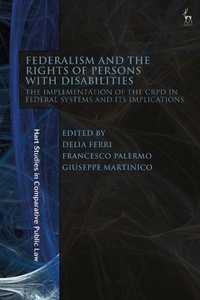
Federalism and the Rights of Persons with Disabilities
The Implementation of the Crpd in Federal Systems and its Implications
1st Edition
Published on 13. July 2023
464 pages
978-1-5099-6245-7 (ISBN)
Description

This book shines a light on the still unexplored relationships between federalism and disability rights. It investigates how the UN Convention on the Rights of Persons with Disabilities (CRPD) is implemented by different federal systems around the world.
It analyses the effects that the obligations undertaken under the CRPD have on federal governance and on the constitutional division of powers within 14 federal systems, including those in Germany, Canada, Brazil, India, the UK and Italy. The book also considers the trends and patterns of disability rights governance in federal systems and looks at the future developments of comparative disability federalism.
It analyses the effects that the obligations undertaken under the CRPD have on federal governance and on the constitutional division of powers within 14 federal systems, including those in Germany, Canada, Brazil, India, the UK and Italy. The book also considers the trends and patterns of disability rights governance in federal systems and looks at the future developments of comparative disability federalism.
More details
Series
Edition
1. Auflage
Language
English
Place of publication
London
United Kingdom
Publishing group
Bloomsbury Publishing PLC
Target group
Professional and scholarly
ISBN-13
978-1-5099-6245-7 (9781509962457)
Copyright in bibliographic data and cover images is held by Nielsen Book Services Limited or by the publishers or by their respective licensors: all rights reserved.
Schweitzer Classification
Other editions
Additional editions
Delia Ferri | Francesco Palermo | Giuseppe Martinico
Federalism and the Rights of Persons with Disabilities
The Implementation of the CRPD in Federal Systems and Its Implications
Book
01/2025
Hart Publishing
€75.70
Shipment within 15-20 days
Delia Ferri | Francesco Palermo | Giuseppe Martinico
Federalism and the Rights of Persons with Disabilities
The Implementation of the CRPD in Federal Systems and Its Implications
Book
07/2023
Hart Publishing
€133.70
Shipment within 15-20 days
Persons
Delia Ferri is Professor of Law at Maynooth University School of Law and Criminology, Ireland, and Co-Director of the MU Assisting Living and Learning Institute, Ireland.
Francesco Palermo is Professor of Comparative Constitutional Law at the University of Verona, Italy, and Head of the Institute for Comparative Federalism at Eurac Research, Bolzano/ Bozen, Italy.
Giuseppe Martinico is Professor of Comparative Public law at the Scuola Superiore Sant'Anna, Pisa, Italy and Director of the Sant'Anna Legal Studies Program, Italy.
Francesco Palermo is Professor of Comparative Constitutional Law at the University of Verona, Italy, and Head of the Institute for Comparative Federalism at Eurac Research, Bolzano/ Bozen, Italy.
Giuseppe Martinico is Professor of Comparative Public law at the Scuola Superiore Sant'Anna, Pisa, Italy and Director of the Sant'Anna Legal Studies Program, Italy.
Content
Introduction: Conceptual and Methodological Approaches, Delia Ferri (University of Maynooth, Ireland), Francesco Palermo (University of Verona, Italy) and Giuseppe Martinico (Scuola Superiore Sant'Anna, Italy)
1. The European Union: Federal Trends in Disability Rights, Delia Ferri (University of Maynooth, Ireland) and Neza subic (Maynooth University, Ireland)
2. Germany: Is Cooperative Federalism Generating Multi-Level Barriers or Facilitating Multi-Level Inclusion? Felix Welti (University of Kassel, Germany)
3. Austria: The Implementation of the CRPD in the Austrian Federal System, Peter Bußjäger (University of Innsbruck, Austria)
4. Italy: Is the CRPD Engendering a Centripetal Dynamic in the Italian Regional State?, Paolo Addis (Scuola Superiore Sant'Anna, Italy) and Matteo Monti (University of Pisa, Italy)
5. Spain: Alignment with the CRPD through Centralisation, Maribel González Pascual (University Pompeu Fabra, Spain)
6. Belgium: The Quest for Equal Employment and Coherence in the Social Protection and Participation of Persons with Disabilities, Naomi Ghys (University of Antwerp, Belgium), Freek Louckx (University of Antwerp, Belgium), and Daniel Dumont (Université Libre de Bruxelles, Belgium)
7. The United Kingdom: Asymmetrical Challenges to Implementing the CRPD, Kasey McCall-Smith (University of Edinburgh, United Kingdom)
8. Canada: A Federal Perspective on the Implementation of the CRPD, Jonas-Sébastien Beaudry (McGill University, Canada)
9. India: Disability Rights in a 'Quasi' Federal Country, Amita Dhanda (NALSAR University of Law, India)
10. South Africa: Centralised Federalism and the Implementation of the CRPD, Tinashe C Chigwata (University of the Western Cape, South Africa) and Robert D Nanima (University of the Western Cape, South Africa)
11. Ethiopia: The Missing Relationship between Federalism and Disability, Yonatan T Fessha (University of the Western Cape, South Africa) and Beza Dessalegn (Hawassa University, Ethiopia)
12. Argentina: Ensuring Disability Rights in the Context of an Anachronistic Federal System, Francisco J Bariffi (Carlos III University of Madrid, Spain)
13. Brazil: The Long Road to Persons with Disabilities' Citizenship, Gilberto MA Rodrigues (Federal University of ABC, Brazil) and Paloma Breit (Mercado Livre, Brazil)
14. Mexico: Disability Rights in Mexican Federalism, Irene Spigno (University of Coahuila, Mexico)
15. Governing the Rights of Persons with Disabilities in Federal Systems: Trends and Patterns, Delia Ferri (University of Maynooth, Ireland), Francesco Palermo (University of Verona, Italy) and Giuseppe Martinico (Scuola Superiore Sant'Anna, Italy)
Concluding Remarks: Perspectives on Future Research, Delia Ferri (University of Maynooth, Ireland), Francesco Palermo (University of Verona, Italy) and Giuseppe Martinico (Scuola Superiore Sant'Anna, Italy)
1. The European Union: Federal Trends in Disability Rights, Delia Ferri (University of Maynooth, Ireland) and Neza subic (Maynooth University, Ireland)
2. Germany: Is Cooperative Federalism Generating Multi-Level Barriers or Facilitating Multi-Level Inclusion? Felix Welti (University of Kassel, Germany)
3. Austria: The Implementation of the CRPD in the Austrian Federal System, Peter Bußjäger (University of Innsbruck, Austria)
4. Italy: Is the CRPD Engendering a Centripetal Dynamic in the Italian Regional State?, Paolo Addis (Scuola Superiore Sant'Anna, Italy) and Matteo Monti (University of Pisa, Italy)
5. Spain: Alignment with the CRPD through Centralisation, Maribel González Pascual (University Pompeu Fabra, Spain)
6. Belgium: The Quest for Equal Employment and Coherence in the Social Protection and Participation of Persons with Disabilities, Naomi Ghys (University of Antwerp, Belgium), Freek Louckx (University of Antwerp, Belgium), and Daniel Dumont (Université Libre de Bruxelles, Belgium)
7. The United Kingdom: Asymmetrical Challenges to Implementing the CRPD, Kasey McCall-Smith (University of Edinburgh, United Kingdom)
8. Canada: A Federal Perspective on the Implementation of the CRPD, Jonas-Sébastien Beaudry (McGill University, Canada)
9. India: Disability Rights in a 'Quasi' Federal Country, Amita Dhanda (NALSAR University of Law, India)
10. South Africa: Centralised Federalism and the Implementation of the CRPD, Tinashe C Chigwata (University of the Western Cape, South Africa) and Robert D Nanima (University of the Western Cape, South Africa)
11. Ethiopia: The Missing Relationship between Federalism and Disability, Yonatan T Fessha (University of the Western Cape, South Africa) and Beza Dessalegn (Hawassa University, Ethiopia)
12. Argentina: Ensuring Disability Rights in the Context of an Anachronistic Federal System, Francisco J Bariffi (Carlos III University of Madrid, Spain)
13. Brazil: The Long Road to Persons with Disabilities' Citizenship, Gilberto MA Rodrigues (Federal University of ABC, Brazil) and Paloma Breit (Mercado Livre, Brazil)
14. Mexico: Disability Rights in Mexican Federalism, Irene Spigno (University of Coahuila, Mexico)
15. Governing the Rights of Persons with Disabilities in Federal Systems: Trends and Patterns, Delia Ferri (University of Maynooth, Ireland), Francesco Palermo (University of Verona, Italy) and Giuseppe Martinico (Scuola Superiore Sant'Anna, Italy)
Concluding Remarks: Perspectives on Future Research, Delia Ferri (University of Maynooth, Ireland), Francesco Palermo (University of Verona, Italy) and Giuseppe Martinico (Scuola Superiore Sant'Anna, Italy)
