

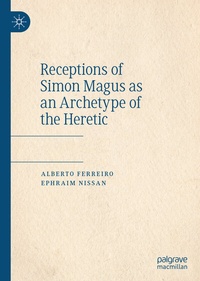
Receptions of Simon Magus as an Archetype of the Heretic
Description

This book about receptions of Simon Magus uncovers further facets of one who was held to be the evil archetype of heretics. Ephraim Nissan and Alberto Ferreiro explore how Simon Magus has been represented in text, visual art, and music. Special attention is devoted to the late medieval Catalan painter Lluís Borrassà and the Italian librettist and musician Arrigo Boito. The tradition of Simon Magus' demonic flight, ending in his crashing down, first appears in the patristic literature. The book situates that flight typologically across cultures. Fascinating observations emerge, as the discussion spans flight of the wicked in rabbinic texts, flight and death of King Lear's father and a Soviet-era Buryat Buddhist monk, flight and doom of the fool in an early modern German broadsheet, and more. The book explains and moves beyond extant scholarly wisdom on how the polemic against Mani (the founder of Manichaeism) was tinged with hues of Simon Magus. The novelty of this book is that it shows that Simon Magus' receptions teach us a great deal about the contexts in which this archetype was deployed.
More details
Other editions
Additional editions
Persons
Alberto Ferreiro is Emeritus Professor in the Department of History at Seattle Pacific University, where he taught for 36 years. He is the author of 11 books, most recently Epistolae Plenae: The Correspondence of the Bishops of Hispania with the Bishops of Rome: Third through Seventh Centuries (2020), and approximately 130 scholarly articles in journals such as Vigiliae Christianae, Harvard Theological Review, and Hispania Sacra. His areas of research are Late Antique Hispania and Gallia, Apocryphal Simon Magus, and the Catalán sermons of Vicent Ferrer.
Ephraim Nissan is a scholar with over 600 publications. He has guest-edited thematic issues for journals more than twenty times, most recently a volume for the centennial of Berthold Laufer's Sino-Iranica on cultural exchanges involving Asia. His humanities research is interdisciplinary and address late antique, pre-modern, and recent cultures, mainly Jewish studies, but also Italian, folklore, humour studies, history of medicine, and more.
