

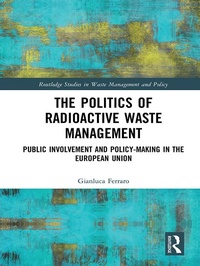
The Politics of Radioactive Waste Management
Public Involvement and Policy-Making in the European Union
Published on 1. November 2018
194 pages
978-1-315-45292-0 (ISBN)
Description

Environmental concerns have pushed the decarbonisation of the European economy high on the EU political agenda. This has renewed old debates about the role of nuclear energy in the European economy and society that gravitate around the issues of nuclear safety and radioactive waste management (RWM). RWM carries many elements of technical complexity, scientific uncertainty and social value, which makes policy decisions highly controversial. Public participation is usually believed to improve these decisions, ease their implementation by solving substantial conflicts, and enhance trust and social acceptance.
Drawing upon sources including Euratom and the OECD Nuclear Energy Agency, the author offers a detailed overview of public involvement in RWM in the EU, analysing the implementation of national policies through official programmes and the views of stakeholders from all Member States. This book highlights the key successes and challenges in the quest for greater participation in RWM, and extrapolates insights for other contested energy infrastructures and controversies in land use.
This book will be of great relevance to students, scholars and practitioners with an interest in radioactive waste management, energy policy, and EU environmental politics and policy.
Drawing upon sources including Euratom and the OECD Nuclear Energy Agency, the author offers a detailed overview of public involvement in RWM in the EU, analysing the implementation of national policies through official programmes and the views of stakeholders from all Member States. This book highlights the key successes and challenges in the quest for greater participation in RWM, and extrapolates insights for other contested energy infrastructures and controversies in land use.
This book will be of great relevance to students, scholars and practitioners with an interest in radioactive waste management, energy policy, and EU environmental politics and policy.
Reviews / Votes
"This book provides a timely guide on public involvement in radioactive waste management, and challenges practitioners and scholars to rethink the governance of this wicked socio-technical problem. With its rich, empirical material and interdisciplinary appeal, it will engage all those interested in environmental policy and conflict resolution more in general." -- Valerie Pattyn, Assistant Professor in Public Administration, Institute of Public Administration, Leiden University, the Netherlands."Gianluca Ferraro does an excellent job of alerting us to questions that need resolving in 'wicked' policy areas. This book draws out important lessons for scholarship on environmental governance and on the quality of democracy. Policymakers across governance levels and policy fields need to read this book to reflect on effective and legitimate long-term policy planning." -- Claire Dupont, Assistant Professor of European and International Governance, Ghent University, Belgium.
"Though the book itself concentrates on radioactive waste management, the insights provided by it on public involvement in EU decision-making processes have broader ramifications. Social acceptance of policies is not simply generated because citizens can be involved in the decision-making process, especially in safety related matters. This complexity is well-explained, and well-analyzed throughout the different chapters." -- Joery Matthys, Assistant Professor, Institute of Security and Global Affairs, Leiden University, the Netherlands.
More details
Series
Language
English
Place of publication
London
United Kingdom
Publishing group
Taylor & Francis Ltd
Target group
College/higher education
Illustrations
10 Tables, black and white; 9 Line drawings, black and white; 9 Illustrations, black and white
File size
5,12 MB
ISBN-13
978-1-315-45292-0 (9781315452920)
Copyright in bibliographic data and cover images is held by Nielsen Book Services Limited or by the publishers or by their respective licensors: all rights reserved.
Schweitzer Classification
Other editions
Additional editions
Gianluca Ferraro
The Politics of Radioactive Waste Management
Public Involvement and Policy-Making in the European Union
Book
06/2020
1st Edition
Routledge
€52.03
Shipment within 15-20 days
Gianluca Ferraro
The Politics of Radioactive Waste Management
Public Involvement and Policy-Making in the European Union
Book
11/2018
1st Edition
Routledge
€230.48
Shipment within 10-20 days
Gianluca Ferraro
The Politics of Radioactive Waste Management
Public Involvement and Policy-Making in the European Union
Book
11/2018
Routledge Is
Unfortunately, price unknown
Available (delivery time upon request)
Person
Gianluca Ferraro is a policy analyst. He has worked for the European Commission and the University of Leuven, Belgium
Content
List of Figures
List of Tables
Foreword
Preface
List of Abbreviations
Introduction
Chapter 1 - Nuclear energy and the management of radioactive waste
Chapter 2 - Public involvement in policy-making
Chapter 3 - The institutional challenge, key issues and stakeholders' needs
Chapter 4 - General principles for public involvement
Chapter 5 - National practices of public involvement
Chapter 6 - The involvement of local stakeholders
Chapter 7 - Public involvement, trust and social acceptance
Chapter 8 Public involvement in RWM: answers and implications
Chapter 9 Conclusions
Index
List of Tables
Foreword
Preface
List of Abbreviations
Introduction
Chapter 1 - Nuclear energy and the management of radioactive waste
Chapter 2 - Public involvement in policy-making
Chapter 3 - The institutional challenge, key issues and stakeholders' needs
Chapter 4 - General principles for public involvement
Chapter 5 - National practices of public involvement
Chapter 6 - The involvement of local stakeholders
Chapter 7 - Public involvement, trust and social acceptance
Chapter 8 Public involvement in RWM: answers and implications
Chapter 9 Conclusions
Index
