

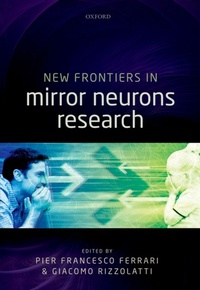
New Frontiers in Mirror Neurons Research
1st Edition
Published on 8. October 2015
408 pages
978-0-19-150968-1 (ISBN)
Description

The discovery of mirror neurons caused a revolution in neuroscience and psychology. Nevertheless, because of their profound impact within life sciences, mirror neuron are still the subject of numerous debates concerning their origins and their functions. With more than 20 years of research in this area, it is timely to synthesise the expanding literature on this topic.
'New frontiers in Mirror Neurons' provides a comprehensive overview of the latest advances in mirror neurons research - accessible both to experts and to non-experts. In the book, leading scholars draw on the latest research to examine methodological approaches, theoretical implications, and the latest findings on mirror neurons research.
A broad range of topics are covered within the book: basic findings and new concepts in action-perception theory, functional properties and evolution, development, and clinical implications. In particular, the last two sections of the book outline the importance of the plasticity and development of the mirror neuron system. This knowledge will be key in future research for helping us understand possible disorders associated with impairments in the mirror neurons system, as well as in helping us design new therapeutic tools for interventions within the field of neurodevelopmental disorders and in neurorehabilitation.
'New Frontiers in Mirror Neurons' is an exciting new work for neuroscientists, psychologists, and philosophers of mind.
More details
Other editions
Additional editions
Pier Francesco Ferrari | Giacomo Rizzolatti
New Frontiers in Mirror Neurons Research
Book
10/2015
Oxford University Press
€165.50
Shipment within 15-20 days
Persons
Pierfrancesco Ferrari is Associate Professor at the University of Parma, Italy, and Adjunct Professor at the University of Maryland, USA. Ferrari's current research focuses on the functional role and development of parietal and premotor cortical functions in relation to social cognitive processes in human and nonhuman primates. From 2007 to 2008, Ferrari served as Adjunct Scientist at the NIH, Bethesda, USA, conducting research on cortical development in relation to cognitive functions in macaque monkeys. Together with Giacomo Rizzolatti he is Director of the International School of Neurosciences "Sir John Eccles ", at the Ettore Majorana Centre in Erice, Italy.
Giacomo Rizzolatti has been President of the European Brain Behavior Society and Italian Society for Neuroscience. He is the Senior Scientist of the research team that discovered mirror neurons. His main research focus has been the role of the motor cortex in higher cognitive functions. He is member of Accademia dei Lincei, Académie des Sciences and the National Academy of Sciences. He is the recipient of several prizes: "Golgi Prize for Physiology", "George Miller Award", "Grawemeyer Prize ", Price of Asturias Prize for Science and Technology " Prix J.L. Signoret in Neuropsychologie " from the IPSEN Fondation, and the "Brain Prize from Lundbeck Foundation ".
Content
- Section 1. Basic findings and concepts in action-perception theory
- 1: Stefano Rozzi: The neuroanatomy of the mirror neuron system
- 2: Leonardo Fogassi and Luca Bonini: The role of mirror neurons in goal coding and intention understanding
- 3: Jörn K. Pomper, Dan Arnstein, Vittorio Caggiano, Martin Giese, and Peter Thier: New properties of F5 Mirror Neurons and their implications for response selection
- 4: Riitta Hari: MEG studies in action observation
- 5: Kristina Grigaityte and Marco Iacoboni: How to study the mirror neuron system with functional MRI: challenges and solutions
- Section 2. Functional properties and evolution
- 6: Lucia Maria Sacheli, Salvatore Maria Aglioti,and Matteo Candidi: Neural underpinnings of anticipatory action simulation and perception in expert brains
- 7: Guy A. Orban: The mirror system in human and non-human primates: comparative functional imaging studies suggest multiple systems
- 8: Maurizio Gentilucci, Doriana De Marco, and Elisa De Stefani: On Gesture and Speech
- 9: Jonathan F. Prather, and Richard Mooney: Mirror Neurons in the Songbird Brain:A Neural Interface for Learned Vocal Communication
- 10: Simone Schütz-Bosbach and Wolfgang Prinz: Mirrors match minds
- 11: Antonella Tramacere, Pier F. Ferrari, and Atsushi Iriki: Epigenetic regulation of mirror neurons' development and related evolutionary hypotheses
- Section 3. Development
- 12: James J. M. Kilner: Relating the ontogeny and function of mirror neurons to perceptual learning and inference
- 13: Kathryn H. Yoo and Nathan A. Fox: The Mirror Neuron System and the Mu Rhythm
- 14: Claes von Hofsten and K. Rosander: On the development of the mirror neuron system
- 15: Elizabeth A. Simpson, Annika Paukner, Stephen J. Suomi, and Pier F. Ferrari: Neonatal imitation and its sensory-motor mechanism
- 16: Courtney Filippi and Amanda Woodward: Mirroring and the ontogeny of social cognition
- Section 4. Theoretical and clinical implications
- 17: Corrado Sinigaglia and Giacomo Rizzolatti: The space of mirror
- 18: Vittorio Gallese and Francesca Ferri: Schizophrenia, bodily selves and embodied simulation
- 19: Giovanni Buccino and Riccardo Dalla Volta: Observing and imitating others to recover motor functions in patients with neurological disorders
- 20: Lindsay M. Oberman and Vilayanur S. Ramachandran: Role of the Mirror Neuron System in the Pathophysiology of Autism Spectrum Disorders
