

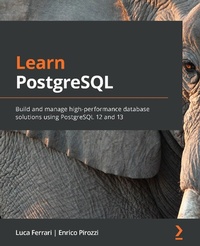
Learn PostgreSQL
Build and manage high-performance database solutions using PostgreSQL 12 and 13
Published on 23. September 2024
650 pages
978-1-83898-689-6 (ISBN)
Description

A comprehensive guide to building, managing, and securing scalable and reliable database and data warehousing applications using Postgres 12 and 13
Key Features
Set up your database cluster and monitor, secure, and fine-tune it for optimal performance
Learn the fundamentals of database management and implement client- and server-side programming using SQL and PL/pgSQL
Explore useful tips to develop efficient PostgreSQL database solutions from scratch
Book DescriptionPostgreSQL is one of the fastest-growing open source object-relational database management systems (DBMS) in the world. As well as being easy to use, it's scalable and highly efficient. In this book, you'll explore PostgreSQL 12 and 13 and learn how to build database solutions using it. Complete with hands-on tutorials, this guide will teach you how to achieve the right database design required for a reliable environment. You'll learn how to install and configure a PostgreSQL server and even manage users and connections. The book then progresses to key concepts of relational databases, before taking you through the Data Definition Language (DDL) and commonly used DDL commands. To build on your skills, you'll understand how to interact with the live cluster, create database objects, and use tools to connect to the live cluster. You'll then get to grips with creating tables, building indexes, and designing your database schema. Later, you'll explore the Data Manipulation Language (DML) and server-side programming capabilities of PostgreSQL using PL/pgSQL, before learning how to monitor, test, and troubleshoot your database application to ensure high-performance and reliability. By the end of this book, you'll be well-versed with the Postgres database and be able to set up your own PostgreSQL instance and use it to build robust solutions.What you will learn
Understand how users and connections are managed by running a PostgreSQL instance
Interact with transaction boundaries using server-side programming
Identify bottlenecks to maintain your database efficiently
Create and manage extensions to add new functionalities to your cluster
Choose the best index type for each situation
Use online tools to set up a memory configuration that will suit most databases
Explore how Postgres can be used in multi-instance environments to provide high-availability, redundancy, and scalability
Who this book is forThis Postgres book is for anyone interested in learning about the PostgreSQL database from scratch. Anyone looking to build robust data warehousing applications and scale the database for high-availability and performance using the latest features of PostgreSQL will also find this book useful. Although prior knowledge of PostgreSQL is not required, familiarity with databases is expected.
Key Features
Set up your database cluster and monitor, secure, and fine-tune it for optimal performance
Learn the fundamentals of database management and implement client- and server-side programming using SQL and PL/pgSQL
Explore useful tips to develop efficient PostgreSQL database solutions from scratch
Book DescriptionPostgreSQL is one of the fastest-growing open source object-relational database management systems (DBMS) in the world. As well as being easy to use, it's scalable and highly efficient. In this book, you'll explore PostgreSQL 12 and 13 and learn how to build database solutions using it. Complete with hands-on tutorials, this guide will teach you how to achieve the right database design required for a reliable environment. You'll learn how to install and configure a PostgreSQL server and even manage users and connections. The book then progresses to key concepts of relational databases, before taking you through the Data Definition Language (DDL) and commonly used DDL commands. To build on your skills, you'll understand how to interact with the live cluster, create database objects, and use tools to connect to the live cluster. You'll then get to grips with creating tables, building indexes, and designing your database schema. Later, you'll explore the Data Manipulation Language (DML) and server-side programming capabilities of PostgreSQL using PL/pgSQL, before learning how to monitor, test, and troubleshoot your database application to ensure high-performance and reliability. By the end of this book, you'll be well-versed with the Postgres database and be able to set up your own PostgreSQL instance and use it to build robust solutions.What you will learn
Understand how users and connections are managed by running a PostgreSQL instance
Interact with transaction boundaries using server-side programming
Identify bottlenecks to maintain your database efficiently
Create and manage extensions to add new functionalities to your cluster
Choose the best index type for each situation
Use online tools to set up a memory configuration that will suit most databases
Explore how Postgres can be used in multi-instance environments to provide high-availability, redundancy, and scalability
Who this book is forThis Postgres book is for anyone interested in learning about the PostgreSQL database from scratch. Anyone looking to build robust data warehousing applications and scale the database for high-availability and performance using the latest features of PostgreSQL will also find this book useful. Although prior knowledge of PostgreSQL is not required, familiarity with databases is expected.
More details
Edition
Digital original
Language
English
Place of publication
Birmingham
United Kingdom
Target group
Professional and scholarly
US School Grade: College Graduate Student
Edition type
Digital original
File size
3,17 MB
ISBN-13
978-1-83898-689-6 (9781838986896)
Copyright in bibliographic data and cover images is held by Nielsen Book Services Limited or by the publishers or by their respective licensors: all rights reserved.
Schweitzer Classification
Other editions
New editions
Luca Ferrari | Enrico Pirozzi
Learn PostgreSQL
Use, manage, and build secure and scalable databases with PostgreSQL 16
E-Book
10/2023
1st Edition
Packt Publishing
from
€29.99
Available for download
Additional editions
Luca Ferrari | Enrico Pirozzi
Learn PostgreSQL
Build and manage high-performance database solutions using PostgreSQL 12 and 13
Book
10/2020
Packt Publishing
€58.80
Shipment within 3-4 weeks
Persons
Ferrari Luca :
Luca Ferrari has been passionate about computer science since the Commodore 64 era, and today holds a master's degree (with honors) and a Ph.D. from the University of Modena and Reggio Emilia. He has written several research papers, technical articles, and book chapters. In 2011, he was named an Adjunct Professor by Nipissing University. An avid Unix user, he is a strong advocate of open source, and in his free time, he collaborates with a few projects. He met PostgreSQL back in release 7.3; he was a founder and former president of the Italian PostgreSQL Community (ITPUG). He also talks regularly at technical conferences and events and delivers professional training.Pirozzi Enrico :
Enrico Pirozzi, EnterpriseDB certified on implementation management and tuning, with a master's in computer science, has been a PostgreSQL DBA since 2003. Based in Italy, he has been providing database advice to clients in industries such as manufacturing and web development for 10 years. He has been training others on PostgreSQL since 2008. Dedicated to open source technology since early in his career, he is a cofounder of the PostgreSQL Italian mailing list, PostgreSQL-it, and of the PostgreSQL Italian community site, PSQL
Luca Ferrari has been passionate about computer science since the Commodore 64 era, and today holds a master's degree (with honors) and a Ph.D. from the University of Modena and Reggio Emilia. He has written several research papers, technical articles, and book chapters. In 2011, he was named an Adjunct Professor by Nipissing University. An avid Unix user, he is a strong advocate of open source, and in his free time, he collaborates with a few projects. He met PostgreSQL back in release 7.3; he was a founder and former president of the Italian PostgreSQL Community (ITPUG). He also talks regularly at technical conferences and events and delivers professional training.Pirozzi Enrico :
Enrico Pirozzi, EnterpriseDB certified on implementation management and tuning, with a master's in computer science, has been a PostgreSQL DBA since 2003. Based in Italy, he has been providing database advice to clients in industries such as manufacturing and web development for 10 years. He has been training others on PostgreSQL since 2008. Dedicated to open source technology since early in his career, he is a cofounder of the PostgreSQL Italian mailing list, PostgreSQL-it, and of the PostgreSQL Italian community site, PSQL
Content
Table of Contents
Introduction to PostgreSQL 12
Getting to know your cluster
Managing users and connections
Basic Statements
Advanced Statements
Window Functions
Server Side Programming
Triggers and Rules
Partitioning
Users, Roles, and Database Security
Transactions, MVCC; WALs and Checkpoints
Extending the database: the Extension ecosystem
Indexes and Performance Optimization
Logging and Auditing
Backup and Restore
Configuring and Monitoring
Physical replication
Logical Replication
Useful Tools and Useful Extensions
Towards PostgreSQL 13
Introduction to PostgreSQL 12
Getting to know your cluster
Managing users and connections
Basic Statements
Advanced Statements
Window Functions
Server Side Programming
Triggers and Rules
Partitioning
Users, Roles, and Database Security
Transactions, MVCC; WALs and Checkpoints
Extending the database: the Extension ecosystem
Indexes and Performance Optimization
Logging and Auditing
Backup and Restore
Configuring and Monitoring
Physical replication
Logical Replication
Useful Tools and Useful Extensions
Towards PostgreSQL 13
