

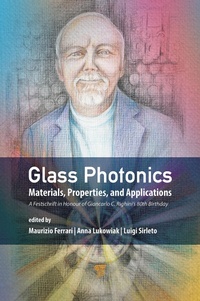
Glass Photonics
Materials, Properties, and Applications
Published on 5. February 2026
414 pages
978-1-040-86606-1 (ISBN)
Description

This book, devoted to glass photonics, is homage to Prof. Dr Giancarlo C. Righini on his 80th birthday. This milestone signifies a lifetime of rich scientific experiences and notable achievements in optics and photonics, with special regard to glass and other optical materials.
The book shows how glass photonics plays a crucial role in the current Age of Light. The former part of book focuses on photonic devices in fiber and integrated optics format. It discusses the basic aspects concerning linear and non-linear interactions of light with optical fibers with nanoparticles glasses, microspheres, particularly in the form of whispering gallery mode resonators, microbubble resonators, and nanostructured glasses, and the main application, which could lead to technological and scientific breakthroughs. In the latter part of the book, first, the potential use of glass-based light management technologies for the design of novel types of solar cells is illustrated. Then, the sensing devices based on glass substrates are described. Finally, additive manufacturing technologies in the production of transparent ceramic components are presented. The book provides both experts and newcomers a detailed view of a few subfields of research and development in peculiar properties of glasses and glass ceramics and glass-based devices.
The book shows how glass photonics plays a crucial role in the current Age of Light. The former part of book focuses on photonic devices in fiber and integrated optics format. It discusses the basic aspects concerning linear and non-linear interactions of light with optical fibers with nanoparticles glasses, microspheres, particularly in the form of whispering gallery mode resonators, microbubble resonators, and nanostructured glasses, and the main application, which could lead to technological and scientific breakthroughs. In the latter part of the book, first, the potential use of glass-based light management technologies for the design of novel types of solar cells is illustrated. Then, the sensing devices based on glass substrates are described. Finally, additive manufacturing technologies in the production of transparent ceramic components are presented. The book provides both experts and newcomers a detailed view of a few subfields of research and development in peculiar properties of glasses and glass ceramics and glass-based devices.
More details
Language
English
Place of publication
London
United Kingdom
Target group
College/higher education
Professional and scholarly
Illustrations
8 Tables, black and white; 41 Illustrations, color; 72 Illustrations, black and white
File size
195,18 MB
ISBN-13
978-1-040-86606-1 (9781040866061)
Copyright in bibliographic data and cover images is held by Nielsen Book Services Limited or by the publishers or by their respective licensors: all rights reserved.
Schweitzer Classification
Other editions
Additional editions
Maurizio Ferrari | Anna Lukowiak | Luigi Sirleto
Glass Photonics
Materials, Properties, and Applications
Book
approx. 02/2026
1st Edition
Jenny Stanford Publishing
€295.00
Not yet published
Persons
Maurizio Ferrari, formerly director of research at the National Research Council's Institute for Photonics and Nanotechnologies (IFN-CNR), is a senior associate at IFN-CNR. His main research area is glass photonics. Dr Ferrari is associate editor of Ceramics International and a member of the Advisory Board of Optical Materials. He is a coauthor of more than 500 publications and is an OPTICA and SPIE fellow.
Anna Lukowiak is associate professor at the Institute of Low Temperature and Structure Research of the Polish Academy of Sciences, Poland. She has a doctorate in chemistry. Her research interests are in glasses, nanoceramics, and carbon-based materials as photonic structures, Ln-doped nanocrystals, bioactive glasses, and GO antibacterial composites.
Luigi Sirleto is a senior researcher at CNR. He is head of the Ultrafast and Nonlinear Optics Laboratory at the Institute of Applied Sciences and Intelligent Systems "Eduardo Caianiello" and an associate editor of Journal of Nonlinear Optical Physics & Materials. His main scientific interests are in nonlinear optics spectroscopy and microscopy and photonics devices. He is a coauthor of more than 200 publications.
Anna Lukowiak is associate professor at the Institute of Low Temperature and Structure Research of the Polish Academy of Sciences, Poland. She has a doctorate in chemistry. Her research interests are in glasses, nanoceramics, and carbon-based materials as photonic structures, Ln-doped nanocrystals, bioactive glasses, and GO antibacterial composites.
Luigi Sirleto is a senior researcher at CNR. He is head of the Ultrafast and Nonlinear Optics Laboratory at the Institute of Applied Sciences and Intelligent Systems "Eduardo Caianiello" and an associate editor of Journal of Nonlinear Optical Physics & Materials. His main scientific interests are in nonlinear optics spectroscopy and microscopy and photonics devices. He is a coauthor of more than 200 publications.
Content
1. Tailoring the Optical Properties of Optical Fiber with Nanoparticles 2. Inside the Wizard Sphere: Glass Microspheres and Their Application as Optical Source 3. Nonlinear Frequency Generation in Glass Whispering Gallery Mode Resonators 4. Nanostructured Glasses: Synthesis, Structural Characterization and Raman Gain Investigations 5. Stained Glass Revisited: Photovoltaics Meets Glass Photonics 6. Optical Biosensing with the Use of Glass Substrates 7. Glasses and Glass-Ceramics: Functionalization and Biomedical Applications 8. Additive Manufacturing of Transparent Ceramic Materials for Photonics
