

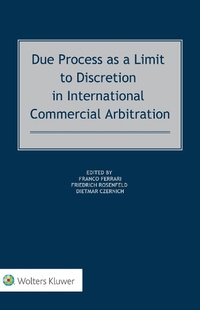
Due Process as a Limit to Discretion in International Commercial Arbitration
Published on 25. September 2020
488 pages
978-94-035-1975-3 (ISBN)
Description

The absence of a coherent body of case law on due process has increasingly motivated recalcitrant parties to use due process as a strategic tool, thereby putting at risk the prospect of obtaining an enforceable award in expeditious proceedings. Countering this inherent danger, here for the first time is a comprehensive study on due process as a limit to arbitral discretion, showing how due process applies in practice in key jurisdictions around the world. Based on country reports prepared by leading arbitration practitioners and academics, the book explores how courts in major arbitration jurisdictions apply due process guarantees when performing their post-award review. The contributors, driven by an interest in exploring the interplay between due process and efficiency, focus on those due process guarantees that set limits to arbitral discretion. Matters covered include the following: the right to be heard and how it may be affected by submission deadlines, evidentiary offers by the opposing party, and directions to the parties as to which aspects require further pleading; the right to be treated equally and its interplay with the duty to give each party full opportunity to present its case and to comment on submissions and evidence filed by the other party; the duty to effect proper notice, including delivery and language issues; the independence and impartiality of arbitrators with a focus on when an arbitrator's conduct can become the basis for a successful challenge; and courts' standards of deference when examining issues arising at the post-award stage. An introductory general report thoroughly analyses the normative basis of due process and its interplay with party autonomy, as well as applicable standards of review and commonalities among manifestations of due process across jurisdictions. A signal contribution to the debate regarding the so-called due process paranoia affecting arbitral tribunals a topic relevant in every single arbitration proceeding this book provides practical guidelines on how to maintain the balance between due process and efficiency and how to apply due process and counteract its misuse in arbitration proceedings. It will be welcomed by counsel, arbitrators, and judges from all countries, as well as by academics and researchers concerned with international commercial arbitration.
More details
Other editions
Additional editions
Franco Ferrari | Friedrich Rosenfeld | Dietmar Czernich
Due Process as a Limit to Discretion in International Commercial Arbitration
Book
09/2020
Kluwer Law International
€248.09
Shipment within 15-20 days
Content
- Intro
- Half-Title Page
- Title Page
- Copyright Page
- Editors
- Contributors
- Summary of Contents
- Table of Contents
- Editors' Note
- Chapter 1 General Report
- §1.01 INTRODUCTION
- §1.02 THE GENERAL FRAMEWORK ON DUE PROCESS
- [A] Normative Basis
- [B] Interpretation
- [C] Threshold
- [D] Waivers
- [E] The Applicable Standards of Review
- §1.03 SPECIFIC MANIFESTATIONS OF DUE PROCESS
- [A] The Right to Be Heard
- [1] The Right to Make Submissions and Evidentiary Offers in Support of One's Case
- [2] The Right to Comment on Submissions and Evidentiary Offers by Opposing Party
- [3] The Right to Comment on Findings of the Arbitral Tribunal
- [4] The Arbitral Tribunal's Duty to Take Cognizance and Consider the Parties' Submissions and Evidentiary Offers
- [B] The Right to Equal Treatment
- [C] Obligation to Ensure Proper Notice
- [D] Independence and Impartiality
- §1.04 CONCLUSION
- Chapter 2 Country Report: Argentina
- §2.01 INTRODUCTION AND SCOPE
- §2.02 ARGENTINE ARBITRATION LAW
- §2.03 THE VIOLATION OF DUE PROCESS AS A GROUND FOR ANNULMENT IN DOMESTIC AND INTERNATIONAL COMMERCIAL ARBITRATION
- §2.04 THE INTERPRETATION OF FUNDAMENTAL PROCEDURAL ERRORS AS ANNULMENT GROUND BY ARGENTINE COURTS
- [A] A Preliminary Distinction: "Formal or Procedural Errors" Versus "Substantive Errors"
- [B] The Requirements of "Fundamental Procedural Errors" as Annulment Ground: Materiality and Timely Objection
- [C] The Sources of Fundamental Procedural Guarantees in Arbitration Proceedings
- [D] Recurrent Issues Concerning "Fundamental Procedural Errors" as Annulment Ground
- [E] The Relevance of the Constitutional Protection Against "Arbitrariness" in the Review of Arbitral Awards Under the Ground of "Fundamental Procedural Errors"
- [1] "Arbitrariness" as a Ground Used by the Supreme Court for Overturning Lower Courts' Decisions
- [2] The (Limited) Expansion of the "Arbitrariness Doctrine" into the Review of Arbitral Awards
- §2.05 CONCLUSION
- Chapter 3 Country Report: Brazil
- §3.01 INTRODUCTION
- §3.02 THE NORMATIVE FRAMEWORK ON DUE PROCESS IN BRAZIL
- §3.03 RELEVANT CASE LAW ON DUE PROCESS IN BRAZIL
- [A] Introduction on Scope and Methodology
- [B] Case Law on Foreign Awards
- [C] Case Law on Domestic Awards
- [D] Conclusion
- Chapter 4 Country Report: Canada
- §4.01 INTRODUCTION
- [A] Recognition and Enforcement
- [B] Set-aside
- §4.02 SOURCES OF INTERPRETATION
- [A] Domestic Sources
- [B] International Law & Other Sources
- [C] Court Decisions in Related Cases
- §4.03 EXAMPLES OF APPLICATION
- [A] Relevant Breach
- [B] No Relevant Breach
- [1] Recognition and Enforcement
- [2] Set-aside
- [C] Case Management and Abuse of Due Process
- §4.04 STANDARD OF REVIEW
- §4.05 THRESHOLD FOR A BREACH OF DUE PROCESS
- §4.06 PARTY AUTONOMY
- [A] Ex Ante Waivers of the Right to Assert a Breach
- [1] Recognition and Enforcement
- [2] Set-Aside
- [B] Ex Post Waivers
- [C] Failure to Invoke During Set-Aside Proceedings
- §4.07 CONCLUSION
- Chapter 5 Country Report: China
- §5.01 INTRODUCTION
- [A] Recognition and Enforcement
- [B] Set-Aside
- [C] China's Special Report-and-Review Scheme
- §5.02 SOURCES OF INTERPRETATION
- [A] New York Convention
- [B] Set-Aside Regime
- §5.03 PRACTICAL IMPLEMENTATION AND EXAMPLES
- [A] Proper Notice
- [B] Awards Exceeding the Scope of the Parties' Submissions
- [C] Right to Be Heard
- [D] Deadlines and Time Frame
- [E] Admission of Evidence
- [F] Composition of Tribunals
- §5.04 STANDARD OF REVIEW
- [A] Recognition and Enforcement
- [B] Set-Aside
- §5.05 THRESHOLD FOR A BREACH OF DUE PROCESS
- [A] Recognition and Enforcement
- [B] Set-Aside
- §5.06 DUE PROCESS AND PARTY AUTONOMY
- §5.07 CONCLUSION
- Chapter 6 Country Report: The Republic of Cyprus
- §6.01 INTRODUCTION
- §6.02 THE LEGAL FRAMEWORK OF DUE PROCESS IN CYPRUS
- §6.03 THE DUE PROCESS IN LEGAL PRACTICE IN CYPRUS
- [A] Access to Justice
- [B] Fairness of the Procedure
- [C] Drafting the Arbitral Award
- §6.04 POSTSCRIPT: THE DUE PROCESS DEFENCE IN CYPRUS
- §6.05 CONCLUSION
- Chapter 7 Country Report: France
- §7.01 INTRODUCTION
- [A] The Notion of 'Due Process' and Its Translation Into French International Arbitration Law
- [B] The Normative Framework for Set-Aside and Recognition and Enforcement Proceedings
- §7.02 DUE PROCESS-RELATED GROUNDS TO SET ASIDE AN AWARD
- [A] Violation of Due Process (Principe de la Contradiction) (Article 1520 4° CCP)
- [1] Standard of Application for Article 1520 4° CCP
- [2] Decisions Rejecting a Violation of Due Process
- [3] Decisions Finding a Violation of Due Process
- [B] Violation of International Public Policy (Article 1520 5° CCP)
- [1] Equality of Parties and Case Management
- [2] Equality of Parties and Impossibility to Pay the Advance on Costs
- [C] Violation of the Arbitral Tribunal's Mandate (Article 1520 3° CCP)
- §7.03 DUE PROCESS-RELATED GROUNDS FOR REFUSAL OF RECOGNITION AND ENFORCEMENT
- [A] Violation of Due Process
- [B] Violation of the Principle of Equality
- [C] Violation of the Arbitral Tribunal's Mandate
- §7.04 DUE PROCESS AND PARTY AUTONOMY
- [A] Ex Post Waivers
- [B] Ex Ante Waivers
- §7.05 CONCLUSION
- Chapter 8 Country Report: Germany
- §8.01 INTRODUCTION
- §8.02 THE RIGHT TO BE HEARD AND TREATED EQUALLY
- [A] Normative Framework
- [B] Case Law
- [1] Commenting on Facts and Submitting Evidence
- [2] Preclusive Deadlines
- [3] The Examination of Witnesses and Experts
- [a] The Decision Whether to Take Evidence
- [b] The Modalities of the Taking of Evidence
- [c] Assessment of the Evidence
- [4] Directions
- [5] Language
- [6] Non-participating Parties
- [7] Conclusion
- §8.03 THE INDEPENDENCE AND IMPARTIALITY OF ARBITRATORS
- [A] Normative Framework
- [B] Case Law
- §8.04 PROPER NOTICE
- §8.05 CONCLUSION
- Chapter 9 Country Report: Hong Kong
- §9.01 INTRODUCTION
- §9.02 THE LEGAL FRAMEWORK FOR ARBITRATION IN HONG KONG
- [A] Background
- [B] The Conduct of Arbitral Proceedings
- [C] Post-Award Proceedings
- §9.03 THE JURISPRUDENCE OF HONG KONG COURTS
- [A] The Parties' Due Process Rights
- [1] The Tribunal's Case Management Decisions
- [2] The Tribunal's Inquisitorial Powers
- [3] Due Process and Public Policy
- [B] The Court's Discretion to Uphold or Remit Awards
- §9.04 CONCLUSION
- Chapter 10 Country Report: India
- §10.01 INTRODUCTION
- §10.02 THE RELEVANT NORMATIVE FRAMEWORK AND THE SOURCES OF INTERPRETATION
- §10.03 RELEVANT INDIAN CASE LAW ON DUE PROCESS
- [A] Decisions Finding a Relevant Breach
- [B] Decisions Rejecting a Relevant Breach
- [1] Recognition and Enforcement
- [2] Set-Aside
- §10.04 STANDARD OF REVIEW AND THRESHOLD
- §10.05 PARTY AUTONOMY
- [A] Ex Ante Waivers of the Right to Assert a Breach
- [B] Ex Post Waivers of the Right to Assert a Breach
- [1] Recognition and Enforcement
- [2] Set-Aside
- §10.06 CONCLUSION
- Chapter 11 Country Report: Italy
- §11.01 INTRODUCTION TO ITALIAN ARBITRATION LAW AND ITS DUE PROCESS GUARANTEES
- §11.02 DUE PROCESS VIOLATIONS AS GROUNDS FOR ANNULMENT OF ARBITRAL AWARDS
- [A] Case Management Issues
- [B] Ne Eat Iudex Extra Petita Partium
- [C] Party Autonomy
- §11.03 DUE PROCESS VIOLATIONS AS A GROUND TO REFUSE RECOGNITION AND ENFORCEMENT OF FOREIGN ARBITRAL AWARDS
- [A] Proper Notice and the Right to Present One's Case
- [B] Irregularity in the Composition of the Arbitral Authority or the Arbitration Procedure
- [C] Public Policy
- §11.04 FINAL REMARKS
- Chapter 12 Country Report: Japan
- §12.01 JAPANESE ARBITRATION LAW IN BRIEF
- §12.02 RULES FOR POST-AWARD REVIEW OF ARBITRAL PROCEDURE
- [A] Recognition and Enforcement of Arbitral Awards
- [B] Annulment of Arbitral Awards
- §12.03 INTERPRETATION
- [A] Annulment
- [1] General Guidelines for Handling a Motion for Annulment
- [2] Inability to Present One's Case
- [3] Decisions Beyond the Scope of Submission
- [4] Breach of Procedural Rules for Arbitration
- [5] Violation of 'Public Order or Good Morals'
- [B] Recognition and Enforcement
- §12.04 THRESHOLD AND STANDARD OF REVIEW
- §12.05 DUE PROCESS PARANOIA
- [A] Evaluation of the Case Law
- [B] Public Policy Scrutiny of Arbitral Procedure
- [C] Concluding Remarks
- Chapter 13 Country Report: Middle East
- §13.01 INTRODUCTION
- §13.02 DUE PROCESS REQUIREMENTS FOR ARBITRATION IN ARAB
- [A] Due Process as a Breach of Domestic and International Public Policy
- [B] Annulment versus Enforcement of Awards
- [C] Standard of Review
- [D] Waivers
- [E] The Substantive Due Process Rights
- [F] Arbitration Proceedings Affected By Nullity
- [G] Breach of Due Process Resulting From the Conduct of Arbitrators
- §13.03 CONCLUSION
- Chapter 14 Country Report: The Netherlands
- §14.01 INTRODUCTION
- §14.02 LEGAL FRAMEWORK
- [A] Due Process
- [B] Recognition and Enforcement and Setting Aside
- [1] Recognition and Enforcement and Setting Aside of Domestic Awards
- [2] Standard of Review
- [3] Treaty-Based Recognition and Enforcement of Foreign Awards
- [4] Recognition and Enforcement of Foreign Awards Based on the DCCP
- [C] Waiver and Estoppel
- [D] Referral Back to the Tribunal (Remission)
- §14.03 PROCEDURE IN GENERAL
- [A] Administration of Deadlines
- [B] Allocation of Hearing Time
- [C] Communication with the Parties
- [D] Offering Preliminary Views
- [E] Notes and Reports of Hearings
- [F] Applicable Laws or Standard
- [G] Costs of the Arbitral Proceedings
- §14.04 SUBMISSIONS
- [A] Disregarding / Refusing (Additional) Written Submissions
- [B] Disregarding / Refusing (Additional) Oral Submissions
- §14.05 EVIDENCE
- [A] Decisions to Refuse, Disregard, or Not Take (Further) Evidence
- [1] Refusing or Disregarding Evidence
- [2] Refusing to Order the Production of Documents
- [3] Refusing to Take Witness Evidence
- [4] Refusing to Take Expert Evidence
- [5] Refusing or Limiting the Cross-Examination of Witnesses
- [6] Refusing or Limiting the Cross-Examination of Experts
- [7] Not Appointing an Independent Expert
- [B] Allegations of Procedural Irregularities in Taking Evidence
- [1] Relying on Evidence Not Invoked by the Parties
- [2] Taking Evidence Outside the Presence of the Parties
- [3] Relying on Evidence That Was Not Available to (Both) Parties
- [4] Relying on Evidence That Parties Could Not Sufficiently Comment On
- [5] Relying on Expert Evidence That Has Been Produced in Violation of the Equality of Arms of the Parties
- §14.06 CONCLUSION
- Chapter 15 Country Report: Norway
- §15.01 INTRODUCTION
- §15.02 ANNULMENT AND REFUSAL OF ENFORCEMENT
- §15.03 AUTONOMOUS INTERPRETATION
- §15.04 IMPACT ON THE DECISION
- §15.05 RIGHT TO BE HEARD
- §15.06 FLEXIBLE PROCEDURE
- §15.07 WAIVERS
- §15.08 CONCLUSION
- Chapter 16 Country Report: Russia
- §16.01 INTRODUCTION
- §16.02 GENERAL OVERVIEW OF THE LAW ON ARBITRATION IN RUSSIA
- §16.03 THE RUSSIAN COURTS' APPROACH TO DUE PROCESS IN INTERNATIONAL COMMERCIAL ARBITRATION
- [A] Introductory Observations
- [B] The Requirement of Proper Notice
- [1] Burden of Proof of Improper Notice
- [2] Standards on Adequacy of Notice of Proceedings
- [3] Evidence of Proper Notice
- [4] Timely Notice of the Arbitral Hearings
- [5] Authority to Receive Notice of the Arbitral Hearings
- [6] Principles of Good Faith and Reasonableness
- [C] The Right to Be Heard and the Right to Equal Treatment
- [D] The Public Policy Exception
- §16.04 CONCLUSION
- Chapter 17 Country Report: Singapore
- §17.01 INTRODUCTION
- §17.02 LEGAL FRAMEWORK FOR ARBITRAL DUE PROCESS IN SINGAPORE
- [A] Statutory Provisions in Singapore on Due Process
- [1] Due Process Guarantees in the IAA and Model Law
- [2] Post-Award Remedies Under the IAA and Model Law Based on Due Process Violations
- [B] Jurisprudential Principles in Singapore on Due Process
- [1] High Threshold for Successful Challenge
- [2] Deference to Arbitral Tribunals' Case Management Powers
- [3] Requirements of Causal Nexus and Prejudice
- §17.03 FACTUAL SCENARIOS
- [A] Written Submissions
- [B] Timelines For and Exclusion of Evidence
- [C] Oral Hearings and Cross-Examination
- [D] Document Production
- [E] Other Procedural Directions
- §17.04 WAIVER OF DUE PROCESS PROTECTIONS
- [A] Implied Waiver Based on Failure to Challenge
- [B] Express Waiver
- [C] Failure to Raise Objections in Setting Aside
- §17.05 CONCLUSION
- Chapter 18 Country Report: Switzerland
- §18.01 INTRODUCTION
- §18.02 THE RELEVANT REGULATORY FRAMEWORK IN SWITZERLAND
- [A] Swiss Private International Law Act
- [1] Chapter 12 PILA as the Lex Arbitri in International Arbitrations in Switzerland
- [2] The Discretion of the Arbitral Tribunal in Proceedings Governed by Chapter 12 PILA
- [3] Limit No. 1: The Parties' Right to Be Heard in Adversarial Proceedings (Articles 182(3) and 190(2)(d) PILA)
- [4] Limit No. 2: The Parties' Right to Equal Treatment (Articles 182(3) and 190(2)(d) PILA)
- [5] Limit No. 3: Procedural Public Policy (Article 190(2)(e) PILA)
- [B] New York Convention
- [1] New York Convention Governs Recognition and Enforcement of Foreign Arbitral Awards in Switzerland
- [2] The Discretion of the Arbitral Tribunal in Proceedings in Light of the New York Convention
- [3] Limit No. 1: The Parties' Right to Present Their Case (Article V(1)(b) New York Convention)
- [4] Limit No. 2: No Irregularity in the Conduct of the Arbitral Proceedings (Article V(1)(d) New York Convention)
- [5] Limit No. 3: Public Policy (Article V(2)(b) New York Convention)
- §18.03 DUE PROCESS-RELATED GROUNDS FOR SET-ASIDE OF AWARDS
- [A] Preliminary Remarks for Set-Aside Proceedings in Switzerland
- [B] The Review of Alleged Due Process Violations Under the Swiss Lex Arbitri
- [1] Standard of Review
- [2] Threshold
- [3] Waiver of the Right to Be Heard or the Right to Equal Treatment
- [C] Specific Issues of Due Process
- [1] Administration of Deadlines
- [2] Hearings/Allocation of Hearing Time
- [3] Right to Make Submissions
- [4] Right to Submit Evidence
- [5] Rules of Procedure
- [6] (Further) Procedural Conduct of the Arbitrator
- §18.04 DUE PROCESS-RELATED GROUNDS FOR REFUSING RECOGNITION AND ENFORCEMENT OF AWARDS
- [A] The Review of Alleged Due Process Violations under the New York Convention
- [1] The Standard of Review
- [2] Threshold
- [B] Specific Issues of Due Process
- §18.05 CONCLUSION
- Chapter 19 Country Report: United Kingdom
- §19.01 INTRODUCTION
- §19.02 FRAMEWORK ISSUES
- [A] Due Process Bases for Annulment and Refusal of Recognition and Enforcement
- [1] Annulment
- [a] Due Process Bases For Annulment: The Statutory Framework
- [b] Due Process Bases for Annulment: Interpretation and Threshold
- [2] Recognition and Enforcement
- [a] Due Process Bases for Refusal to Enforce: Statutory Framework
- [b] Due Process Bases for Refusal to Enforce: Interpretation and Threshold
- [B] Waiver
- [1] Waiver in Annulment Proceedings
- [2] Waiver in Recognition and Enforcement Proceedings
- [C] Additional Issues in Recognition and Enforcement Proceedings: Estoppel, Finality, Recognition of Annulment Decisions and Adjournment
- [1] Issue Estoppel and the Public Policy of Finality
- [2] Recognition of Decisions to Annul
- [3] Adjournment of Recognition or Enforcement Proceedings Pending Outcome of Annulment Proceedings
- §19.03 EXAMPLES
- [A] Examples of the English Courts' Consideration of Due Process Grounds in Annulment Proceedings
- [1] Examples of Successful Applications on the Basis of Failure to Give Notice (Arbitration Act, Sections 68(2)(a) and 68(2)(d))
- [2] Unsuccessful Challenges Based on Failure to Comply with General Duty of Fairness (Arbitration Act, Section 68(2)(a))
- [3] Unsuccessful Challenges Based on Failure to Deal With the Issues (Arbitration Act, Section 68(2)(d))
- [4] Challenges Based on the Ground That the Tribunal Exceeded Its Powers (Arbitration Act, Section 68(2)(b))
- [5] Challenges Based on the Ground That Arbitration Is Not in Accordance with the Parties' Agreement (Arbitration Act, Section 68(2)(c))
- [6] Challenges Based on Award Being Obtained by Fraud or in a Way That Is Contrary to Public Policy (Arbitration Act, Section 68(2)(g))
- [B] Examples of the English Courts' Consideration of Due Process Grounds in Recognition and Enforcement Proceedings
- [1] Inability to Present One's Case (Arbitration Act, Section 103(2)(c))
- [2] Arbitral Procedure Not in Accordance with Party Agreement (Arbitration Act, Section 103(2)(e))
- [3] Award Contrary to Public Policy (Arbitration Act, Section 103(3))
- §19.04 CONCLUSION
- Chapter 20 Country Report: The United States of America
- §20.01 INTRODUCTION
- §20.02 US LEGAL FRAMEWORK FOR DUE PROCESS IN INTERNATIONAL ARBITRAL AWARDS
- [A] Arbitration in the US Federal System
- [B] Due Process and Its Interpretation in the Review of Arbitral Awards
- §20.03 JUDICIAL REVIEW OF ARBITRAL AWARDS FOR DUE PROCESS
- [A] Personal Jurisdiction
- [B] Set-Aside under the FAA
- [1] Refusal to Postpone a Hearing
- [2] Failure to Hear Pertinent Evidence
- [3] Other Misbehavior That Prejudiced the Rights of Any Party
- [C] Defenses to Enforcement Under the New York Convention
- [1] Inability to Present One's Case
- [2] Procedure or Composition of Tribunal Inconsistent with Agreement or Governing Law
- [3] Public Policy
- [D] Party Autonomy to Determine Procedure
- §20.04 CONCLUSION
- Index
