

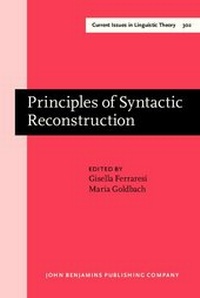
Principles of Syntactic Reconstruction
1st Edition
Published on 3. December 2008
XVII, 219 pages
978-90-272-8988-9 (ISBN)
Description

This is a collection of state-of-the-art papers in the field of syntactic reconstruction. It treats a range of topics which are representative of current debates in historical syntax. The novelty and merit of the present book is, the editors believe, that, in contrast to most previous work on diachronic syntax, it combines the perspectives of the traditional philological research on syntactic reconstruction with the insights of modern syntactic theory, as it is emphasised in the Foreword by Giuseppe Longobardi. The volume includes articles by well-recognized researchers in historical linguistics with a focus on syntactic change. In the present volume syntactic reconstruction is discussed from a variety of angles, including historical linguistics, phenomena of language contact, generative approaches as well as typological and variationist research. In the articles, languages from a diverse range of families are discussed, including Indo-European, North and South Caucasian, Sino-Tibetan, and Turkic.
More details
Other editions
Additional editions
Gisella Ferraresi | Maria Goldbach
Principles of Syntactic Reconstruction
Book
12/2008
John Benjamins Publishing Co
€111.30
Shipment within 10-15 days
Persons
Content
- Principles of Syntactic Reconstruction
- Editorial page
- Title page
- LCC data
- Table of contents
- Acknowledgments
- Foreword
- References
- Syntactic reconstruction
- 1. The historical-comparative method
- 2. Reconstruction in syntax: a historical overview
- 3. Generative syntax meets historical linguistics
- 4. Issues of syntactic reconstruction in this volume
- References
- How much syntactic reconstruction is possible?
- 0. Introduction
- 1. The object of inquiry
- 2. On the nature of syntactic change and reconstruction
- 1.1 Syntactic change
- 1.2 Syntactic Reconstruction: What one would need to reconstruct
- 3. The formal primitives of syntactic reconstruction
- 4. Constraints on syntax and their extension to syntactic change?
- 5. Can the Comparative Method be applied to Syntactic Reconstruction?
- 5.1 Why surface word order is not enough
- 5.2 Reconstruction in the absence of precise criteria?
- 5.3 When morphosyntactic reconstruction fails
- 5.4 Reconstruction of the Romance future?
- 6. Conclusion
- References
- Reconstruction in syntax
- 1. Introduction
- 2. The Comparative Method in syntax
- 2.1 Correspondence sets
- 2.2 Determination of the ancestral form
- 2.2.1 Relics
- 2.2.2 Dialect data
- 2.3 Summary
- 3. What do we require of a correspondence?
- 4. Reasons for pessimism
- 5. Conclusions
- Appendix
- References
- Reconstructing complex structures - a typological perspective
- 1. What the Comparative Method can do
- 1.1 Reconstruction vs. phylogenetic classification
- 1.2 The Comparative Method and Syntactic Reconstruction
- 1.3 Correspondence and diachronic identity
- 2. Reconstructing proto-syntax
- 2.1 Implicational universals
- 2.2 Grammaticalization and syntactic reconstruction
- 3. Conclusion
- References
- Competitive Indo-European syntax
- 1. Introduction
- 2. Analysis
- 2.1 That-clauses and that-clause competitors in the function of an object in the older Indo-European languages
- 2.1.1 Abstract deverbal nouns
- 2.1.2 Infinitive constructions
- 2.1.3 Participle constructions, constructions with predicative adjectives
- 2.1.4 that-clause
- 2.1.5 Main clauses
- 2.2 The prototypical that-clause competitors
- 2.2.1 The accusativus-cum-participio/adjectivo construction
- 2.2.2 The explicative clause
- 2.3 The change in meaning from 'what' to 'that'
- 3. Conclusion
- References
- Principles of syntactic reconstruction and "morphology as paleosyntax"
- 1. The problem of syntactic reconstruction and Indo-European linguistics
- 2. Typology, grammaticalization theory and "morphology as paleosyntax"
- 3. Some secondary Indo-European verbal formations and their origin
- 3.1 Some Indo-European secondary verbal stems
- 3.2 The Old Indic cvi-construction
- 4. Conclusion
- References
- Syntactic change and syntactic borrowing in generative grammar
- 1. Introduction
- 2. Historical syntax and historical phonology
- 2.1 The domain of study
- 2.2 The ontological status of a 'language'
- 2.3 E-language and I-language
- 2.4 The meaning of patterns and the status of a correspondence set
- 2.5 The status and locus of a change
- 2.6 The theory of change
- 2.7 The status of language contact
- 2.8 Summary
- 3. Calquing in generative syntax
- 3.1 Longobardi and Inertial syntax
- 3.2 What can be borrowed?
- 3.3 How does syntactic borrowing occur?
- 4. Methodology of identifying syntactic loans
- 4.1 Irregular correspondences
- 4.2 Syntax associated with items known to be loans
- 4.3 Similarities to surrounding languages
- 4.4 Exotic constructions
- 4.5 Apparent discontinuities and rapid shift
- 4.6 Problems
- 5. Conclusions
- References
- Index
- The series CURRENT ISSUES IN LINGUISTIC THEORY
