

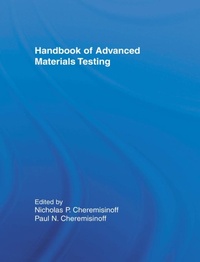
Handbook of Advanced Materials Testing
Published on 29. November 1994
1040 pages
978-1-4822-7761-6 (ISBN)
Description

This work discusses techniques for developing new engineering materials such as elastomers, plastic blends, composites, ceramics and high-temperature alloys. Instrumentation for evaluating their properties and identifying potential end uses are presented.;The book is intended for materials, manufacturing, mechanical, chemical and metallurgical engi
Reviews / Votes
". . .a considerable achievement. . .will be of great value to those in the chemical community who have to tackle the varied, real-life problems of materials science and want to obtain an over- view of the techniques available. Every library should have a copy. "---Journal of the American Chemical Society
". . .should serve as a compendium to which the user can turn for quick and reliable answers arising in the course of his or her work and should prove a valuable resource. "
---Silicates Industriels (Journal of the Belgian Ceramic Society)
More details
Series
Language
English
Place of publication
London
United Kingdom
Publishing group
Taylor & Francis Ltd
Target group
Professional and scholarly
File size
297,38 MB
ISBN-13
978-1-4822-7761-6 (9781482277616)
Copyright in bibliographic data and cover images is held by Nielsen Book Services Limited or by the publishers or by their respective licensors: all rights reserved.
Schweitzer Classification
Other editions
Additional editions
Louise Ferrante
Handbook of Advanced Materials Testing
Book
11/1994
1st Edition
CRC Press
€526.14
Shipment within 15-20 days
Content
Part 1 Structural characterization methods: nuclear methods of materials analysis; trace deterioration of molecules by laser two-photon ionization; material characterization using electron energy loss spectroscopy; principles of scanning electron microscope (SEM) for structural characterization; ion-exclusion chromatography; quantitative structure-retention relationships and chromatographic determination of hydrophobicity; applications of micro-Raman spectroscopy; isotope dilution LC/MS using a particle beam interface; applications of electron holography; use of X-ray diffusion in properties testing. Part 2 Interface and structural composite test methods: characterization of fiber/matrix interface strength and fiber strength by an acoustic emission coupled single-fiber-composite techniques; new techniques for grain boundary determinations; techniques for studying composite interfaces; determination of interfacial properties of fibrous composites; methods for determination of the work-of-fracture of ceramics; fracture toughness and strength testing of ceramic composites; crack propagation modes in composites; effects of thermal expansion anisotropy of coating on thermal stresses in fiber/coating systems; characterization of polycarbonate toughness by precrack hystersis; high temperature stress rupture tests for evaluating the durability of ceramics. Part 3 Properties testing of polymers and composites: GPC-UV/VIS - a powerful tool for polymer analysis; acid-base properties of polymers in the solid-state; solid state NMR investigation of cationic polymerized epoxy resins; bending beam technique for the measurement of solvent diffusions in polymer containing layered structures; techniques for studying the viscous flow behavior of glassy alloys; the design, construction, and evaluation of a pulse rheometer for reacting foams; techniques for tensile properties testing of composites; application of flow birefringence to converging weld flows; dynamic analysis technique an
