

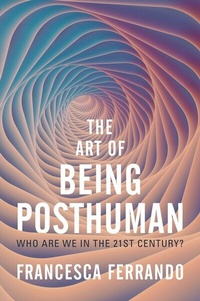
The Art of Being Posthuman
Description

This book offers a comprehensive reflection on the existential condition of the 21st century. A visionary introduction to existential posthumanism, it takes the form of eight meditations.
This posthuman journey of self-inquiry engages with a wide range of knowledge and wisdom: from the Paleolithic times to the futures of radical life extension, from multi-species evolutions to the rights of Nature, the Anthropocene and the rise of Artificial Intelligence.
The book declutters the habit of being human. Letting go of the need for anthropocentric mastery and species-specific ambitions, the reader emerges regenerated. The manifold paths of posthuman self-realization reveal that we are all co-creators in the existential unfolding: our lives are our ultimate works of art.
The Art of Being Posthuman is a self-help guide to navigate our brave new world.
You can listen to Dr. Ferrando talk about the book's key themes in these videos: 1. Introduction and 2. Conclusion
All prices
More details
Other editions
Additional editions
Person
Content
Introduction: How can Posthumanism bring Change?
Meditation 1: Posthuman Self-Enquiry
Meditation 2: Human Evolutions
Meditation 3: Biotic Co-Emergences
Meditation 4: Ecological Presence
Meditation 5: Cosmic Constellations
Meditation 6: Technological Enhancement
Meditation 7: Socio-cultural Agency
Meditation 8: Ontological Awareness
Conclusions: Posthuman Mantra
Download supporting exercises and prompts here
Meditation 1
Posthuman Self-Enquiry
#Existential Posthumanism
What is existential posthumanism? Existential posthumanism is a path of self-enquiry and self-discovery, aimed at full existential awareness. It is not simply an academic trend; it can be found in all eras and geographical areas, from all cultural arenas. It is, in some sense, ahistorical, for it is not tied to a specific contextual, and conceptual, background. Like a wild card in poker, it can refer to different paths to (self-)realiza-tion, embracing the art of existing in the affects - and effects - each of us is unfolding in our revealing. Given that existence is in constant flux, in order to be integrally aware, we must be conscious of all the situated and embodied dimensions of our manifestations. Existential posthumanism, as a philosophy of life, approaches humans (in all of their diversities), other-than-human animals, technology and ecology relationally, investigating the human condition in co-emergences. This is the time to realize that our lives are our greatest legacy.1 By doing so, we can unfold the possibilities that surface by embracing existence as our ultimate work of art: ontological poiesis.2 Life is a journey, and we are the wanderers: anything can happen, and eventually does. "Posthuman," in this sense, means being brave enough to know that the human condition is neither our destiny nor our nature but, rather, spatio-temporal manifestations of unlimited material and semiotic possibilities. The fact that specific histories and herstories have been foundational to the manifesting of our human societies does not mean that we need to repeat the canon: we can change it, right here, right now. We can manifest different ways of existing, enacting our own cosmic game.3 In order to be conscious channels in the unfolding of our existential manifestations, we need to be completely aware of who we are.
Who are we? We4 are. Ways of revealing; (actions of) the multiverse; trans-forming energies.5 Born out of a specific planet: Earth. In a specific era: the 21st century (so defined in accordance with the Gregorian calendar; other measures of time reveal different definitions). From biological parents of a specific species: Homo sapiens. We are quite unique: everyone is. In order to realize who we are, we need to acknowledge our specificities as well as our commonalities. On the path of self-discovery, this is the (st)art. As the philosopher Jiddu Krishnamurti (1895-1986) put it: "the first step is the last step. The first step is the step of clear perception, and that act of clear perception is the last act" (2012: 42). We must be clear with our visions; they are already (p)art of our manifestations. At the existential level,6 existence is all we have: that's plenty.
Existential posthumanism addresses the primal question of existence "Who am I?" not in isolation, but relationally, together with other foundational questions, such as "What am I?," "Who are You?" and "Where and when are We?" This is the ontological epiphany of relationality, according to which relata7 and relations are not in competition for primacy; they can only co-emerge, in the present moment. The philosopher of science Karen Barad (b. 1956) clearly explains: "relata do not precede relations; rather, relata-within-phenomena emerge through specific intra-actions" (2007: 334). The rich trajectory of material feminism8 underlines how the ontological is not independent from socio-political, bio-cultural, eco-technological and, more in general, spatio-temporal elements. This dimensional co-manifestation is nourished by, and is nourishing, unlimited and constantly shifting layers of existence. The one and the many are not in separation. Quite the opposite: they induce an understanding of the notion of the self that transcends the loneliness of the autonomous humanist "Subject,"9 in the recognition of the others as ontologically and necessarily co-generative of the Self. A pluralistic monism and a monistic pluralism:10 we inter-are.
#Inter-being
This posthumanist journey of self-knowledge starts by realizing the inter-being11 of the self: as individuals, societies, species, planet, cosmos, and so on. To explain the necessary conditions of existence, the expression "interbeing" was coined by the Zen Buddhist master Thich Nhat Hanh (1926-2022) in these terms: "'Interbeing' is a word that is not in the dictionary yet, but if we combine the prefix 'inter' with the verb 'to be,' we have a new verb, inter-be" (Hanh 2021: 55). The verb "to inter-be" is clarified with vivid examples, such as the following (which we can directly apply to the experience of reading this book in its paper form):12 If you are a poet, you will see clearly that there is a cloud floating in this sheet of paper. Without a cloud, there will be no rain; without rain, the trees cannot grow; and without trees, we cannot make paper. The cloud is essential for the paper to exist. If the cloud is not here, the sheet of paper cannot be here either. So we can say that the cloud and the paper inter-are. (Ibid.) The posthuman perception of inter-being takes all these dynamics into consideration. Furthermore, coming from an academic tradition, it is specifically aware of the role of social narratives in the constitution of reality. It thus makes it a point to respect human and non-human diversity at all levels, including the symbolic one - for instance, by selecting gender-neutral language, race-aware discourses and species-transformative epistemes, among others. Intrinsically intra-acting, we always inter-are: we are our actions and reactions; our genetics and epigenetics; the food we eat, the water we drink, the air we breathe; the narratives we co-generate and sustain; the people, objects, and places we associate with, among unlimited others. We(/ they) are (p)art of who they(/we) are. For instance, human bodies can be addressed as universes to all the entities that make them "be," such as the bacteria that are collectively called the human microbiome and that, more than "inhabiting" our organisms, truly "are" us - (in)forming our physical manifestation, including our health, well-being, and so on.13 "We," as individuals, are many. Concurrently, we are intrabeing with the environment: in post-Darwinian terms; we are changed by, and we change, the places we inhabit.14 We do not simply live on planet Earth: we are (p)art of it - in a specular existential condition as the microbiome is to our bodies. We can be agents of change right now, once we realize that our existential performing is intimately generative and wholly resonant: manifesting, affecting and effecting in the waves of species consciousness, planetary experiencing and, more extensively, ontological revealing. To be human has ripple effects; this is why, when unfolding the petals of wisdom in the 21st century, it is important to understand our agency as a species.
#Existentialism?
Is existential posthumanism related to 19th- and 20th-century European existentialism? Existential posthumanism can relate to but should not be confused with Existentialism, the philosophical approach developed by 19th- and 20th-century European philosophers, from Søren Kierkegaard (1813-1855) to Jean-Paul Sartre (1905-1980) and Simone de Beauvoir (1908-1986), among many others. Existential posthumanism shares with European Existentialism the focus on exploring meanings, purposes and values of human existence in authenticity; and yet it approaches such intentions with no emphasis on the human subject. While "Existentialism is a Humanism," as famously stated by Sartre (1946), from a posthuman perspective, the human is seen not as the main subject but as a natural-cultural convergence,15 comprehending the resonances, impacts, affects and effects of our being-in-the-world. This relates to the work of Martin Heidegger (1889-1976), who actually refused to be associated with the existentialist movement and its humanistic trajectories.16 In tune with phenomenological approaches, existential posthumanism underlines that, if we do not become (p)art of our own research, if we do not include self-enquiry in our scientific investigations, we will never know who we are or what we are researching: no one, outside of ourselves, can fully teach us that. Existential awareness does not come simply by studying objectively; it comes from experiencing directly - the object and the subject are not separated. Real wisdom never goes out of fashion, and yet it must be updated: emerging out of realizations that go beyond spacetime, it often manifests through specific symbolic apparatuses, which may reflect the limits of their era.
How do we partake in socio-cultural dynamics? In order to comprehend who we are, we need to transcend the lenses through which we have been taught to categorize ourselves. In our shared consciousness, these semiotic frames are embedded with resonances; they be/come (p)art of (how we narrate) who we are, not only to others: more clearly, to ourselves. To reach deep awareness of who we are, it is wise to know the risks of limiting such narratives to socio-culturally constructed categorizations, beliefs and norms. Through socialization and education, some...
