

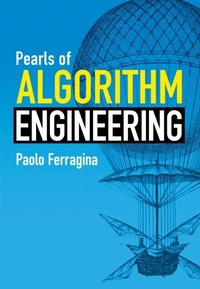
Pearls of Algorithm Engineering
Published on 7. June 2023
978-1-009-35856-9 (ISBN)
Description

There are many textbooks on algorithms focusing on big-O notation and basic design principles. This book offers a unique approach to taking the design and analyses to the level of predictable practical efficiency, discussing core and classic algorithmic problems that arise in the development of big data applications, and presenting elegant solutions of increasing sophistication and efficiency. Solutions are analyzed within the classic RAM model, and the more practically significant external-memory model that allows one to perform I/O-complexity evaluations. Chapters cover various data types, including integers, strings, trees, and graphs, algorithmic tools such as sampling, sorting, data compression, and searching in dictionaries and texts, and lastly, recent developments regarding compressed data structures. Algorithmic solutions are accompanied by detailed pseudocode and many running examples, thus enriching the toolboxes of students, researchers, and professionals interested in effective and efficient processing of big data.
Reviews / Votes
'When I joined Google in 2000, algorithmic problems came up every day. Even strong engineers didn't have all the background they needed to design efficient algorithms. Paolo Ferragina's well-written and concise book helps fill that void. A strong software engineer who masters this material will be an asset.' Martin Farach-Colton, Rutgers University 'There are plenty of books on Algorithm Design, but few about Algorithm Engineering. This is one of those rare books on algorithms that pays the necessary attention to the more practical aspects of the process, which become crucial when actual performance matters, and which render some theoretically appealing algorithms useless in real life. The author is an authority on this challenging path between theory and practice of algorithms, which aims at both conceptually nontrivial and practically relevant solutions. I hope the readers will find the reading as pleasant and inspiring as I did.' Gonzalo Navarro, University of Chile 'Ferragina combines his skills as a coding engineer, an algorithmic mathematician, and a pedagogic innovator to engineer a string of pearls made up of beautiful algorithms. In this, beauty dovetails with computational efficiency. His data structures of Stringomics hold the promise for a better understanding of population of genomes and the history of humanity. It belongs in the library of anyone interested in the beauty of code and the code of beauty.' Bud Mishra, Courant Institute, New York University 'There are many textbooks on algorithms focusing on big-O notation and general design principles. This book offers a completely unique aspect of taking the design and analyses to the level of predictable practical efficiency. No sacrifices in generality are made, but rather a convenient formalism is developed around external memory efficiency and parallelism provided by modern computers. The benefits of randomization are elegantly used for obtaining simple algorithms, whose insightful analyses provide the reader with useful tools to be applied to other settings. This book will be invaluable in broadening the computer science curriculum with a course on algorithm engineering.' Veli Makinen, University of HelsinkiMore details
Language
English
Place of publication
Cambridge
United Kingdom
Illustrations
Worked examples or Exercises
File size
23,49 MB
ISBN-13
978-1-009-35856-9 (9781009358569)
Copyright in bibliographic data and cover images is held by Nielsen Book Services Limited or by the publishers or by their respective licensors: all rights reserved.
Schweitzer Classification
Other editions
Additional editions
Paolo Ferragina
Pearls of Algorithm Engineering
Book
06/2023
Cambridge University Press
€63.50
Shipment within 15-20 days
Person
Content
1. Prologue; 2. A warm-up!; 3. Random sampling; 4. List ranking; 5. Sorting atomic items; 6. Set intersection; 7. Sorting strings; 8. The dictionary problem; 9. Searching strings by prefix; 10. Searching strings by substring; 11. Integer coding; 12. Statistical coding; 13. Dictionary-based compressors; 14. The burrows-wheeler transform; 15. Compressed data structures; 16. Conclusion.
