

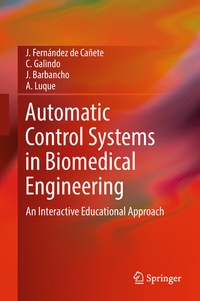
Automatic Control Systems in Biomedical Engineering
Description

This book presents the fundamental principles and challenges encountered in the control of biomedical systems, providing practical solutions and suggesting alternatives. The perspective of the text is based on the system behaviour in the time domain both linear and non-linear, continuous and discrete, helping the reader to be able to interpret the physical significance of mathematical results during control system analysis and design focusing on biomedical engineering applications.
Interactive learning is promoted, endowing students with the ability to change parameters and conditions during the simulation and see the effects of these changes, by using interactive MATLAB and SIMULINK software tools, also presenting realistic problems in order to analyse, design and develop automatic control systems.
The text is also complemented with MATLAB and SIMULINK exercise files solved to aid students to focus on the fundamental concepts treated throughout the book, followinga new pedagogical approach distinct from the classical one whereby fundamental control concepts are introduced together with adequate software tools in order to gain insight on the biomedical engineering control problems.
The book is suitable for second or third-year undergraduate students who will find the illustrative examples particularly useful to their studies of control system design and implementation. Lecturers in the control field will find the computer aided design approach as an alternative to teaching the fundamental concepts of feedback analogic and digital control.
More details
Other editions
Additional editions
Persons
Cipriano Galindo is Associate Professor at the Engineering system and Automation Department of the University of Malaga, Spain. His main research interests are on mobile robotics, artificial intelligence, and control systems.
Julio Barbancho is an Associate Professor at the University of Seville, Spain. His main interests focus on computational intelligence, IoT, data analytics and big data applied to industrial applications; and automatic control applied to health
Amalia Luque is an Assistant Professor at the University of Seville, Spain. Her research interests are on control, business intelligence, data mining, industry 4.0.and artificial intelligence.
