

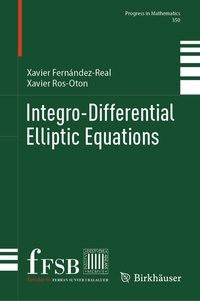
Integro-Differential Elliptic Equations
Description

This monograph offers a self-contained introduction to the regularity theory for integro-differential elliptic equations, mostly developed in the 21st century. This class of equations finds relevance in fields such as analysis, probability theory, mathematical physics, and in several contexts in the applied sciences. The work gives a detailed presentation of all the necessary techniques, with a primary focus on the main ideas rather than on proving all the results in their greatest generality.
The basic building blocks are presented first, with the study of the square root of the Laplacian, and weak solutions to linear equations. Subsequently, the theory of viscosity solutions to nonlinear equations is developed, and proofs are provided for the main known results in this context. The analysis finishes with the investigation of obstacle problems for integro-differential operators and establishes the regularity of solutions and free boundaries.
A distinctive feature of this work lies in its presentation of nearly all covered material in a monographic format for the first time, and several proofs streamline, and often simplify, those in the original papers. Furthermore, various open problems are listed throughout the chapters.
Reviews / Votes
"The book ranges from introductory material for the very basic features of the operator to state-of-the-art results in the regularity theory for solutions. ... This makes the book accessible to beginners while making it an interesting read (and in some cases an inescapable one) to experts in the field." (Nicola Abatangel, zbMATH 1567.35002, 2025)
More details
Other editions
Additional editions
Persons
Xavier Fernández-Real Girona is SNF Ambizione Fellow at EPFL. He received his PhD in Mathematics from ETH Zürich in 2020, for which he received the Dimitris N. Chorafas Prize as well as the Vicent Caselles Prize. He is the winner of the Rubio de Francia Prize from the Royal Spanish Mathematical Society and the Antonio Valle Young Researcher Award from the Spanish Society of Applied Mathematics. He is author of the book 'Regularity Theory for Elliptic PDE', jointly written with X. Ros-Oton.
Xavier Ros Oton is ICREA Research Professor at Universitat de Barcelona since 2020. Previously, he has been Assistant Professor at Universität Zürich, as well as R. H. Bing Instructor at the University of Texas at Austin. He has received several awards for young mathematicians in Spain, including the 'Premio Nacional de Investigación' for researchers under 40 in Mathematics and Computer Science. He also received the Scientific Research Award from the Fundación Princesa de Girona, as well as the Stampacchia Gold Medal. In 2022, he was elected member of the Spanish Royal Academy of Sciences.
Content
The square root of the Laplacian.- Linear integro-differential equations.- Fully nonlinear equations.- Obstacle problems.
