

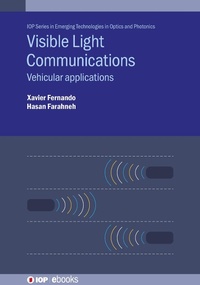
Visible Light Communications
Description

Visible Light Communication (VLC) has emerged as an attractive alternative to radio frequency (RF) communication, due to its abundant, license-free bandwidth and cost effectiveness. The visible light spectrum is much larger than the entire RF spectrum, and it is largely unexplored. VLC has proved its viability in automotive applications to provide short range vehicle-to-vehicle and vehicle-to-infrastructure communications due to increased deployment of LED lights and image sensors in modern vehicles. However, there are a few challenges that need to be addressed before global adaptation. A must-read for researchers, graduate students and industry professionals who work in the VLC field, this book investigates the suitability of VLC for vehicular communications from a fundamental wireless communication standpoint. Mathematically accurate channel models are developed, and advanced signal processing approaches to overcome challenges such as sunlight interference, shadowing and fast changing channels are described. Results are verified through simulation with realistic parameters.
More details
Other editions
Additional editions
Persons
Xavier Fernando is a professor in the Department of Electrical and Computer Engineering at Ryerson University, Canada. He has co-authored more than 200 research articles, as well as three books, and he holds three patents. Additionally, he has won 30 awards and prizes, including the Professional Engineers Ontario Award in 2016, the IEEE Microwave Theory and Techniques Society Prize in 2010, the Sarnoff Symposium Prize in 2009, the Opto-Canada best poster prize in 2003, and the CCECE best paper prize in 2001.
Hasan Farahneh received his PhD from Ryerson University, Canada in 2018. In September 2019 he joined the Electrical Engineering Department at the University of Jordan as a teaching staff member. His interests include wireless and visible light communication, and his current research is focused on vehicular communication using visible light spectrum.
