

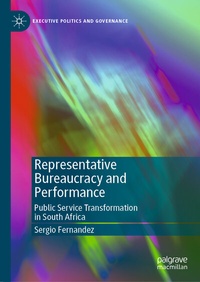
Representative Bureaucracy and Performance
Public Service Transformation in South Africa
1st Edition
Published on 22. November 2019
XVIII, 288 pages
978-3-030-32134-5 (ISBN)
Description

"
Representative Bureaucracy and Performance: Public Service Transformation in South Africa
is a first-rate blend of quantitative and qualitative analysis of one of the major transitions in modern governance. Fernandez makes a major theoretical contribution to the literature on representative bureaucracy in demonstrating how descriptive representation translates into both active representation and better performance. His discussion of the crucial role of language and communication brings new insight to the literature on public administration and democracy."-Kenneth Meier, Distinguished Scholar in Residence, American University
"This study of public sector transformation goes beyond the descriptive qualitative research largely found in South African public administration historiography by undertaking sophisticated quantitative analysis to show that representation of previously historically disadvantaged groups, under certain circumstances, can improve the performance of public organizations. This is an excellent contribution, not only to public administration scholarship in South Africa, but also to the sparse literature on public organizations in developing countries. The book should be of great value to scholars and practitioners of public administration, as well as to students of political science and organizational studies."-Robert Cameron, Professor, University of Cape Town
"This book provides an excellent analysis of the theory of representative bureaucracy in the context of South African post-apartheid government. South Africa is an important and fascinating case. The work adds substantially to the literature on representative bureaucracy and will be of interest to all who are concerned with the effectiveness of government organizations."-J. Edward Kellough, Professor, University of Georgia
Governments throughout the world seek to promote employment equity and ensure that bureaucracies are representative of the citizenry. South Africa offers a rare and fascinating case for exploring what happens to bureaucracies as they undergo demographic transformation. Grounded in the theory of representative bureaucracy and using a mixed methods approach, this book explores how major changes in the demographics of the South African public service have affected the performance of the institution. The empirical analysis offers compelling evidence that representative bureaucracies perform better. As public organizations become increasingly representative by hiring historically disadvantaged persons, especially Africans, their performance improves, controlling for a range of factors. Evidence indicates representative bureaucracies perform better because they empathize with and advocate for historically disadvantaged communities, are equipped with linguistic and cultural competencies to serve a diverse citizenry, and can induce compliance, cooperation, and coproduction.
"This study of public sector transformation goes beyond the descriptive qualitative research largely found in South African public administration historiography by undertaking sophisticated quantitative analysis to show that representation of previously historically disadvantaged groups, under certain circumstances, can improve the performance of public organizations. This is an excellent contribution, not only to public administration scholarship in South Africa, but also to the sparse literature on public organizations in developing countries. The book should be of great value to scholars and practitioners of public administration, as well as to students of political science and organizational studies."-Robert Cameron, Professor, University of Cape Town
"This book provides an excellent analysis of the theory of representative bureaucracy in the context of South African post-apartheid government. South Africa is an important and fascinating case. The work adds substantially to the literature on representative bureaucracy and will be of interest to all who are concerned with the effectiveness of government organizations."-J. Edward Kellough, Professor, University of Georgia
Governments throughout the world seek to promote employment equity and ensure that bureaucracies are representative of the citizenry. South Africa offers a rare and fascinating case for exploring what happens to bureaucracies as they undergo demographic transformation. Grounded in the theory of representative bureaucracy and using a mixed methods approach, this book explores how major changes in the demographics of the South African public service have affected the performance of the institution. The empirical analysis offers compelling evidence that representative bureaucracies perform better. As public organizations become increasingly representative by hiring historically disadvantaged persons, especially Africans, their performance improves, controlling for a range of factors. Evidence indicates representative bureaucracies perform better because they empathize with and advocate for historically disadvantaged communities, are equipped with linguistic and cultural competencies to serve a diverse citizenry, and can induce compliance, cooperation, and coproduction.
More details
Series
Language
English
Place of publication
Cham
Switzerland
Publishing group
Springer International Publishing
Target group
Professional and scholarly
Product notice
Reflowable
Illustrations
XVIII, 288 p. 11 illus.
File size
3,12 MB
ISBN-13
978-3-030-32134-5 (9783030321345)
DOI
10.1007/978-3-030-32134-5
Schweitzer Classification
Other editions
Additional editions
Sergio Fernandez
Representative Bureaucracy and Performance
Public Service Transformation in South Africa
Book
12/2019
Palgrave Macmillan
€80.24
Shipment within 7-9 days
Person
Sergio Fernandez is Associate Professor at Indiana University O'Neill School of Public and Environmental Affairs, USA. He also serves as Extraordinary Professor at University of Pretoria School of Public Management and Administration, South Africa, and Visiting Professor at University of Johannesburg Centre for Public Management and Governance, South Africa.
Content
1. Representative Bureaucracy and Performance.- 2. Apartheid and the Bureaucracy.- 3. Addressing the Legacy of Apartheid.- 4. Public Sector Reform and the Quest for a Capable Public Service.- 5. The Theory of Representative Bureaucracy.- 6. Representative Bureaucracy and Performance: Empirical Evidence from South Africa.- 7. Why Do Representative Bureaucracies Perform Better?.- 8. What We Have Learned and the Way Forward.
