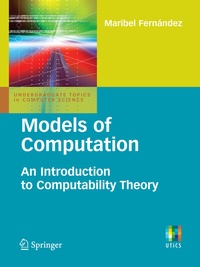
Models of Computation
Description

A Concise Introduction to Computation Models and Computability Theory provides an introduction to the essential concepts in computability, using several models of computation, from the standard Turing Machines and Recursive Functions, to the modern computation models inspired by quantum physics. An in-depth analysis of the basic concepts underlying each model of computation is provided.
Divided into two parts, the first highlights the traditional computation models used in the first studies on computability: - Automata and Turing Machines; - Recursive functions and the Lambda-Calculus; - Logic-based computation models.
and the second part covers object-oriented and interaction-based models. There is also a chapter on concurrency, and a final chapter on emergent computation models inspired by quantum mechanics.
At the end of each chapter there is a discussion on the use of computation models in the design of programming languages.
Reviews / Votes
From the reviews:
"The focus of this relatively short book is on newer object-oriented and interaction-oriented models, including recent work in quantum computing and systems biology. . the book is designed for advanced undergraduate and graduate students. . Each chapter starts by clearly indicating what will be covered and ends with a series of exercises. . the book as a whole is extremely well written. Definitions are clearly stated . . Each model of computation is precisely defined, and the examples are clear and to the point." (K. Harrow, ACM Computing Reviews, September, 2009)
"It is a pleasure to see a book which takes a different approach to computer theory. . This short book can be used for a one-term course . . A valuable primer for students of programming languages. Summing Up: Highly recommended. Upper-division undergraduates and graduate students." (P. Cull, Choice, Vol. 47 (3), November, 2009)More details
Other editions
Additional editions