

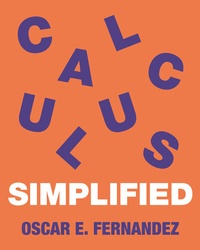
Calculus Simplified
1st Edition
Published on 11. June 2019
272 pages
978-0-691-18941-3 (ISBN)
Description

No detailed description available for "Calculus Simplified".
More details
Other editions
Additional editions
Oscar E. Fernandez
Calculus Simplified
Book
06/2019
Princeton University Press
€24.00
Shipment within 10-20 days
Person
Oscar E. Fernandez is associate professor of mathematics at Wellesley College. He is the author of Everyday Calculus and The Calculus of Happiness (both Princeton).
Content
- Cover
- Contents
- Preface
- To the Student
- To the Instructor
- Before You Begin . . .
- 1. The Fast Track Introduction to Calculus
- 1.1 What Is Calculus?
- Calculus as a Way of Thinking
- What Does "Infinitesimal Change" Mean?
- 1.2 Limits: The Foundation of Calculus
- 1.3 The Three Difficult Problems That Led to the Invention of Calculus
- 2. Limits: How to Approach Indefinitely (and Thus Never Arrive)
- 2.1 One-Sided Limits: A Graphical Approach
- 2.2 Existence of One-Sided Limits
- 2.3 Two-Sided Limits
- 2.4 Continuity at a Point
- 2.5 Continuity on an Interval
- 2.6 The Limit Laws
- 2.7 Calculating Limits-Algebraic Techniques
- 2.8 Limits Approaching Infinity
- 2.9 Limits Yielding Infinity
- 2.10 Parting Thoughts
- Chapter 2 Exercises
- 3. Derivatives: Change, Quantified
- 3.1 Solving the Instantaneous Speed Problem
- 3.2 Solving the Tangent Line Problem-The Derivative at a Point
- 3.3 The Instantaneous Rate of Change Interpretation of the Derivative
- 3.4 Differentiability: When Derivatives Do (and Don't) Exist
- 3.5 The Derivative, a Graphical Approach
- 3.6 The Derivative, an Algebraic Approach
- Leibniz Notation
- 3.7 Differentiation Shortcuts: The Basic Rules
- 3.8 Differentiation Shortcuts: The Power Rule
- 3.9 Differentiation Shortcuts: The Product Rule
- 3.10 Differentiation Shortcuts: The Chain Rule
- 3.11 Differentiation Shortcuts: The Quotient Rule
- 3.12 (Optional) Derivatives of Transcendental Functions
- 3.13 Higher-Order Derivatives
- 3.14 Parting Thoughts
- Chapter 3 Exercises
- 4. Applications of Differentiation
- 4.1 Related Rates
- 4.2 Linearization
- 4.3 The Increasing/Decreasing Test
- 4.4 Optimization Theory: Local Extrema
- 4.5 Optimization Theory: Absolute Extrema
- 4.6 Applications of Optimization
- 4.7 What the Second Derivative Tells Us About the Function
- 4.8 Parting Thoughts
- Chapter 4 Exercises
- 5. Integration: Adding Up Change
- 5.1 Distance as Area
- 5.2 Leibniz's Notation for the Integral
- 5.3 The Fundamental Theorem of Calculus
- 5.4 Antiderivatives and the Evaluation Theorem
- 5.5 Indefinite Integrals
- 5.6 Properties of Integrals
- 5.7 Net Signed Area
- 5.8 (Optional) Integrating Transcendental Functions
- 5.9 The Substitution Rule
- 5.10 Applications of Integration
- 5.11 Parting Thoughts
- Chapter 5 Exercises
- Epilogue
- Acknowledgments
- Appendix A: Review of Algebra and Geometry
- Appendix B: Review of Functions
- Appendix C: Additional Applied Examples
- Answers to Appendix and Chapter Exercises
- Bibliography
- Index of Applications
- Index of Subjects
