

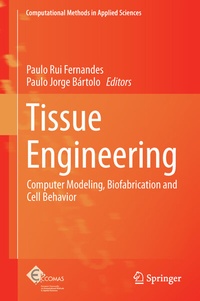
Tissue Engineering
Description

Tissue Engineering is a multidisciplinary field involving scientists from different fields. The development of mathematical methods is quite relevant to understand cell biology and human tissues as well to model, design and fabricate optimized and smart scaffolds.
Emphasis is put on mathematical and computational modeling for scaffold design and fabrication. This particular area of tissue engineering, whose goal is to obtain substitutes for hard tissues such as bone and cartilage, is growing in importance.
Reviews / Votes
From the book reviews:
"This is an outstanding reference on in vitro and in vivo regrowth of soft tissues. The use of connective tissues stem cells (mesenchymal) is explored in detail. . I highly recommend this book for engineers, orthopaedic, plastic, and general surgeons. . I highly recommend this book to all audiences." (Joseph J. Grenier, Amazon.com, August, 2014)
More details
Other editions
Additional editions
Content
Preface . - 1. Cell mechanics: The role of simulation Stem Cell-Based Tissue Engineering for Bone Repair: Influence of cell communication and 3-D cell-matrix environment, by Swathi Damaraju and Neil A. Duncan.- 2. In silico biology of bone regeneration inside calcium phosphate scaffolds, by Aurélie Carlier, Hans Van Oosterwyck and Liesbet Geris.- 3. Constitutive Effects of Hydrolytic Degradation in Electro-spun Polyester-urethane Scaffolds for Soft Tissue Regeneration, by Hugo Krynauw, Lucie Bruchmüller, Deon Bezuidenhout, Peter Zilla, Thomas Franz.- 4. 4D numerical analysis of scaffolds: a new approach, by A. C. Vieira, A. T. Marques, R. M. Guedes, V. Tita.- 5. Microrheology of B iopolymers at non-thermal regimes, by Rommel G. Bacabac, Heev Ayade, Lara Gay M. Villaruz, Raymund Sarmiento, Roland Otadoy.- 6. Optimization approaches for the design of additively manufactured scaffolds, by Sara M. Giannitelli, Alberto Rainer, Dino Accoto, Stefano De Porcellinis, Elena De-Juan-Pardo, Eugenio Guglielmelli, Marcella Trombetta.- 7. Rational Design of Artificial Cellular Niches for Tissue Engineering, by Ana Sancho-Erkizia, Javier Aldazabal, Alberto Rainer, Elena M. De-Juan-Pardo.- 8. Photocrosslinkable materials for the fabrication of tissue-engineered constructs by stereolithography, by Rúben F. Pereira, Paulo J. Bártolo.
