
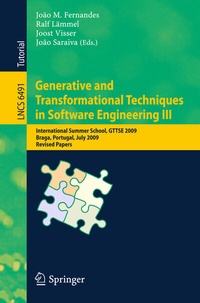
Generative and Transformational Techniques in Software Engineering III
Description
Alles über E-Books | Antworten auf Fragen rund um E-Books, Kopierschutz und Dateiformate finden Sie in unserem Info- & Hilfebereich.
More details
Other editions
Additional editions
Content
An Introduction to Software Product Line Refactoring.- Excerpts from the TXL Cookbook.- Model Synchronization: Mappings, Tiles, and Categories.- An Introductory Tutorial on JastAdd Attribute Grammars.- Model Driven Language Engineering with Kermeta; EASY Meta-programming with Rascal.- The Theory and Practice of Modeling Language Design for Model-Based Software Engineering-A Personal Perspective.- Code Transformations for Embedded Reconfigurable Computing Architectures.- Model Transformation Chains and Model Management for End-to-End Performance Decision Support; Building Code Generators with Genesys: A Tutorial Introduction; The Need for Early Aspects.- Lightweight Language Processing in Kiama .- Some Issues in the 'Archaeology' of Software Evolution; Teaching Computer Language Handling - From Compiler Theory to Meta-modelling; C++ Metastring Library and Its Applications.- Language Convergence Infrastructure.

System requirements
File format: PDF
Copy protection: Watermark-DRM (Digital Rights Management)
System requirements:
- Computer (Windows; MacOS X; Linux): Use the free software Adobe Reader, Adobe Digital Editions, or any other PDF viewer of your choice (see eBook Help).
- Tablet/Smartphone (Android; iOS): Install the free app Adobe Digital Editions or another reading app for eBooks, e.g., PocketBook (see eBook Help).
- E-reader: Bookeen, Kobo, Pocketbook, Sony, Tolino and many more (only limited: Kindle).
The file format PDF always displays a book page identically on any hardware. This makes PDF suitable for complex layouts such as those used in textbooks and reference books (images, tables, columns, footnotes). Unfortunately, on the small screens of e-readers or smartphones, PDFs are rather annoying, requiring too much scrolling.
This eBook uses Watermark-DRM, a „soft” copy protection. This means that there are no technical restrictions to prevent illegal distribution. However, there is a personalised watermark embedded in the eBook that can be used to identify the purchaser of the eBook in the event of misuse and to provide evidence for legal purposes.
For more information, see our eBook Help page.