

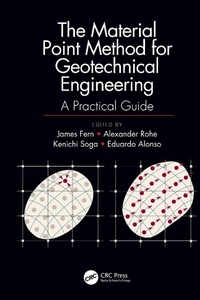
The Material Point Method for Geotechnical Engineering
A Practical Guide
Published on 30. January 2019
442 pages
978-0-429-65066-6 (ISBN)
Description

This practical guide provides the best introduction to large deformation material point method (MPM) simulations for geotechnical engineering. It provides the basic theory, discusses the different numerical features used in large deformation simulations, and presents a number of applications -- providing references, examples and guidance when using MPM for practical applications.
MPM covers problems in static and dynamic situations within a common framework. It also opens new frontiers in geotechnical modelling and numerical analysis. It represents a powerful tool for exploring large deformation behaviours of soils, structures and fluids, and their interactions, such as internal and external erosion, and post-liquefaction analysis; for instance the post-failure liquid-like behaviours of landslides, penetration problems such as CPT and pile installation, and scouring problems related to underwater pipelines. In the recent years, MPM has developed enough for its practical use in industry, apart from the increasing interest in the academic world.
MPM covers problems in static and dynamic situations within a common framework. It also opens new frontiers in geotechnical modelling and numerical analysis. It represents a powerful tool for exploring large deformation behaviours of soils, structures and fluids, and their interactions, such as internal and external erosion, and post-liquefaction analysis; for instance the post-failure liquid-like behaviours of landslides, penetration problems such as CPT and pile installation, and scouring problems related to underwater pipelines. In the recent years, MPM has developed enough for its practical use in industry, apart from the increasing interest in the academic world.
Reviews / Votes
'The authors present some examples of application of the Material Point Method to common geotechnical engineering problems, ranging from landslides and strutted excavations to the simulation of the cone penetration test. There is useful guidance on the basic computational background that underpins this particular numerical method... it is a book that I would want to have as a point of reference for MPM...It forms a reasonable foundation for researchers to expand the method towards the wider geotechnical landscape.'-- Nick O'Riordan, Arup 'The authors present some examples of application of the Material Point Method to common geotechnical engineering problems, ranging from landslides and strutted excavations to the simulation of the cone penetration test. There is useful guidance on the basic computational background that underpins this particular numerical method... it is a book that I would want to have as a point of reference for MPM... It forms a reasonable foundation for researchers to expand the method towards the wider geotechnical landscape.'
-- Nick O'Riordan, Arup
More details
Language
English
Place of publication
London
United Kingdom
Publishing group
Taylor & Francis Ltd
Target group
College/higher education
Professional and scholarly
Illustrations
39 Tables, black and white; 22 Illustrations, color; 205 Illustrations, black and white
File size
153,36 MB
ISBN-13
978-0-429-65066-6 (9780429650666)
Copyright in bibliographic data and cover images is held by Nielsen Book Services Limited or by the publishers or by their respective licensors: all rights reserved.
Schweitzer Classification
Other editions
Additional editions
James Fern | Alexander Rohe | Kenichi Soga
The Material Point Method for Geotechnical Engineering
A Practical Guide
Book
12/2020
1st Edition
CRC Press
€69.00
Shipment within 15-20 days
James Fern | Alexander Rohe | Kenichi Soga
The Material Point Method for Geotechnical Engineering
A Practical Guide
Book
01/2019
1st Edition
CRC Press
€252.55
Shipment within 10-20 days
Persons
Dr. James Fern is a researcher at UC Berkeley and is working on the applications of the material point method in engineering practice. He has worked as an industry consultant designing caverns and tunnels for hydroelectric power schemes, and using computational geomechanics. He is currently working on the constitutive modelling for large deformation MPM simulations and its application to the 2014 Oso Landslide.
Dr. Alexander Rohe is a senior researcher at Deltares and the chairman of the Anura3D community, and specialises in geotechnical engineering of soft soils and computational geomechanics, and is very active in the development of the material point methods.
Prof. Kenichi Soga is Chancellor's Professor at the University of California, Berkeley and was formerly Professor of Civil Engineering at the University of Cambridge, UK. He is a Fellow of the Royal Academy of Engineering and a Fellow of the Institution of Civil Engineers.
Prof. Eduardo Alonso is a professor of civil engineering at the Polytechnic University of Catalonia, Sapain. He has several times received the Telford Medal from the Institution of Civil Engineers, and delivered the 57th Rankine Lecture in 2017 in which the MPM was a relevant part of the presentation. He was the honorary editor of Geotechnique in 2017.
Dr. Alexander Rohe is a senior researcher at Deltares and the chairman of the Anura3D community, and specialises in geotechnical engineering of soft soils and computational geomechanics, and is very active in the development of the material point methods.
Prof. Kenichi Soga is Chancellor's Professor at the University of California, Berkeley and was formerly Professor of Civil Engineering at the University of Cambridge, UK. He is a Fellow of the Royal Academy of Engineering and a Fellow of the Institution of Civil Engineers.
Prof. Eduardo Alonso is a professor of civil engineering at the Polytechnic University of Catalonia, Sapain. He has several times received the Telford Medal from the Institution of Civil Engineers, and delivered the 57th Rankine Lecture in 2017 in which the MPM was a relevant part of the presentation. He was the honorary editor of Geotechnique in 2017.
Content
Foreword. Acknowledgements. Contributors. List of Common Symbols. Part I: Theory. 1. Computational Geomechanics. 2. Fundamentals of the Material Point Method. 3. Different Formulations and Integration Schemes. 4. Recent Developments to Improve the Numerical Accuracy. 5. Axisymmetric Formulation. 6. Numerical Features used in Simulations. 7. An Introduction to Critical State Soil Mechanics. 8. An Introduction to Constitutive Modelling. Part II: Application. 9. The Granular Column Collapse. 10. Inverse Analysis for Modelling Reduced-Scale Laboratory Slopes. 11. Dyke Embankment Analysis. 12. Landslides in Unsaturated Soil. 13. Preliminary Analysis of a Landslide in the North-West Pacific. 14. Thermal Interaction in Shear Bands: the Vajont Landslide. 15. Excavation-Induced Instabilities. 16. Slope Reliability and Failure Analysis using Random Fields. 17. Jacked Pile Installation in Sand. 18. Cone Penetration Tests. 19. Dynamic Compaction. 20. Installation of Geocontainers. 21. Applications in Hydraulic Engineering. Appendix: Thermal Interaction in Shear Bands. Bibliography. Index.
