

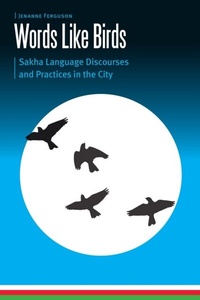
Words Like Birds
Sakha Language Discourses and Practices in the City
1st Edition
Published on 1. February 2019
354 pages
978-1-4962-1239-9 (ISBN)
Description

What does it mean to speak Sakha in the city? Words Like Birds, a linguistic ethnography of Sakha discourses and practices in urban far eastern Russia, examines the factors that have aided speakers in maintaining-and adapting-their minority language over the course of four hundred years of contact with Russian speakers and the federal power apparatus.
Words Like Birds analyzes modern Sakha linguistic sensibilities and practices in the urban space of Yakutsk. Sakha is a north Siberian Turkic language spoken primarily in the Sakha Republic (Yakutia) in the northeastern Russian Federation. For Sakha speakers, Russian colonization in the region inaugurated a tumultuous history in which their language was at times officially supported and promoted and at other times repressed and discouraged.
Jenanne Ferguson explores the communicative norms that arose in response to the top-down promotion of the Russian language in the public sphere and reveals how Sakha ways of speaking became emplaced in villages and the city's private spheres. Focusing on the language ideologies and practices of urban bilingual Sakha-Russian speakers, Ferguson illuminates the changes that have taken place in the first two post-Soviet decades, in contexts where Russian speech and communicative norms dominated during the Soviet era.
Weaving together three major themes-language ideologies and ontologies, language trajectories, and linguistic syncretism-this study reveals how Sakha speakers transform and adapt their beliefs, evaluations, and practices to revalorize a language, maintain and create a sense of belonging, and make their words heard in Sakha again in many domains of city life. Like the moveable spirited words, the focus of Words Like Birds is mobility, change, and flow, the tracing of the situation of bilinguals in Yakutsk.
Words Like Birds analyzes modern Sakha linguistic sensibilities and practices in the urban space of Yakutsk. Sakha is a north Siberian Turkic language spoken primarily in the Sakha Republic (Yakutia) in the northeastern Russian Federation. For Sakha speakers, Russian colonization in the region inaugurated a tumultuous history in which their language was at times officially supported and promoted and at other times repressed and discouraged.
Jenanne Ferguson explores the communicative norms that arose in response to the top-down promotion of the Russian language in the public sphere and reveals how Sakha ways of speaking became emplaced in villages and the city's private spheres. Focusing on the language ideologies and practices of urban bilingual Sakha-Russian speakers, Ferguson illuminates the changes that have taken place in the first two post-Soviet decades, in contexts where Russian speech and communicative norms dominated during the Soviet era.
Weaving together three major themes-language ideologies and ontologies, language trajectories, and linguistic syncretism-this study reveals how Sakha speakers transform and adapt their beliefs, evaluations, and practices to revalorize a language, maintain and create a sense of belonging, and make their words heard in Sakha again in many domains of city life. Like the moveable spirited words, the focus of Words Like Birds is mobility, change, and flow, the tracing of the situation of bilinguals in Yakutsk.
Reviews / Votes
"Informed by an awareness of comparable case studies of Native American and other Indigenous language revitalization projects, Words Like Birds is itself a must-read not just for specialists but for all who regard language as a critical resource for maintaining Indigenous cultures and for those who know that revitalization and reclamation are so much more than merely language documentation."-Paul V. Kroskrity, Native American and Indigenous Studies "Ferguson's vibrant ethnography offers a multifaceted view of contemporary Sakha cultural and linguistic practices, blending analyses of syncretism and language revitalization with explorations of place, movement, and belief to capture speakers' complex understandings of what it means to be Sakha."-J. A. Dickinson, associate professor of anthropology at the University of VermontMore details
Series
Language
English
Place of publication
Lincoln
United States
Target group
Professional and scholarly
Illustrations
3 maps, 2 tables, 19 photos, index
File size
2,65 MB
ISBN-13
978-1-4962-1239-9 (9781496212399)
Copyright in bibliographic data and cover images is held by Nielsen Book Services Limited or by the publishers or by their respective licensors: all rights reserved.
Schweitzer Classification
Other editions
Additional editions
Book
02/2019
University of Nebraska Press
€63.00
Shipment within 15-20 days
Person
Jenanne Ferguson is an assistant professor of linguistic anthropology at the University of Nevada-Reno.
Content
List of Illustrations
Notes on Transcription and Transliteration
Acknowledgments
Introduction: A Short History of Sakha
1. We Have Always Been Adaptable: Frameworks for Sakha Language Vitality
2. Sakha under the Tsars and Beyond: Language Policies and Communicative Norms
3. Like Sweet Cream and Lingonberries: Language, Spirits, and Sustenance
4. One Drop Traveling along a Great Artery: Moving the Ulus to the City
5. Sakhalyy in the City: Language Mixing and Indexing Authenticity
6. Acquiring Russian, Maintaining Sakha: Language Choices and Life Trajectories
7. Ohuokhaj in Lenin Square, Hip Hop in Virtual TUEhulgeter: Adapting New Spaces for Sakha
Conclusion: Words Like Birds
Notes
References
Index
Notes on Transcription and Transliteration
Acknowledgments
Introduction: A Short History of Sakha
1. We Have Always Been Adaptable: Frameworks for Sakha Language Vitality
2. Sakha under the Tsars and Beyond: Language Policies and Communicative Norms
3. Like Sweet Cream and Lingonberries: Language, Spirits, and Sustenance
4. One Drop Traveling along a Great Artery: Moving the Ulus to the City
5. Sakhalyy in the City: Language Mixing and Indexing Authenticity
6. Acquiring Russian, Maintaining Sakha: Language Choices and Life Trajectories
7. Ohuokhaj in Lenin Square, Hip Hop in Virtual TUEhulgeter: Adapting New Spaces for Sakha
Conclusion: Words Like Birds
Notes
References
Index
