

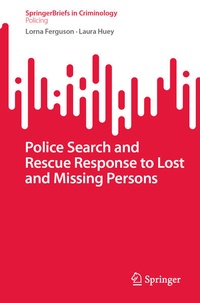
Police Search and Rescue Response to Lost and Missing Persons
Description

This brief discusses the significant contribution of police search and rescue to the successful location and resolution of missing persons cases.
Across seven chapters, this volume offers a detailed examination of the routine practices of police search and rescue personnel. To do so, it draws from a collection of data, including in-depth interviews with police and thousands of different types of missing persons records. Laced with the stories of missing persons, it presents a detailed overview of what these teams do, the processes and procedures employed, and the tools and technologies in police search and rescue. It explores some of the challenges impacting police search and rescue response, emphasizing how to leverage this work in the field. This book also identifies future trends to address the "What may be next" question in the police search and rescue response to missing persons.
As the first analysis of the role of police in search and rescue missions, this brief is of interest to law enforcement professionals and researchers of policing, policymakers, and professionals in psychology, criminology, sociology, and beyond
More details
Other editions
Additional editions
Persons
Vanier Scholar Lorna Ferguson is a PhD(c) at the University of Western Ontario and is the Founder of the Missing Persons Research Hub. She is a criminologist who has dedicated over nine years to studying crime and criminal justice and working in this field. Overall, her research interests pertain to the sociology of work with respect to policing and developing evidence-based approaches to policing and crime prevention, including the study of issues related to crime concentration, police data, and cybercrime. Her research specialization is police responses to missing persons cases. Lorna's research has been published in numerous peer-reviewed journals in her field and has been the subject of many local, national, and international presentations. Her most recent research has appeared in Criminology & Criminal Justice , Crime and Delinquency , Policing & Society , Policing: A Journal of Policy and Practice , Policing: An International Journal , and Deviant Behavior .
Dr. Laura Huey is a Professor of Sociology at the University of Western Ontario, Editor of Police Practice & Research , a member of the College of New Scholars, Artists and Scientists of the Royal Society of Canada (RSC), a member of the RSC's Covid-19 Taskforce and Chair of its Working Group on Mental Health and Policing, as well as being a member of the Canadian Council of Academies' expert panels on Cybercrime and Policing. Recently, she founded an international working group on Police & Crime Data and co-runs #CrimComm, a global network promoting knowledge mobilization. Formerly, she was the Director of the Canadian Society of Evidence-Based Policing and a Senior Research Fellow with the (U.S.) National Police Foundation.
Content
Chapter 1. Introduction to Search and Rescue in Canada.- Chapter 2. The Organization of Police Search and Rescue.- Chapter 3. The Launch of Police Search and Rescue Response.- Chapter 4. The Work of Police Search and Rescue, Part I.- Chapter 5. The Work of Police Search and Rescue, Part II.- Chapter 6. The Events After Police Search and Rescue Response.- Chapter 7. Outroduction to Police Search and Rescue.
