

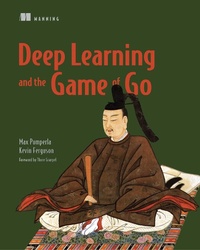
Deep Learning and the Game of Go
1st Edition
Published on 6. January 2019
384 pages
978-1-63835-401-7 (ISBN)
Description

Summary
Deep Learning and the Game of Go teaches you how to apply the power of deep learning to complex reasoning tasks by building a Go-playing AI. After exposing you to the foundations of machine and deep learning, you'll use Python to build a bot and then teach it the rules of the game.
Foreword by Thore Graepel, DeepMind
Purchase of the print book includes a free eBook in PDF, Kindle, and ePub formats from Manning Publications.
About the Technology
The ancient strategy game of Go is an incredible case study for AI. In 2016, a deep learning-based system shocked the Go world by defeating a world champion. Shortly after that, the upgraded AlphaGo Zero crushed the original bot by using deep reinforcement learning to master the game. Now, you can learn those same deep learning techniques by building your own Go bot!
About the Book
Deep Learning and the Game of Go introduces deep learning by teaching you to build a Go-winning bot. As you progress, you'll apply increasingly complex training techniques and strategies using the Python deep learning library Keras. You'll enjoy watching your bot master the game of Go, and along the way, you'll discover how to apply your new deep learning skills to a wide range of other scenarios!
What's inside
About the Reader
All you need are basic Python skills and high school-level math. No deep learning experience required.
About the Author
Max Pumperla and Kevin Ferguson are experienced deep learning specialists skilled in distributed systems and data science. Together, Max and Kevin built the open source bot BetaGo.
Table of Contents
Deep Learning and the Game of Go teaches you how to apply the power of deep learning to complex reasoning tasks by building a Go-playing AI. After exposing you to the foundations of machine and deep learning, you'll use Python to build a bot and then teach it the rules of the game.
Foreword by Thore Graepel, DeepMind
Purchase of the print book includes a free eBook in PDF, Kindle, and ePub formats from Manning Publications.
About the Technology
The ancient strategy game of Go is an incredible case study for AI. In 2016, a deep learning-based system shocked the Go world by defeating a world champion. Shortly after that, the upgraded AlphaGo Zero crushed the original bot by using deep reinforcement learning to master the game. Now, you can learn those same deep learning techniques by building your own Go bot!
About the Book
Deep Learning and the Game of Go introduces deep learning by teaching you to build a Go-winning bot. As you progress, you'll apply increasingly complex training techniques and strategies using the Python deep learning library Keras. You'll enjoy watching your bot master the game of Go, and along the way, you'll discover how to apply your new deep learning skills to a wide range of other scenarios!
What's inside
- Build and teach a self-improving game AI
- Enhance classical game AI systems with deep learning
- Implement neural networks for deep learning
About the Reader
All you need are basic Python skills and high school-level math. No deep learning experience required.
About the Author
Max Pumperla and Kevin Ferguson are experienced deep learning specialists skilled in distributed systems and data science. Together, Max and Kevin built the open source bot BetaGo.
Table of Contents
PART 1 - FOUNDATIONS
- Toward deep learning: a machine-learning introduction
- Go as a machine-learning problem
- Implementing your first Go bot
PART 2 - MACHINE LEARNING AND GAME AI
- Playing games with tree search
- Getting started with neural networks
- Designing a neural network for Go data
- Learning from data: a deep-learning bot
- Deploying bots in the wild
- Learning by practice: reinforcement learning
- Reinforcement learning with policy gradients
- Reinforcement learning with value methods
- Reinforcement learning with actor-critic methods
PART 3 - GREATER THAN THE SUM OF ITS PARTS
- AlphaGo: Bringing it all together
- AlphaGo Zero: Integrating tree search with reinforcement learning
More details
Other editions
Additional editions
Max Pumperla | Kevin Ferguson
Deep Learning and the Game of Go
Book
06/2019
Manning Publications
€51.50
Shipment within 10-20 days
Persons
Kevin Ferguson has 18 years of experience in distributed systems and data science. He is a data scientist at Honor, and has experience at companies such as Google and Meebo.
Max Pumperla is a Data Scientist and Engineer specializing in Deep Learning at the artificial intelligence company skymind.ai. He is the co-founder of the Deep Learning platform aetros.com.
Max Pumperla is a Data Scientist and Engineer specializing in Deep Learning at the artificial intelligence company skymind.ai. He is the co-founder of the Deep Learning platform aetros.com.
Content
- Intro
- Deep Learning and the Game of Go
- Max Pumperla and Kevin Ferguson
- Copyright
- Dedication
- Brief Table of Contents
- Table of Contents
- front matter
- Foreword
- Preface
- Acknowledgments
- About this book
- Who should read this book
- Roadmap
- About the code
- Book forum
- About the authors
- About the cover illustration
- Part 1. Foundations
- 1 Toward deep learning: a machine-learning introduction
- 1.1. What is machine learning?
- 1.1.1. How does machine learning relate to AI?
- 1.1.2. What you can and can't do with machine learning
- 1.2. Machine learning by example
- 1.2.1. Using machine learning in software applications
- 1.2.2. Supervised learning
- 1.2.3. Unsupervised learning
- 1.2.4. Reinforcement learning
- 1.3. Deep learning
- 1.4. What you'll learn in this book
- 1.5. Summary
- 2 Go as a machine-learning problem
- 2.1. Why games?
- 2.2. A lightning introduction to the game of Go
- 2.2.1. Understanding the board
- 2.2.2. Placing and capturing stones
- 2.2.3. Ending the game and counting
- 2.2.4. Understanding ko
- 2.3. Handicaps
- 2.4. Where to learn more
- 2.5. What can we teach a machine?
- 2.5.1. Selecting moves in the opening
- 2.5.2. Searching game states
- 2.5.3. Reducing the number of moves to consider
- 2.5.4. Evaluating game states
- 2.6. How to measure your Go AI's strength
- 2.6.1. Traditional Go ranks
- 2.6.2. Benchmarking your Go AI
- 2.7. Summary
- 3 Implementing your first Go bot
- 3.1. Representing a game of Go in Python
- 3.1.1. Implementing the Go board
- 3.1.2. Tracking connected groups of stones in Go: strings
- 3.1.3. Placing and capturing stones on a Go board
- 3.2. Capturing game state and checking for illegal moves
- 3.2.1. Self-capture
- 3.2.2. Ko
- 3.3. Ending a game
- 3.4. Creating your first bot: the weakest Go AI imaginable
- 3.5. Speeding up game play with Zobrist hashing
- 3.6. Playing against your bot
- 3.7. Summary
- Part 2. Machine learning and game AI
- 4 Playing games with tree search
- 4.1. Classifying games
- 4.2. Anticipating your opponent with minimax search
- 4.3. Solving tic-tac-toe: a minimax example
- 4.4. Reducing search space with pruning
- 4.4.1. Reducing search depth with position evaluation
- 4.4.2. Reducing search width with alpha-beta pruning
- 4.5. Evaluating game states with Monte Carlo tree search
- 4.5.1. Implementing Monte Carlo tree search in Python
- 4.5.2. How to select which branch to explore
- 4.5.3. Applying Monte Carlo tree search to Go
- 4.6. Summary
- 5 Getting started with neural networks
- 5.1. A simple use case: classifying handwritten digits
- 5.1.1. The MNIST data set of handwritten digits
- 5.1.2. MNIST data preprocessing
- 5.2. The basics of neural networks
- 5.2.1. Logistic regression as simple artificial neural network
- 5.2.2. Networks with more than one output dimension
- 5.3. Feed-forward networks
- 5.4. How good are our predictions? Loss functions and optimization
- 5.4.1. What is a loss function?
- 5.4.2. Mean squared error
- 5.4.3. Finding minima in loss functions
- 5.4.4. Gradient descent to find minima
- 5.4.5. Stochastic gradient descent for loss functions
- 5.4.6. Propagating gradients back through your network
- 5.5. Training a neural network step-by-step in Python
- 5.5.1. Neural network layers in Python
- 5.5.2. Activation layers in neural networks
- 5.5.3. Dense layers in Python as building blocks for feed-forward networks
- 5.5.4. Sequential neural networks with Python
- 5.5.5. Applying your network handwritten digit classification
- 5.6. Summary
- 6 Designing a neural network for Go data
- 6.1. Encoding a Go game position for neural networks
- 6.2. Generating tree-search games as network training data
- 6.3. Using the Keras deep-learning library
- 6.3.1. Understanding Keras design principles
- 6.3.2. Installing the Keras deep-learning library
- 6.3.3. Running a familiar first example with Keras
- 6.3.4. Go move prediction with feed-forward neural networks in Keras
- 6.4. Analyzing space with convolutional networks
- 6.4.1. What convolutions do intuitively
- 6.4.2. Building convolutional neural networks with Keras
- 6.4.3. Reducing space with pooling layers
- 6.5. Predicting Go move probabilities
- 6.5.1. Using the softmax activation function in the last layer
- 6.5.2. Cross-entropy loss for classification problems
- 6.6. Building deeper networks with dropout and rectified linear units
- 6.6.1. Dropping neurons for regularization
- 6.6.2. The rectified linear unit activation function
- 6.7. Putting it all together for a stronger Go move-prediction network
- 6.8. Summary
- 7 Learning from data: a deep-learning bot
- 7.1. Importing Go game records
- 7.1.1. The SGF file format
- 7.1.2. Downloading and replaying Go game records from KGS
- 7.2. Preparing Go data for deep learning
- 7.2.1. Replaying a Go game from an SGF record
- 7.2.2. Building a Go data processor
- 7.2.3. Building a Go data generator to load data efficiently
- 7.2.4. Parallel Go data processing and generators
- 7.3. Training a deep-learning model on human game-play data
- 7.4. Building more-realistic Go data encoders
- 7.5. Training efficiently with adaptive gradients
- 7.5.1. Decay and momentum in SGD
- 7.5.2. Optimizing neural networks with Adagrad
- 7.5.3. Refining adaptive gradients with Adadelta
- 7.6. Running your own experiments and evaluating performance
- 7.6.1. A guideline to testing architectures and hyperparameters
- 7.6.2. Evaluating performance metrics for training and test data
- 7.7. Summary
- 8 Deploying bots in the wild
- 8.1. Creating a move-prediction agent from a deep neural network
- 8.2. Serving your Go bot to a web frontend
- 8.2.1. An end-to-end Go bot example
- 8.3. Training and deploying a Go bot in the cloud
- 8.4. Talking to other bots: the Go Text Protocol
- 8.5. Competing against other bots locally
- 8.5.1. When a bot should pass or resign
- 8.5.2. Let your bot play against other Go programs
- 8.6. Deploying a Go bot to an online Go server
- 8.6.1. Registering a bot at the Online Go Server
- 8.7. Summary
- 9 Learning by practice: reinforcement learning
- 9.1. The reinforcement-learning cycle
- 9.2. What goes into experience?
- 9.3. Building an agent that can learn
- 9.3.1. Sampling from a probability distribution
- 9.3.2. Clipping a probability distribution
- 9.3.3. Initializing an agent
- 9.3.4. Loading and saving your agent from disk
- 9.3.5. Implementing move selection
- 9.4. Self-play: how a computer program practices
- 9.4.1. Representing experience data
- 9.4.2. Simulating games
- 9.5. Summary
- 10 Reinforcement learning with policy gradients
- 10.1. How random games can identify good decisions
- 10.2. Modifying neural network policies with gradient descent
- 10.3. Tips for training with self-play
- 10.3.1. Evaluating your progress
- 10.3.2. Measuring small differences in strength
- 10.3.3. Tuning a stochastic gradient descent (SGD) optimizer
- 10.4. Summary
- 11 Reinforcement learning with value methods
- 11.1. Playing games with Q-learning
- 11.2. Q-learning with Keras
- 11.2.1. Building two-input networks in Keras
- 11.2.2. Implementing the ?-greedy policy with Keras
- 11.2.3. Training an action-value function
- 11.3. Summary
- 12 Reinforcement learning with actor-critic methods
- 12.1. Advantage tells you which decisions are important
- 12.1.1. What is advantage?
- 12.1.2. Calculating advantage during self-play
- 12.2. Designing a neural network for actor-critic learning
- 12.3. Playing games with an actor-critic agent
- 12.4. Training an actor-critic agent from experience data
- 12.5. Summary
- Part 3. Greater than the sum of its parts
- 13 AlphaGo: Bringing it all together
- 13.1. Training deep neural networks for AlphaGo
- 13.1.1. Network architectures in AlphaGo
- 13.1.2. The AlphaGo board encoder
- 13.1.3. Training AlphaGo-style policy networks
- 13.2. Bootstrapping self-play from policy networks
- 13.3. Deriving a value network from self-play data
- 13.4. Better search with policy and value networks
- 13.4.1. Using neural networks to improve Monte Carlo rollouts
- 13.4.2. Tree search with a combined value function
- 13.4.3. Implementing AlphaGo's search algorithm
- 13.5. Practical considerations for training your own AlphaGo
- 13.6. Summary
- 14 AlphaGo Zero: Integrating tree search with reinforcement learning
- 14.1. Building a neural network for tree search
- 14.2. Guiding tree search with a neural network
- 14.2.1. Walking down the tree
- 14.2.2. Expanding the tree
- 14.2.3. Selecting a move
- 14.3. Training
- 14.4. Improving exploration with Dirichlet noise
- 14.5. Modern techniques for deeper neural networks
- 14.5.1. Batch normalization
- 14.5.2. Residual networks
- 14.6. Exploring additional resources
- 14.7. Wrapping up
- 14.8. Summary
- Appendix A. Mathematical foundations
- Vectors, matrices, and beyond: a linear algebra primer
- Vectors: one-dimensional data
- Matrices: two-dimensional data
- Rank 3 tensors
- Rank 4 tensors
- Calculus in five minutes: derivatives and finding maxima
- Appendix B. The backpropagation algorithm
- A bit of notation
- The backpropagation algorithm for feed-forward networks
- Backpropagation for sequential neural networks
- Backpropagation for neural networks in general
- Computational challenges with backpropagation
- Appendix C. Go programs and servers
- Go programs
- GNU Go
- Pachi
- Go servers
- OGS
- IGS
- Tygem
- Appendix D. Training and deploying bots by using Amazon Web Services
- Model training on AWS
- Hosting a bot on AWS over HTTP
- Appendix E. Submitting a bot to the Online Go Server
- Registering and activating your bot at OGS
- Testing your OGS bot locally
- Deploying your OGS bot on AWS
- Index
- List of Figures
- List of Tables
- List of Listings
