

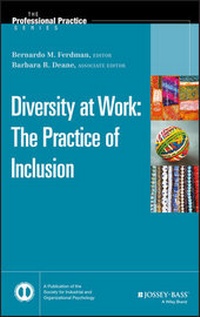
Diversity at Work
Description

More details
Other editions
Additional editions
Persons
Content
Preface
Diversity at Work: The Practice of Inclusion
Bernardo M. Ferdman and Barbara R. Deane
Much has been said and written—especially in recent years—about diversity at work. The idea that people vary on a range of identity and cultural dimensions and that this diversity matters for organizations and society is now widely accepted and discussed, not only in industrial-organizational (I-O) psychology, in human resources, in management, and in related fields, but also in the world at large.
We have learned a great deal about the role of diversity in organizations and about the interactions in the workplace among individuals and groups with different social identities and backgrounds; increasing scholarly and practical effort has been applied to describing the dynamics of these relationships and to documenting ways to manage them productively. In part, this is because intergroup relations often can be problematic; indeed, much diversity scholarship and practice has focused on the problems associated with diversity and on ways to avoid or surmount them. This has been important and generative work. In today's and tomorrow's societies and workplaces, it is imperative to reduce and prevent invidious bias and discrimination, to eliminate negative conflicts, to avoid waste, to increase fairness, and to take better advantage of all possible resources, in ways that ideally result in creativity, innovation, and better outcomes for more people, for their organizations, and for society as a whole.
Yet, working with and managing diversity in ways that are productive, healthy, growthful, and empowering—for both individuals and organizations—often remains an elusive goal. How can groups and organizations best use and benefit from the diversity that is inevitably present in and around them? What can individuals, leaders, and organizations do to work with diversity not simply as a reality that must be addressed, but rather as an opportunity and a gift? How might diversity truly be put to work on our individual and collective behalf? What can individuals, leaders, and organizations do to make this happen?
In this book, we present a fresh perspective and approach to understand and benefit from diversity. We focus on inclusion—and specifically the practice of inclusion—as a fundamental approach for benefitting from diversity, in a way that works for everyone, across multiple dimensions of difference. Inclusion involves creating, fostering, and sustaining practices and conditions that encourage and allow each of us to be fully ourselves—with our differences from and similarities to those around us—as we work together. To be inclusive, these practices and conditions should also permit and elicit everyone's full contributions to the collective (Ferdman, 2010; Ferdman & Sagiv, 2012), in a virtuous cycle that is beneficial both for individuals and the larger groups and/or organizations to which they belong (as well for their various social identity groups). The practice of inclusion is what individuals, leaders, and organizations do to bring this experience and process to life. Essentially, our claim, as documented and supported throughout this book, is that the practice of inclusion permits applying the collective wisdom regarding diversity—developed through theory, research, application, and experience—and does so in a way that focuses on recognizing and realizing the positive contributions of diversity. Rather than assuming diversity is a problem to be solved, practitioners of inclusion assume that it is a rich resource to be tapped and enjoyed.
This view is in evidence today to some degree—as seen, for example, in the typical pairing of the terms diversity and inclusion, as in Chief Diversity and Inclusion Officer, or Office of Diversity and Inclusion. But it is a perspective that evolved over time, as the field developed, and it is in many ways still in its infancy. In 1992, SIOP published Diversity in the Workplace: Human Resources Initiatives, by Susan Jackson and Associates, as the second volume of its then newly launched Professional Practice Series, in which this current volume now takes its place. Jackson's book exemplified the goal of the series, which is to provide practitioners in organizations—particularly I-O psychologists, HR professionals, managers, executives, and others who address human behavior at work—with resources, insights, information, and guidance on how to address key organizational issues by applying the best of what organizational psychology has to offer. Diversity in the Workplace combined the voices of scholars and practitioners to document effective ways to conceptualize and address the challenges of diversity. Along with other work emerging at the time (for example, Cox, 1993; Cross, Katz, Miller, & Seashore, 1994; Ferdman, 1992, 1994; Fernandez, 1991; Jamieson & O'Mara, 1991; Loden & Rosener, 1991; Morrison, 1992; Thiederman, 1990; Thomas, 1990; Thompson & DiTomaso, 1998; Triandis, Kurowski, & Gelfand, 1994) produced by both academics and practitioners, Jackson's book provided some theory and structure, grounded in psychology and related fields, for the emerging field of diversity in organizations. From an initial focus on addressing historical inequities, targeting oppression, and bringing the promise of civil rights to the workplace—with a primary emphasis on gender, race, ethnicity, and sometimes cultural and national origin, and combined with the goal of preparing for demographic shifts in the workforce and increasing globalization—the field developed to incorporate attention to reaping the potential business benefits of diversity of various types, both visible and invisible, including sexual orientation, ability status, age, social class, religion, life experience, and a myriad of other dimensions.
More than twenty years after Jackson's (1992) book, knowledge about both the role and dynamics of diversity in organizations and the practice of diversity management has dramatically developed and expanded. Many of the challenges posed by Jackson and her collaborators remain, but they are no longer seen as unusual or new—they have become part of the “normal” work of organizations. For example, recruitment, retention, and assessment that account for diversity are now focal topics in I-O psychology and human resource management, thanks in part to the efforts of pioneers such as Jackson and the contributors to her volume. At the same time, attention to diversity has become a global phenomenon, and the dimensions of diversity that matter have expanded and become more complex and nuanced. With globalization, new forms of exchange and collaboration have proliferated across cultural boundaries of all sorts. I-O psychologists and diversity practitioners are often asked to help global organizations navigate, in both broad and systematic ways, through the tensions associated with difference. Beyond addressing these tensions, professionals find themselves supporting organizations in a time of shrinking resources and great competition and must seek proactive ways to ensure that all people's contributions can be used effectively and wisely for the benefit of the organization and its many stakeholders.
Given these trends, and in line with work grounded in what has become known as positive organizational scholarship and with new insights on multiple identities and their intersections across a range of dimensions of diversity, the concept and practice of inclusion provide a frame to permit addressing the dynamics of diversity in more complex, expansive, and productive ways. Through an inclusion lens, we can continue to incorporate our prior insights regarding diversity and also highlight the practices needed so that individuals, groups, and organizations can truly benefit from that diversity. Through an inclusion lens, we can attend to the complexity of individual experience and identity, without losing sight of intergroup relations, intercultural dynamics, and systemic processes and structures.
Today, then, the cutting edge of diversity practice for organizations addresses the challenge of inclusion—the degree to which organizations and their members are able to fully connect with, engage, and utilize people across all types of differences. Diversity can provide advantages only when it is combined with fundamental changes in individual behaviors and attitudes, group norms and approaches, and organizational policies, procedures, and practices that result in people feeling appreciated, valued, safe, respected, listened to, and engaged—both as individuals and as members of multiple social identity groups. This is the work of inclusion, which is both theoretically and practically different from diversity. Inclusion is a key driver and basis for reaping diversity's potential benefits.
Nevertheless, theory and practice have not kept pace with the needs of organizations to attend to diversity and its implications, particularly in regard to inclusion, in spite of the growing use of the term. I-O psychologists, human resource professionals, managers and executives, and related practitioners need clearer guidance regarding best practices for inclusion. This book provides practitioners with an understanding of and a way to navigate the new challenges posed by the need for inclusion amidst diversity, a challenge that has yet to be taken up in a systematic way by the bulk of I-O psychologists, or with any consensual definition or approach by the bulk of practitioners. The book's key premise is that inclusion...
