

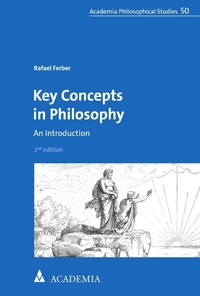
Key Concepts in Philosophy
An Introduction
2nd Edition
Published on 17. December 2020
177 pages
978-3-89665-943-9 (ISBN)
Description

Das Buch ist die überarbeitete und revidierte englische Fassung einer kleinen Denkschule für Studierende der Philosophie und interessierte Laien. Verständlich und doch anspruchsvoll führt der Autor den Leser in die Grundbegriffe "Philosophie", "Sprache", "Erkenntnis", "Wahrheit", "Sein" und "das Gute" ein. Inhalt, Methode und Anspruch der Philosophie werden so "philosophierend" nahegebracht. Einerseits eine Einführung in die Philosophie, enthält das Werk andererseits einen kohärenten Gedankengang, in dem der Autor platonische und analytische Philosophie miteinander verbindet. Die deutsche Version ist in acht Auflagen erschienen. Die neue englische Überarbeitung hat das Potenzial, ein Handbuch für ein internationales Publikum zu werden.
More details
Other editions
Additional editions
Book
01/2021
2nd Edition
academia
€26.00
Shipment within 7-9 days
Content
- Cover
- I. Philosophy
- 1. The Beginning in the Cave
- 2. Word and Concept
- 3. Philosophy and Common Sense
- 4. Philosophy, Science and Art
- 5. Philosophy as an Ideal
- II. Language
- 1. Speech as Action
- 2. Three Functions of Linguistic Action
- 3. Expression and Meaning
- 4. What Is the Meaning of an Expression?
- 5. Meaning and Rule
- III. Knowledge
- 1. Sensation and Argument
- 2. Deductive and Inductive Arguments
- 3. How Do We Justify the Conclusion of an Inductive Argument?
- 4. The Induction Principle as a Hypothetical Postulate of Practical Reason
- 5. When Are Axioms True?
- IV. Truth
- 1. The Classic Definition of Truth
- 2. Objections to the Classic Definition and Tarski's Reformulation
- 3. Five Criteria of Truth
- 4. The Surplus of the Concept of Truth in Relation to the Five Criteria
- 5. The Classic Definition as the Decisive Criterion and the Ideal
- V. Being
- 1. The Four Meanings of "is"
- 2. Real Existence and Real Facts
- 3. Physical Facts and Psychic Facts
- 4. Semantic Existence and Semantic Facts
- 5. The Being of Universals, the Being of Fictitious Things and the Being of Nothingness
- a) The Being of Universals
- b) The Being of Fictitious Things and the Being of Nothingness
- VI. Good
- 1. The Good, Morally and Extramorally
- 2. The Metaethics of Moral Good
- a) Cognitivism
- b) Emotivism
- c) Institutionalism
- 3. Normative Ethics
- a) The Concept of the Good as the Foundation of Morality
- b) The Good as Utility
- c) The Good as a Rule
- 4. Minimum and Maximum Morality
- 5. The Generalisation Rule as an Axiomatic Postulate of Practical Reason
- Bibliography
- Indexes
