

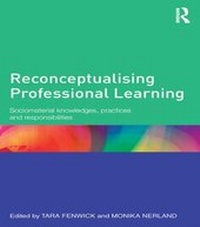
Reconceptualising Professional Learning
Sociomaterial knowledges, practices and responsibilities
1st Edition
Published on 14. March 2014
246 pages
978-1-317-80237-2 (ISBN)
Description

This book presents leading-edge perspectives and methodologies to address emerging issues of concern for professional learning in contemporary society. The conditions for professional practice and learning are changing dramatically in the wake of globalization, new modes of knowledge production, new regulatory regimes, and increased economic-political pressures. In the wake of this, a number of challenges for learning emerge:
more practitioners become involved in interprofessional collaboration
developments in new technologies and virtual workworlds
emergence of transnational knowledge cultures and interrelated circuits of knowledge.
The space and time relations in which professional practice and learning are embedded are becoming more complex, as are the epistemic underpinnings of professional work. Together these shifts bring about intersections of professional knowledge and responsibilities that call for new conceptions of professional knowing.
Exploring what the authors call sociomaterial perspectives on professional learning they argue that theories that trace not just the social but also the material aspects of practice - such as tools, technologies, texts but also bodies and actions - are useful for coming to terms with the challenges described above.
Reconceptualising Professional Learning develops these issues through specific contemporary cases focused on one of the book's three main themes: (1) professionals' knowing in practice, (2) professionals' work arrangements and technologies, or (3) professional responsibility. Each chapter draws upon innovative theory to highlight the sociomaterial webs through which professional learning may be reconceptualised. Authors are based in Australia, Canada, Italy, Norway, Sweden, and the USA as well as the UK and their cases are based in a range of professional settings including medicine, teaching, nursing, engineering, social services, the creative industries, and more.
By presenting detailed accounts of these themes from a sociomaterial perspective, the book opens new questions and methodological approaches. These can help make more visible what is often invisible in today's messy dynamics of professional learning, and point to new ways of configuring educational support and policy for professionals.
more practitioners become involved in interprofessional collaboration
developments in new technologies and virtual workworlds
emergence of transnational knowledge cultures and interrelated circuits of knowledge.
The space and time relations in which professional practice and learning are embedded are becoming more complex, as are the epistemic underpinnings of professional work. Together these shifts bring about intersections of professional knowledge and responsibilities that call for new conceptions of professional knowing.
Exploring what the authors call sociomaterial perspectives on professional learning they argue that theories that trace not just the social but also the material aspects of practice - such as tools, technologies, texts but also bodies and actions - are useful for coming to terms with the challenges described above.
Reconceptualising Professional Learning develops these issues through specific contemporary cases focused on one of the book's three main themes: (1) professionals' knowing in practice, (2) professionals' work arrangements and technologies, or (3) professional responsibility. Each chapter draws upon innovative theory to highlight the sociomaterial webs through which professional learning may be reconceptualised. Authors are based in Australia, Canada, Italy, Norway, Sweden, and the USA as well as the UK and their cases are based in a range of professional settings including medicine, teaching, nursing, engineering, social services, the creative industries, and more.
By presenting detailed accounts of these themes from a sociomaterial perspective, the book opens new questions and methodological approaches. These can help make more visible what is often invisible in today's messy dynamics of professional learning, and point to new ways of configuring educational support and policy for professionals.
More details
Language
English
Place of publication
London
United Kingdom
Publishing group
Taylor & Francis Ltd
Target group
College/higher education
Professional and scholarly
Illustrations
1 s/w Tabelle
1 Tables, black and white
File size
1,25 MB
ISBN-13
978-1-317-80237-2 (9781317802372)
Copyright in bibliographic data and cover images is held by Nielsen Book Services Limited or by the publishers or by their respective licensors: all rights reserved.
Schweitzer Classification
Other editions
Additional editions
Tara Fenwick | Monika Nerland
Reconceptualising Professional Learning
Sociomaterial knowledges, practices and responsibilities
Book
03/2014
1st Edition
Routledge
€206.40
Shipment within 15-20 days
Tara Fenwick | Monika Nerland
Reconceptualising Professional Learning
Sociomaterial knowledges, practices and responsibilities
Book
03/2014
1st Edition
Routledge
€74.50
Shipment within 15-20 days
Persons
Tara Fenwick is Professor of Education at the University of Stirling, UK and director of ProPEL, an international network for research in professional practice, education and learning.. Her most recent book is Emerging Approaches to Educational Research: tracing the sociomaterial, with R. Edwards and P. Sawchuk (Routledge 2012).
Monika Nerland is Professor of Education at the University of Oslo, Norway. She has led several research projects focusing on leraning and knowledge development in different professions. She recently co-edited the book Professional Learning in the Knowledge Society, with K. Jensen and L.C. Lahn (Sense 2012).
Monika Nerland is Professor of Education at the University of Oslo, Norway. She has led several research projects focusing on leraning and knowledge development in different professions. She recently co-edited the book Professional Learning in the Knowledge Society, with K. Jensen and L.C. Lahn (Sense 2012).
Content
Professional knowing, work arrangements and responsibility: new times, new concepts?
Tara Fenwick, University of Stirling and Monika Nerland, University of Oslo
Section1: Reconceptualising Professional Knowing
Professional knowing-in-practice: rethinking materiality and border resources in telemedicine
Silvia Gherardi, University of Trento, Italy
Learning through epistemic practices in professional work: examples from nursing and engineering
Monika Nerland and Karen Jensen, University of Oslo, Norway
The doctor and the blue form: learning professional responsibility
Miriam Zukas, Birkbeck, University of London and
Sue Kilminster, Leeds Medical Education Institute, University of Leeds
Re-thinking teacher professional learning: a more than representational account
Dianne Mulcahy, University of Melbourne, Australia
Surfacing the multiple: diffractive methods for rethinking professional practice and knowledge
Davide Nicolini and Bridget Roe, Warwick University, UK
Section II: Reconceptualising Professional Work Arrangements
Nurturing occupational expertise in the contemporary workplace: an 'apprenticeship turn' in professional learning
Alison Fuller, University of Southampton
Lorna Unwin, Institute of Education, UK
A technology shift and its challenges to professional conduct: mediated vision in endodontics
Asa Maekitalo, University of Gotenburg, Sweden
Claes Reit
Engineering knowing in the digital workplace: aligning sociality and materiality in practice
Aditya Johri, Virginia Tech University, USA
Interprofessional working and learning: a conceptualization of their relationship and its implications for education
David Guile, Institute of Education, UK
Arrangements of co-production in healthcare: partnership modes of interprofessional practice
Roger Dunston, University of Technology at Sydney, Australia
Section III: Reconceptualising Professional Responsibility
Materiality and professional responsibility
Tara Fenwick, University of Stirling, UK
Developing professional responsibility in medicine: a sociomaterial curriculum
Nick Hopwood, University of Technology at Sydney, Australia
Madeleine Abrandt Dahlgren, Linkoeping University, Sweden
Karin Siwe, Linkoeping University, Sweden
Dilemmas of responsibility for health professionals in independent practice
Sarah Wall, University of Alberta, Canada
Putting time to 'good' use in educational work: a question of responsibility
Helen Colley, Huddersfield University, UK
Lea Henriksson, University of Tampere, Finland
Beatrix Niemeyer, University of Flensburg, Germany
Terri Seddon, Monash University, Australia
Professional learning for planetary sustainability: 'thinking through country'
Margaret Somerville, University of Western Sydney
Tara Fenwick, University of Stirling and Monika Nerland, University of Oslo
Section1: Reconceptualising Professional Knowing
Professional knowing-in-practice: rethinking materiality and border resources in telemedicine
Silvia Gherardi, University of Trento, Italy
Learning through epistemic practices in professional work: examples from nursing and engineering
Monika Nerland and Karen Jensen, University of Oslo, Norway
The doctor and the blue form: learning professional responsibility
Miriam Zukas, Birkbeck, University of London and
Sue Kilminster, Leeds Medical Education Institute, University of Leeds
Re-thinking teacher professional learning: a more than representational account
Dianne Mulcahy, University of Melbourne, Australia
Surfacing the multiple: diffractive methods for rethinking professional practice and knowledge
Davide Nicolini and Bridget Roe, Warwick University, UK
Section II: Reconceptualising Professional Work Arrangements
Nurturing occupational expertise in the contemporary workplace: an 'apprenticeship turn' in professional learning
Alison Fuller, University of Southampton
Lorna Unwin, Institute of Education, UK
A technology shift and its challenges to professional conduct: mediated vision in endodontics
Asa Maekitalo, University of Gotenburg, Sweden
Claes Reit
Engineering knowing in the digital workplace: aligning sociality and materiality in practice
Aditya Johri, Virginia Tech University, USA
Interprofessional working and learning: a conceptualization of their relationship and its implications for education
David Guile, Institute of Education, UK
Arrangements of co-production in healthcare: partnership modes of interprofessional practice
Roger Dunston, University of Technology at Sydney, Australia
Section III: Reconceptualising Professional Responsibility
Materiality and professional responsibility
Tara Fenwick, University of Stirling, UK
Developing professional responsibility in medicine: a sociomaterial curriculum
Nick Hopwood, University of Technology at Sydney, Australia
Madeleine Abrandt Dahlgren, Linkoeping University, Sweden
Karin Siwe, Linkoeping University, Sweden
Dilemmas of responsibility for health professionals in independent practice
Sarah Wall, University of Alberta, Canada
Putting time to 'good' use in educational work: a question of responsibility
Helen Colley, Huddersfield University, UK
Lea Henriksson, University of Tampere, Finland
Beatrix Niemeyer, University of Flensburg, Germany
Terri Seddon, Monash University, Australia
Professional learning for planetary sustainability: 'thinking through country'
Margaret Somerville, University of Western Sydney
