

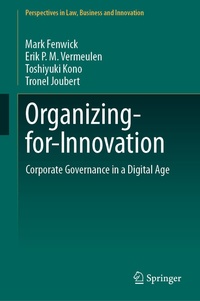
Organizing-for-Innovation
Description

This book argues that large corporations need to implement governance practices and processes that make them better innovators and that the challenge is to identify organizational principles and practices that provide the best chance of delivering innovative products to create a meaningful consumer experience. In this context, it is important to recognize that when we address organizational forms, we are not thinking of corporate governance in the sense of managing agency costs and ensuring regulatory compliance, but the more pressing business task of putting in place organizational systems and processes that facilitate value creation through continued and sustained innovation. The book examines how the contemporary concept and discourse of corporate governance may be obsolete or, at least, is increasingly disconnected from the needs and realities of the most innovative firms today. The concept of organizing for innovation-identifying process and practices that deliver the best opportunities for innovation-needs to take centre stage. This book aims to contribute to the nascent debate in this area by bringing together a series of chapters that examine various issues related to organizing for innovation.
More details
Other editions
Additional editions
Persons
Mark Fenwick is a professor at the Graduate School of Law, Kyushu University, Fukuoka, Japan.
Erik P. M. Vermeulen is a professor at the Department of Private, Business and Labour Law, Tilburg University, Tilburg, the Netherlands; Legal Department, Signify (formerly Philips Lightening), Amsterdam, the Netherlands.
Toshiyuki Kono is a trustee and executive vice-president, Kyushu University, Fukuoka, Japan.
Tronel Joubert is a lecturer at the Department of Private, Business and Labour Law, Tilburg University, Tilburg, the Netherlands.
Content
Organizing-for-innovation.- The board of directors as a missed opportunity.- Mobilizing institutional investors.- Corporate venturing strategies to foster innovation.- Corporate governance and new technology.- Blockchain and the disruption of the corporation.- The future of the corporation.- Regulation tomorrow.
