

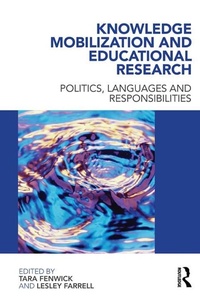
Knowledge Mobilization and Educational Research
Politics, languages and responsibilities
1st Edition
Published on 18. August 2011
264 pages
978-1-136-72933-1 (ISBN)
Description

How can educational research have more impact? What processes of knowledge exchange are most effective for increasing the uses of research results? How can research-produced knowledge be better 'mobilized' among users such as practicing educators, policy makers, and the public communities?
These sorts of questions are commanding urgent attention in educational discourses and research policies now circulating around the world. This attention has been translated into powerful material exercises that shape what is considered to be worthwhile research and how research is funded, recognized, and assessed. Yet precisely what activities constitute effective knowledge mobilization, or even what is meant by 'moving knowledge', remains unclear. What politics are at play in determining knowledge 'impact' across radically different contexts? Who determines what counts as impact, and for what purposes? How are 'results' of educational research separated from its participants and processes? In addition knowledge mobilization also invokes debates about the languages through which knowledge is constructed, policy processes are enacted, and research unfolds.
This volume is unique in bringing together these wide-ranging issues of knowledge mobilization in education. The volume editors critically analyse these complex issues and also describe various efforts of knowledge mobilization and their effects. While the contributors themselves speak from diverse material, occupational and theoretical locations. Leading scholars in Canada, the US, the UK, and Australia bring disciplinary perspectives from law, digital media studies, museum studies, journalism and policy-making as well as fields of education. Some speak from Anglo-'Western' perspectives but others such as Phan Le Ha (Vietnamese), Rui Yang (Chinese) and Dolores van der Wey (Haida/West Coat Salish First Nations) speak from Asian, Indigenous and diasporic locations.
These sorts of questions are commanding urgent attention in educational discourses and research policies now circulating around the world. This attention has been translated into powerful material exercises that shape what is considered to be worthwhile research and how research is funded, recognized, and assessed. Yet precisely what activities constitute effective knowledge mobilization, or even what is meant by 'moving knowledge', remains unclear. What politics are at play in determining knowledge 'impact' across radically different contexts? Who determines what counts as impact, and for what purposes? How are 'results' of educational research separated from its participants and processes? In addition knowledge mobilization also invokes debates about the languages through which knowledge is constructed, policy processes are enacted, and research unfolds.
This volume is unique in bringing together these wide-ranging issues of knowledge mobilization in education. The volume editors critically analyse these complex issues and also describe various efforts of knowledge mobilization and their effects. While the contributors themselves speak from diverse material, occupational and theoretical locations. Leading scholars in Canada, the US, the UK, and Australia bring disciplinary perspectives from law, digital media studies, museum studies, journalism and policy-making as well as fields of education. Some speak from Anglo-'Western' perspectives but others such as Phan Le Ha (Vietnamese), Rui Yang (Chinese) and Dolores van der Wey (Haida/West Coat Salish First Nations) speak from Asian, Indigenous and diasporic locations.
More details
Language
English
Place of publication
London
United Kingdom
Publishing group
Taylor & Francis Ltd
Target group
College/higher education
Professional and scholarly
Product notice
Reflowable
Illustrations
4 s/w Abbildungen
4 Illustrations, black and white
File size
3,40 MB
ISBN-13
978-1-136-72933-1 (9781136729331)
Copyright in bibliographic data and cover images is held by Nielsen Book Services Limited or by the publishers or by their respective licensors: all rights reserved.
Schweitzer Classification
Other editions
Additional editions
Tara Fenwick | Lesley Farrell
Knowledge Mobilization and Educational Research
Politics, languages and responsibilities
Book
08/2011
1st Edition
Routledge
€262.20
Shipment within 15-20 days
Tara Fenwick | Lesley Farrell
Knowledge Mobilization and Educational Research
Politics, languages and responsibilities
Book
08/2011
1st Edition
Routledge
€74.60
Shipment within 15-20 days
Persons
Tara Fenwick is Professor of Education at the School of Education, University of Stirling in Scotland.
Lesley Farrell is Professor and Associate Dean of Research and Development in the Faculty of Arts and Social Sciences, University of Technology, Sydney, Australia.
Lesley Farrell is Professor and Associate Dean of Research and Development in the Faculty of Arts and Social Sciences, University of Technology, Sydney, Australia.
Content
Introduction: Knowledge mobilization: The new research imperative Part 1: Considering the Issues and Players 1. Theory, Research and Practice in Mobilizing Research Knowledge in Education 2. Exploring Strategies for Impact: Riding the Wave with the TLRP 3. 'User Engagement' and the Processes of Educational Research Part 2: Politics in Knowledge Flows: Research Meets Policy 4. Affairs of the Smart: How Researchers and Decision-makers Became Bedfellows in Education 5. Knowledge Stocks and Flows: Research Meets Policy 6. Art, Community and Knowledge Flows 7. Fighting for the Role of the Nation State in Knowledge Mobilisation and Educational Research: An Autoethnography of a Mobile Vietnamese Scholar Part 3: Languages and Enactments of Knowledge Mobilization 8. Finding Common Perspectives: Knowledge Mobilization in a Transnational Museum Project 9. Bridging Journalistic-Academic Divides to Promote Democratic Dialogue and Debate 10. Ethics and Experimennts with Art in Mobilizing Educational Research 11. Balancing Knowledge Management and Knowledge Mobility in the University Part 4: Responsibilities and Rights in Mobilizing Knowledge 12. Regulating Knowledge in the Global Knowledge Economy 13. Scholarly Publishing, Knowledge Mobility and Internationalisation of Chinese Universities 14. Explicating a Shared Truth about a Colonial Past: Knowledge Mobilization, Coalition Building, Aboriginal Literature and Pedagogy 15. Deparochializing Educational Research; Three Critical Illustrative Narratives
