

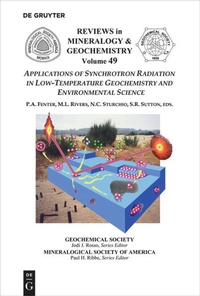
Applications of Synchrotron Radiation in Low-Temperature Geochemistry and Environmental Science
Description

Volume 49 of Reviews in Mineralogy and Geochemistry reviews the state of the art of synchrotron radiation applications in low temperature geochemistry and environmental science, and offer speculations on future developments. The reader of this volume will acquire an appreciation of the theory and applications of synchrotron radiation in low temperature geochemistry and environmental science, as well as the significant advances that have been made in this area in the past two decades.
It gives a fairly comprehensive overview of synchrotron radiation applications in low temperature geochemistry and environmental science, describes the ways that synchrotron radiation is generated, including a history of synchrotrons and a discussion of aspects of synchrotron radiation that are important to the experimentalist, describes specific synchrotron methods that are most useful for single-crystal surface and mineral-fluid interface studies as well as methods that can be used more generally for investigating complex polyphase fine-grained or amorphous materials, including soils, rocks, and organic matter.
More details
Other editions
Additional editions
Persons
Paul A. Fenter
, Argonne, Illinois, USA;
Mark L. Rivers
;
Neil C. Sturchio
and
Stephen R. Sutton
, Chicago, Illinois, USA.
Content
- Intro
- COPYRIGHT
- REVIEWS
- DEDICATION
- FOREWORD
- PREFACE AND ACKNOWLEDGMENTS
- THE AUTHORS
- Table of Contents
- 1. An Overview of Synchrotron Radiation Applications to Low Temperature Geochemistry and Environmental Science
- 2. A Brief Overview of Synchrotron Radiation
- 3. X-ray Reflectivity as a Probe of Mineral-Fluid Interfaces: A User Guide
- 4. X-ray Standing Wave Studies of Minerals and Mineral Surfaces: Principles and Applications
- 5. Grazing-incidence X-ray Absorption and Emission Spectroscopy
- 6. Applications of Storage Ring Infrared Spectromicroscopy and Reflection-Absorption Spectroscopy to Geochemistry and Environmental Science
- 7. Quantitative Speciation of Heavy Metals in Soils and Sediments by Synchrotron X-ray Techniques
- 8. Microfluorescence and Microtomography Analyses of Heterogeneous Earth and Environmental Materials
- 9. Soft X-ray Spectroscopy and Spectromicroscopy Studies of Organic Molecules in the Environment
