

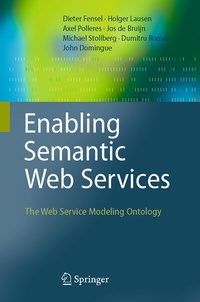
Enabling Semantic Web Services
Description

Service-oriented computing has become one of the predominant factors in current IT research and development. Web services seem to be the middleware solution of the future for highly interoperable distributed software solutions. In parallel, research on the Semantic Web provides the results required to exploit distributed machine-processable data. To combine these two research lines into industrial-strength applications, a number of research projects have been set up by organizations like W3C and the EU.
Dieter Fensel and his coauthors deliver a profound introduction into one of the most promising approaches - the Web Service Modeling Ontology (WSMO). After a brief presentation of the underlying basic technologies and standards of the World Wide Web, the Semantic Web, and Web Services, they detail all the elements of WSMO from basic concepts to possible applications in e-commerce, e-government and e-banking, and they also describe its relation to other approaches like OWL-S or WSDL-S.
While many of the related technologies and standards are still under development, this book already offers both a broad conceptual introduction and lots of pointers to future application scenarios for researchers in academia and industry as well as for developers of distributed Web applications.
Reviews / Votes
From the reviews:
"This book presents a description of the major ideas in this stream of development, and a technically detailed description of the emerging technologies and tools. . The book is a very accessible treatment of this material, intended for readers from a variety of backgrounds." (D. I. Barnard, Computing Reviews, January, 2008)
More details
Other editions
Additional editions
Persons
Prof. Dr. Dieter Fensel is the scientific director of the Digital Enterprise Research Institute (DERI). His current research interests include Ontologies, Semantic Web, Web Services, Knowledge Management, Enterprise Application Integration, and Electronic Commerce. He has been involved in several national and international research projects, for example, in the IST projects DIP, IBROW, Knowledge Web, On-To-Knowledge, Ontoweb, SWWS, and Wonderweb. He is the project coordinator of dip, Knowledge Web, Ontoknowledge, Ontoweb, and SWWS. He published around 150 papers as books and journals, book, conference, and workshop contributions and won the Carl-Adam-Petri-Award of the Faculty of Economic Sciences from the University of Karlsruhe, Germany (2000).
