

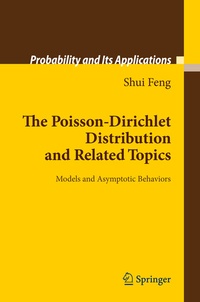
The Poisson-Dirichlet Distribution and Related Topics
Models and Asymptotic Behaviors
1st Edition
Published on 27. May 2010
XIV, 218 pages
978-3-642-11194-5 (ISBN)
Description

Shui Feng is a Professor of Mathematics and Statistics at McMaster University, Canada. His research is in the broad area of stochastic processes and limit theorems, with particular interests in stochastic models in population genetics, finance, and statistical physics. He is the co-editor of one book and the author of more than 30 research papers.
Reviews / Votes
From the reviews:
"The intended audience of this book includes researchers and graduate students in probability, population genetics and statistics. Most material in the book is self-contained and should be accessible to anyone with a graduate level knowledge of probability theory. . this book provides useful connections to mathematical population genetics and many advanced probabilistic applications." (Wenbo V. Li, Mathematical Reviews, Issue 2012 c)More details
Other editions
Additional editions
Book
06/2010
Springer
€53.49
Shipment within 7-9 days
Person
Shui Feng is a Professor of Mathematics and Statistics at McMaster University, Canada. His research is in the broad area of stochastic processes and limit theorems, with particular interests in stochastic models in population genetics, finance, and statistical physics. He is the co-editor of one book and the author of more than 30 research papers.
Content
Models.- The Poisson-Dirichlet Distribution.- The Two-Parameter Poisson-Dirichlet Distribution.- The Coalescent.- Stochastic Dynamics.- Particle Representation.- Asymptotic Behaviors.- Fluctuation Theorems.- Large Deviations for the Poisson-Dirichlet Distribution.- Large Deviations for the Dirichlet Processes.
"Chapter 1 Introduction (p. 3-4)
In this chapter, we introduce several basic models in population genetics including the Wright–Fisher model, the Moran model, and the corresponding diffusion approximations. The Dirichlet distribution is introduced as the reversible measure of the corresponding diffusion processes. Its connection to the gamma distribution is explored. These will provide the necessary intuition and motivation for the Poisson– Dirichlet distribution and other sophisticated models considered in subsequent chapters.
1.1 Discrete Models
We begin this section with a brief introduction of the genetic terminology used throughout the book.
1.1.1 Genetic Background
All living organisms inherit biological characteristics from their parents. The characteristics that can be inherited are called the genetic information. Genetics is concerned with the study of heredity and variation. Inside each cell of an organism, there is a fixed number of chromosomes, which are threadlike objects, each containing a single, long molecule called DNA (deoxyribonucleic acid). Each DNA molecule is composed of two strands of nucleotides in which the sugar is deoxyribose and the bases are adenine (A), cytosine (C), guanine (G), and thymine (T).
Linked by hydrogen bonds with A paired with T, and G paired with C, the two strands are coiled around to form the famous double helix structure discovered by Watson and Crick in 1953. These DNA molecules are responsible for the storage and inheritance of genetic information. A gene is a hereditary unit composed of a portion of DNA. The place that a gene resides on a chromosome is called a locus (loci in plural form). Different forms of a gene are called alleles.
An example is the ABO blood group locus, admitting three alleles, A, B, and O. The complete set of genetic information of an organism is called a genome. An organism is called haploid if there is only one set of chromosomes; if chromosomes appear in pairs, the organism is diploid. The set of chromosomes in a polyploid organism is at least tripled. Bacteria and fungi are generally haploid organisms, whereas most higher organisms such as mammals are diploid.
Human diploid cells have 46 (or 23 pairs) chromosomes and human haploid gametes (egg and sperm) each have 23 chromosomes. Bread wheat and canola have six and four sets of chromosomes, respectively. The genotype of an individual at a particular locus is the set of allele(s) presented. For a diploid individual, this is an unordered pair of alleles (one on each chromosome). A diploid individual is homozygous (heterozygous) at a particular locus if the corresponding genotype consists of two identical alleles (different alleles). A phenotype of an organism is any observable characteristic. Phenotypes are determined by an organism’s genotypes and the interaction of the genotypes with the environment."
In this chapter, we introduce several basic models in population genetics including the Wright–Fisher model, the Moran model, and the corresponding diffusion approximations. The Dirichlet distribution is introduced as the reversible measure of the corresponding diffusion processes. Its connection to the gamma distribution is explored. These will provide the necessary intuition and motivation for the Poisson– Dirichlet distribution and other sophisticated models considered in subsequent chapters.
1.1 Discrete Models
We begin this section with a brief introduction of the genetic terminology used throughout the book.
1.1.1 Genetic Background
All living organisms inherit biological characteristics from their parents. The characteristics that can be inherited are called the genetic information. Genetics is concerned with the study of heredity and variation. Inside each cell of an organism, there is a fixed number of chromosomes, which are threadlike objects, each containing a single, long molecule called DNA (deoxyribonucleic acid). Each DNA molecule is composed of two strands of nucleotides in which the sugar is deoxyribose and the bases are adenine (A), cytosine (C), guanine (G), and thymine (T).
Linked by hydrogen bonds with A paired with T, and G paired with C, the two strands are coiled around to form the famous double helix structure discovered by Watson and Crick in 1953. These DNA molecules are responsible for the storage and inheritance of genetic information. A gene is a hereditary unit composed of a portion of DNA. The place that a gene resides on a chromosome is called a locus (loci in plural form). Different forms of a gene are called alleles.
An example is the ABO blood group locus, admitting three alleles, A, B, and O. The complete set of genetic information of an organism is called a genome. An organism is called haploid if there is only one set of chromosomes; if chromosomes appear in pairs, the organism is diploid. The set of chromosomes in a polyploid organism is at least tripled. Bacteria and fungi are generally haploid organisms, whereas most higher organisms such as mammals are diploid.
Human diploid cells have 46 (or 23 pairs) chromosomes and human haploid gametes (egg and sperm) each have 23 chromosomes. Bread wheat and canola have six and four sets of chromosomes, respectively. The genotype of an individual at a particular locus is the set of allele(s) presented. For a diploid individual, this is an unordered pair of alleles (one on each chromosome). A diploid individual is homozygous (heterozygous) at a particular locus if the corresponding genotype consists of two identical alleles (different alleles). A phenotype of an organism is any observable characteristic. Phenotypes are determined by an organism’s genotypes and the interaction of the genotypes with the environment."
