

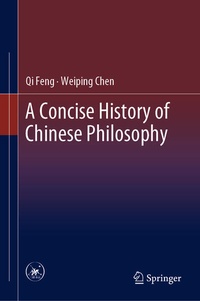
A Concise History of Chinese Philosophy
Description

This book is an abridged version of Feng Qi's two major works on the history of philosophy, The Logical Development of Ancient Chinese Philosophy and The Revolutionary Course of Modern Chinese Philosophy . It is a comprehensive history of Chinese philosophy taking the reader from ancient times to the year 1949.
It illuminates the characteristics of traditional Chinese philosophy from the broader vantage point of epistemology. The book revolves around important debates including those on "Heaven and humankind" ( tian ren ??), "names and actualities" ( mingshi ??), "principle and vital force" ( liqi ??), "the Way and visible things" ( daoqi ??), "mind and matter/things" ( xinwu ??), and "knowledge and action" ( zhixing ??). Through discussion of these debates, the course of Chinese philosophy unfolds.
Modern Chinese philosophy has made landmark achievements in the development of historical and epistemological theory,namely the "dynamic and revolutionary theory of reflection". However, modern Chinese philosophy is yet to construct a systematic overview of logic and methodology, as well as questions of human freedom and ideals. Amid this discussion, the question of how contemporary China is to "take the baton" from the thinkers of the modern philosophical revolution is addressed.More details
Other editions
Additional editions
Persons
Feng Qi (1915-1995) is a prestigious Modern Chinese philosopher and historian of philosophy. He was the founder of the Department of Philosophy, East China Normal University, Shanghai. He firmly believed that "one should keep one's mind free regardless of the circumstances." He devoted his life to the enduring question of how to transform knowledge into wisdom, and tried to resolve the question by constructing what he called "epistemology in a broad sense."
Feng Qi's original philosophical thinking is compiled in his "Three Treatises on Wisdom" (including Knowing the World and Knowing Oneself, The Dialectics of Logical Thinking, and The Good, the True, and the Beautiful: Contexts of Human Freedom, and his two works on the history of Chinese philosophy, including The Logical Development of Ancient Chinese Philosophy and The Revolutionary Course of Modern Chinese Philosophy. Feng Qi's theory of wisdom comprehensively brings together Marxist, Chinese, and Western philosophy in his search for the values of truth, goodness, and beauty. His thought aligns philosophy with the ultimate aspirations of humankind. His theory of wisdom has been an important source for the study of Chinese philosophy and attracted international attention over the past 20 years.
Chen Weiping , a professor at the Department of Philosophy, East China Normal University. He is well-known and influential for his study of Chinese philosophy, especially the history of modern and contemporary Chinese philosophy. As a disciple of Feng Qi, he is one of the philosophers who know Feng Qi's theory best. Feng Qi was quite satisfied with this abridged version of his history of Chinese philosophy, just as he says in the "Preface": "Chen Weiping's abridgement is faithful to the original and creatively done. He has for many years been teaching and doing research in the history of Chinese philosophy, and his own insights are quite naturally reflected in the present abridgement, adding to its special character."
