

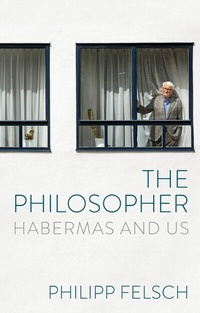
The Philosopher
Description

Jürgen Habermas is the voice of a generation. One of the world's most influential philosophers and Germany's greatest living intellectual, he has shaped debates, both academic and public, for more than half a century. For as long as the cultural historian Philipp Felsch can remember, Habermas has been around: as an admonishing voice of reason, as the moral conscience of post-Holocaust German society, as the son of his grandparents' neighbours in Gummersbach. Is the philosopher's intellectual supremacy coming to an end today, or are his ideas gaining new relevance in the crisis times in which we now find ourselves?
To answer this question, Felsch plunged anew into Habermas's voluminous work and travelled to his home to talk with him over tea and cake about the concerns that have motivated him, the people who have influenced him and the controversies in which he has been involved. Can the ideas that the philosopher has championed throughout his career - universalism, reason, dialogue - be of any help to us now as we face the major challenges of the twenty-first century?
This compelling account of a strikingly original thinker is also a portrait of an epoch that bears his imprint and a glimpse of a future we could embrace.
More details
Other editions
Additional editions
Persons
Translated by Tony Crawford.
Content
In the Upside-down World
Perpetrators and Victims
Farewell to Profundity
The Consciousness of the Present
The Centre Does Not Hold
Running the Gauntlet in Frankfurt
Rocket Science for a Better Society
What We Must Presuppose
The Stigma of the Spoken
Uncanny Germany
Theory of the Loss of Meaning
Was That Really Necessary?
Taxonomy of the Counter-Enlightenment
Distance and Thymos
J'accuse
Back from the Future
History and Memory
Stirrings of Postnational Feeling
The Primacy of Global Domestic Politics
On War
The Philosopher of the Universal Provinces
Acknowledgements
Bibliography
Notes
An Afternoon in Starnberg
It looks as though my forty-minute train ride from Munich's main station has brought me to Long Island: the modernistic bungalow overlooking a wooded slope would be more at home in the Hamptons than in upper Bavaria. The owner of the house looks American to me too, coming to the door in his chinos and brand-new Reeboks.
In spite of his age, Jürgen Habermas makes a slim, sprightly impression. I can't deny feeling a certain awe in his presence. This man in trainers worked closely with Adorno, conversed with Hannah Arendt in New York and Michel Foucault in Paris - and is himself the author of a monumental philosophical oeuvre. And not only that: even now, seventy years after he entered the German public sphere in the early 1950s, his influence still seems to be tangible in every debate. His political positions with regard to Germany's history continue to influence German commemorative culture. Whether he weighs in on digital media, the Ukraine war or the crisis in the Middle East, he can be sure of national - even international - attention. At over ninety! If they had lived as long, Foucault would have interpreted the election of Donald Trump, Hannah Arendt would have analysed 9/11 and Adorno would have commented on Oliver Bierhoff's golden goal in the 1996 European Championship. In spite of his status as an old white man, Habermas still seems to be indispensable. It is as if what Chancellor Olaf Scholz has named our Zeitenwende - the disturbing break with long-cherished beliefs - calls more than anything for a re-examination of his work.
Habermas has been around for as long as I can remember - but as someone I acknowledged more or less out of duty, and whose ideas I received mostly second-hand, and preferably from the point of view of his opponents. Today, that strikes me as negligent. Hadn't he been an indispensable point of reference in my own intellectual development? Hadn't he influenced, as no other, the political discourse of West Germany? What does the passing of the world of yesteryear mean for his legacy? Will Germany be a different country without him?
Although people told me he hardly ever received visitors any more, he immediately answered my written request to talk to him with an invitation to come to Starnberg. Because he no longer travelled, he wrote, he was leaving the date and time up to me. On this Friday afternoon in early June 2022 in Bavaria, the heat feels more like August. A joint search for a vase for the flowers I bought at the train station helps me over my initial timidity. While making tea, Habermas apologizes for the fact that the chocolate marble cake he bought for our meeting is cut too thick.
His unusual-sounding name has been a familiar one to me since my childhood. The Habermas family lived diagonally across from my grandparents in Gummersbach, in a neighbourhood of single-family homes with generous gardens just outside the zone of the 1950s housing estates. Their name was part of the vocabulary of our visits to Gummersbach - just like that of the Bergmanns, whom my grandparents visited to watch television before they could afford their own set; like Adamek's, the grocery shop around the corner, and like Magerquark, the low-fat cheese curd that my digestively impaired grandfather spread on his bread. The Habermases too were part of my grandparents' loose-knit neighbourhood network. I remember that my grandmother used to have coffee once in a while with old Mrs Habermas, whose husband had died in the early 1970s, and on one of those occasions - a birthday party, I believe - she also met Mrs Habermas's famous son.
Habermas's reaction to my memories of Gummersbach is reserved - he almost seems embarrassed. He left the town right after finishing school, he says. And because his parents hadn't moved to that house until the 1950s, he only knew it from his sporadic visits. The rather distant relationship to his family of origin seems to be a characteristic of West Germany's postwar generations in general. By this time, he has led me into the living room, where we take seats in the corner with the sofa whose light wool tones have long since entered the iconography of West German intellectual history as the 'communicative epicentre' of the Habermas home. On this sofa, beneath the abstract colour fields of a Günter Fruhtrunk painting titled 'Wiesengrund Daydream' after Theodor Wiesengrund Adorno, which a clueless critic in the 1970s thought must be a landscape, the philosopher of the relations of communication has been photographed at least as often as in front of the obligatory wall-to-wall bookshelves. This is where he has had discussions with many great minds, artists and prominent politicians, including Herbert Marcuse, Wolf Biermann and half the leadership of the Social Democratic Party - a circumstance that heightens my sensation of how unpretentious the atmosphere is. I try to imagine the ceremony that a visit to Jacques Derrida or Peter Sloterdijk might have involved. In the Habermas house, in any case, everything exudes a cultivated normalcy. His wife Ute joins us after a while. With tea and marble cake, with her husband's barely perceptible accent of the area east of Cologne in my ears, I experience my second epiphany of this afternoon: on my arrival, Habermas had looked to me like an American; now I have a momentary déjà vu of those visits to my grandparents in Gummersbach.1
Of course, my grandparents' living room would have been dominated by genre paintings in oil and by the dark brown tones and rounded corners of 1950s middle-class nostalgia. Here, on the contrary, is the bright sobriety of postwar modernism - although its austerity is checked by the comfortable sofa group and an antique here and there. The avant-garde of 1960s Critical Theory had at least found living in the new buildings of the ribbon developments, exposed to the brutal inhospitality of the rebuilt cities, conducive to the cultivation of true class consciousness. The fact that Habermas fulfilled his dream of homeownership here, in this idyllic environment, was seen by his contemporaries in the early 1970s as a symbolic act announcing the end of an era. 'Style is lived behaviour', he wrote with regard to Heidegger, who had allowed a photographer to shoot an exclusive photo essay in his Black Forest cabin in 1966. Ten years later, Habermas allowed Barbara Klemm to take portrait photos of him in his house. Was homeowners' philosophy coming into its own? From the 1970s, Habermas's letters were sent from house to house - to Martin Walser, Niklas Luhmann, friends and colleagues sitting in their single-family homes in other corners of West Germany. Was this the only appropriate form of housing for the poets and philosophers of a country whose new urban fringe developments had resolved the historic conflict between the metropolis and the provinces?2
While I hasten to steer the conversation away from Gummersbach and my grandparents, and towards the questions that actually brought me here, the scene is disturbed by the muffled rumble of a lawnmower. Those who grew up in the time before leaf blowers came along inevitably associate this noise with the atmosphere of lazy, uneventful summer afternoons. Like the aroma of the famous madeleine that Proust dipped in his tea, it makes my observations of the past hour suddenly crystallize into a whole gestalt. In the 1990s, after German reunification, when many of his colleagues were indulging in fantasies of Germany's new prestige in the world, Habermas had insisted that he wished to remain the citizen of a 'universal-provincial country'.3 Here, in his sober, comfortable living room, this phrase suddenly becomes intuitively obvious: the mixture of worldliness and provincialism - the Hamptons and Gummersbach; the constellation of lawnmower, mid-century and marble cake - reveals its secret significance: it is symbolic of the old West Germany.
I never would have dreamed that I would one day be sitting with Habermas in his living room. In the 1990s during my studies, when his name crossed my path for the second time, the lines were clearly drawn: Habermas had called my favourite authors of the time, the French philosophers, 'young conservatives', classing them with people like Helmut Kohl and Arnold Gehlen - an offence that some of the French had repaid with outrage and others with indifference. At a chilly dinner in the spring of 1983, when Habermas was teaching at the Collège de France in Paris, Michel Foucault is said to have asked, with his characteristic shark's smile, whether Habermas considered him an anarchist. According to the historian and Foucault translator Ulrich Raulff, he probably would have taken an affirmative answer 'as a compliment'. For my part, I considered Habermas hopelessly fixated, to my existentialist political mind, on the structure of our institutions and their legitimacy. Gilles Deleuze's cutting reference to the 'bureaucrats of pure reason', the ivy-covered administrators of philosophy, seemed to be tailored to him. The Byzantine architecture of his theory was supposed to reunite the True and the Good (if not necessarily the Beautiful), as Hegel's once had done. But when it came to academic styles, I preferred that of his domestic rival Luhmann, who stood for a leaner, meaner way of thinking - with no mercy towards 'neat,...
