

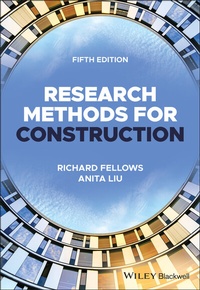
Research Methods for Construction
Description

Research Methods for Construction is designed to help construction students develop the research skills needed to achieve success in their research projects. Providing clear guidance on research formulation, methodologies, and methods, this comprehensive textbook addresses the theoretical, philosophical, and practical aspects of research in many areas of construction. The authors explain the requirements for data and analysis and describe the methods used for scientific and engineering experiments, modelling and simulations, research on management and socio-economic issues, and more.
Now in its fifth edition, Research Methods for Construction is fully revised to reflect contemporary developments and emerging areas of construction research. New and expanded chapters cover topics including data protection and ethics, theory borrowing, sensemaking, and directionally motivated reasoning. This edition includes additional models and details relating to translation, and offers fresh discussion of axiology, determinism, and stochasticism. Providing students with coherent, well-structured account of construction research, this market-leading textbook:
* Emphasizes and instils rigor into construction students' problem-solving, reports, and publications
* Assists researchers in selecting appropriate methods to execute research
* Articulates the stages of construction research processes: producing a proposal, executing the research, and reporting the results
* Examines qualitative and quantitative approaches and statistical considerations for a wide range of construction research
* Discusses current ethical, legal, and regulatory issues pertaining to research in construction
The fifth edition of Research Methods for Construction is the ideal textbook for advanced undergraduate and postgraduate students embarking on a research project, at bachelors, masters or doctoral level, in construction, surveying, architecture, civil engineering, and other built environment disciplines.
More details
Other editions
Additional editions
Persons
Richard Fellows is Emeritus Professor of Construction Business Management, Loughborough University, UK. He is an experienced quantity surveyor and in his academic career has taught at several universities in the UK and other countries. His research interests concern economics, contracts and law, and the management of people in construction - especially cultural issues as drivers of behaviour and performance. He was a founder and for many years was joint coordinator of the CIB group, W112 - Culture in Construction. Richard is an editor of a leading construction journal and frequent reviewer of papers for international conferences and journals.
Anita Liu graduated from the University of Reading and returned to Hong Kong to work in a quantity surveying consultancy, for the Hong Kong government, and for a major contractor. She then moved into academia, obtaining an MSc and a PhD from the University of Hong Kong. She became Chair Professor of Commercial Management and Quantity Surveying at Loughborough University and subsequently Head of Department and Professor in the Department of Real Estate and Construction at The University of Hong Kong. She was also joint co-coordinator of CIB group W112: Culture in Construction.
Content
Contents
About the Authors ix
Preface to the Fifth Edition xi
Part 1 Producing a Proposal 1
1 Introduction 3
1.1 The concept of research 3
1.1.1 Research: a careful search/investigation 4
1.1.2 Research: contribution to knowledge 4
1.1.3 A learning process 6
1.1.4 Contextual factors affecting research 6
1.2 Classifications of research 7
1.2.1 Pure and applied research 7
1.2.2 Quantitative and qualitative research 8
1.2.3 Other categories of research 11
1.3 Theories and paradigms 12
1.3.1 Development of knowledge 13
1.3.2 Testing a theory 16
1.3.3 Paradigms 19
1.3.4 Positivism 20
1.3.5 Interpretivism 21
1.3.6 Pragmatism 23
1.3.7 Models and hypotheses 23
1.4 Research styles 25
1.4.1 Action research 25
1.4.2 Ethnographic research 26
1.4.3 Surveys 27
1.4.4 Case studies 28
1.4.5 Experiments 29
1.5 Quantitative and qualitative approaches 31
1.5.1 Quantitative approaches 32
1.5.2 Qualitative approaches 32
1.5.3 Triangulated studies 32
1.5.4 Data sources 33
1.6 Where to begin 35
1.7 Summary 36
References 37
2 Topic for Study 41
2.1 Selection of a topic 41
2.1.1 Resources 41
2.1.2 Subject selection 43
2.1.3 Choosing a topic 46
2.1.4 Evaluating alternatives 46
2.1.5 Refining a topic 47
2.2 Writing the proposal 48
2.2.1 Aim 49
2.2.2 Proposition 49
2.2.3 Objectives 50
2.2.4 Hypotheses 51
2.2.5 Methodology and methods 53
2.2.6 Programme 55
2.2.7 Deliverables and industrial or practitioner support 55
2.3 Summary 56
References 56
Part 2 Executing the Research 59
3 Initial Research 61
3.1 The research process 61
3.1.1 Initial phase 64
3.1.2 Data and information 66
3.1.3 Dynamic process 68
3.2 Initial search 69
3.2.1 Definitions and assumptions 71
3.2.2 Theory and literature reviews 71
3.2.3 Analysing data from a search 72
3.3 Literature based discovery 75
3.4 Assembling the theoretical framework 76
3.4.1 Theory borrowing 79
3.4.2 Theorising 83
3.5 Philosophy and paradigms 84
3.5.1 Ontology, epistemology, and axiology 86
3.5.2 Positivism 88
3.5.3 Realism 89
3.5.4 Interpretivism 91
3.5.5 Constructivism 92
3.5.6 Phenomenalism 93
3.5.7 Postmodernism 95
3.5.8 Pragmatism 96
3.6 Fuzzy thinking 96
3.7 Theoretical models and constructs 97
3.7.1 Theoretical model 98
3.7.2 Constructs 100
3.8 Proper referencing 101
3.9 Summary 103
Notes 104
References 104
4 Approaches to Empirical Work 110
4.1 Starting data collection 110
4.2 Experience 111
4.3 Reasoning and inference 112
4.3.1 Sensemaking 114
4.3.2 Motivated reasoning 115
4.3.3 Determinism and stochasticism 117
4.3.4 Complexity 119
4.4 Systems of methods 122
4.5 Research design 123
4.5.1 Context 126
4.5.2 Variance and errors 126
4.5.3 Empiricism, rationalism, and verification 127
4.6 Qualitative and quantitative approaches 129
4.6.1 When are qualitative approaches employed? 130
4.6.2 When are quantitative approaches employed? 134
4.7 Experimental 135
4.7.1 Experiments and quasi-experiments 135
4.7.2 Variables 138
4.7.3 Experimental control 141
4.7.4 Replication 142
4.7.5 Between-subjects design (simple randomised experiments) 143
4.7.6 Between-subjects design (matched randomised groups) 143
4.7.7 Within-subject design (repeated measure design) 144
4.7.8 Factorial experiments 145
4.8 Survey 145
4.9 Secondary 147
4.9.1 Archival 149
4.9.2 Meta-analysis 150
4.10 Case study 151
4.11 Ethnographic 155
4.11.1 Ethnography 156
4.11.2 Ethnomethodology 158
4.12 Action 158
4.13 Grounded theory (development of theory from data) 159
4.14 Narrative 162
4.15 Modelling 163
4.15.1 Classification of models 163
4.15.2 Deterministic and stochastic models 164
4.15.3 The modelling process 165
4.16 Simulation 166
4.16.1 Dynamism 166
4.16.2 Heuristics 166
4.16.3 Approaches 167
4.17 Level of research 168
4.18 Practice-based research 171
4.19 Summary 175
References 176
5 Hypotheses 182
5.1 Essentials of a valid hypothesis 182
5.2 Roles of hypotheses 185
5.3 Objective testing of hypotheses 187
5.4 Role of sampling 188
5.5 Common statistical measures 191
5.5.1 Normal distribution 196
5.6 Null hypotheses 198
5.7 Validities 199
5.8 Summary 202
References 202
6 Data Collection 204
6.1 Data requirements 204
6.2 Sources of quantitative data 207
6.3 Collecting data from respondents 210
6.3.1 Questionnaires 213
6.3.2 Interviews 215
6.4 Case studies 218
6.5 Triangulation 218
6.6 Sampling 219
6.6.1 Sample size 223
6.7 Scales of measurement 227
6.7.1 Scaling techniques (non-metric and metric) 229
6.7.2 Non-comparative (metric) scales 229
6.7.3 Comparative (non-metric) scales 230
6.7.4 Common scaling methods 231
6.7.5 Development of multi-item scales 233
6.8 Obtaining data 235
6.9 Translation 243
6.10 Response styles and biases 244
6.11 Summary 246
References 247
7 Data Analysis 251
7.1 Analysing data 251
7.2 Plotting data 256
7.3 Statistical methods 260
7.4 Non-parametric tests 261
7.4.1 Sign test 261
7.4.2 Rank-sum tests 262
7.4.3 Chi-square (¿¿¿¿2) test 266
7.4.4 Goodness of fit 267
7.5 Parametric tests 267
7.5.1 t-Test 268
7.5.2 Analysis of variance (ANOVA) 268
7.5.3 Regression and correlation 271
7.5.4 Multiple regression 276
7.5.5 Time series 277
7.5.6 Index numbers 282
7.5.7 Simple average index 283
7.5.8 Chained index 287
7.6 Other analytical techniques 289
7.6.1 Cluster analysis 289
7.6.2 Factor analysis 290
7.6.3 Path analysis 292
7.6.4 Analytic hierarchy process (AHP) 295
7.7 Analysis of qualitative data 296
7.7.1 Analysing documents (from texts) 297
7.7.2 Conversation analysis 299
7.7.3 Discourse analysis 300
7.7.4 Social network analysis 301
7.7.5 Multi-level research 303
7.7.6 Meta-analysis 304
7.7.7 Longitudinal research 304
7.8 Summary 305
References 306
8 Ethics in Research 310
8.1 The concepts of morals and ethics 310
8.2 Research ethics 314
8.2.1 Theory and literature 317
8.2.2 Data collection, use, and disposal 318
8.3 Data analysis, intellectual property, and data protection 320
8.3.1 Data analysis, results, and reporting 320
8.3.2 Intellectual property 322
8.3.3 Data protection 322
8.4 Equality, diversity, and inclusion 323
8.5 Summary 327
References 328
Part 3 Reporting the Results 331
9 Results, Inferences, and Conclusions 333
9.1 Requirements for valid results 333
9.2 Potential sources of error 334
9.3 Reliability 335
9.4 Results 336
9.4.1 Producing the results 336
9.4.2 Introductory results 337
9.4.3 Substantive results 338
9.4.4 Inferences 339
9.4.5 Causal relationships 340
9.4.6 Interpretation 341
9.5 Conclusions 345
9.5.1 How to write conclusions 345
9.5.2 Further research 347
9.6 Summary 347
References 348
10 Reports and Presentations 349
10.1 Report production 349
10.2 Communication 350
10.3 Contents of the report 352
10.3.1 How to begin 352
10.3.2 Text of the report 353
10.3.3 Theory and literature 354
10.3.4 Reporting on methodology and methods 356
10.3.5 Reporting on data sourcing and data collection 356
10.3.6 Presentation of results 357
10.3.7 Discussion of results 358
10.3.8 Conclusions 358
10.3.9 Limitations 359
10.3.10 Recommendations 359
10.3.11 Introduction 360
10.3.12 Remainder of the report 360
10.4 Oral presentation 361
10.5 Summary 362
References 362
Index 363
1
Introduction
The objectives of this chapter are to:
- introduce the concept of research
- provide awareness of different classifications of research
- outline the essentials of theories and paradigms
- discuss the various research styles
- introduce quantitative, qualitative, and triangulated approaches
- consider where, and how, to begin.
1.1 The concept of research
Chambers English Dictionary defines research as:
- a careful search
- investigation
- systematic investigation towards increasing the sum of knowledge.
For many people, the prospect of embarking on a research project is a daunting one. However, especially for people who are associated with a project-oriented industry, such as property development, building design, construction or facilities management, familiarity with the nature of projects and their management is a significant advantage. Dr Martin Barnes, an ex-chairperson of the Association of Project Managers (APM), has described a project as a task or an activity which has a beginning (start), a middle, and an end that involves a process which leads to an output (product/solution). Thus, getting married is a project but staying married is not a project! Staying married is a process. Despite the situation that much research is carried out as part of a long-term 'rolling' programme, each individual package of research is an entity which is complete in itself, while contributing to the overall programme.
Indeed, any work which assists in the advancement of knowledge, whether of society, a group or an individual, involves research; it will also involve enquiry and learning.
1.1.1 Research: a careful search/investigation
Research can be considered to be a 'voyage of discovery', whether anything is discovered or not. In fact, it is highly likely that some discovery will result because discovery can concern the process of investigation as well as the 'technical subject' (the topic of investigation). Even if no new knowledge is apparent, the investigation may lend further support for existing theory.
What is discovered depends on the question(s) or topic which the research addresses, the patterns and techniques of searching, the location and subject material investigated, the analyses carried out and, importantly, reflection by the researcher on the results of the analyses in the context of the theory and literature, the methodology and the methods employed. The knowledge and abilities of researchers and their associates are important in executing the investigative work and, perhaps more especially, in the production of results, discussion of them, and the drawing of conclusions. Being open-minded, self-aware and as objective as possible is vital for good research.
1.1.2 Research: contribution to knowledge
The Economic and Social Research Council (ESRC) defines research as '. any form of disciplined inquiry that aims to contribute to a body of knowledge or theory' (ESRC 2007). That definition demonstrates that the inquiry must be designed and structured appropriately and that it is the intent of the inquiry which is important (to distinguish from casual inquiries) rather than the outcome per se.
The Concise Oxford Dictionary (1995) provides a more extensive definition of research as 'the systematic investigation into and study of materials, sources, etc. in order to establish facts and reach new conclusions'. Here the emphasis lies on determining facts in order to reach new conclusions - hence, new knowledge. The issue of 'facts' is not as clear, philosophically speaking, as is commonly assumed, and will be considered later.
The dictionary continues: 'an endeavour to discover new or collate old facts, etc. by the scientific study of a subject or by a course of critical investigation'. Here there is added emphasis on the method(s) of study; the importance of being both scientific and critical is reinforced.
Therefore, research comprises what (facts and conclusions) and how (systematic; scientific; critical) components. Being critical, even sceptical, rather than merely accepting is vital; evidence to support assertions, use of methods, production of findings, etc. is essential. '.critical analysis questions the authority and objective necessity of the normative framework that is taken for granted.also challenges the adequacy of.accounts.' (Willmott 1993: 522). Further, it is concerned to '.situate the development and popularity of ideas and practices.in the material and historical contexts of their emergence and application.' (ibid: 521).
The history of the nature of investigations constituting research is paralleled by the continuum of activities undertaken in a modern research project - description, classification, comparison, measurement, establishing (any) association, determining cause and effect (Bonoma 1985). 'Studies toward the description end of the continuum might be associated more frequently with theory building, whereas those near the cause-and-effect end are more frequently used for theory disconfirmation [testing]' ([..] added, ibid: 201).
Traditionally, the essential feature of research for a doctoral degree (PhD - Doctor of Philosophy) is that the work makes an original (incremental) contribution to knowledge. This is a requirement for a PhD, and many other research projects make original contributions to knowledge also. A vast number of research projects synthesise and analyse existing theory, ideas, and findings of other research, in seeking to answer a particular question or to provide new insights. Often, such research is referred to as scholarship; scholarship forms a vital underpinning for almost every type of research project (including PhD). However, the importance of scholarship is, all too often, not appreciated adequately - it informs and provides a major foundation upon which further knowledge is built, for both the topic of investigation and the methodology and methods by which investigations may be carried out.
Despite its image, research is not an activity which is limited to academics, scientists, etc.; it is carried out by everyone many times each day. Some research projects are larger, need more resources and are more important than others.
Example
Consider what you would do in response to being asked, 'What is the time, please?'
Having heard and understood the question, your response process might be:
- look at watch/clock
- read time
- formulate answer
- state answer ('The time is .').
In providing an answer to the original question, a certain amount of research has been done.
Clearly, it is the research question, issue or problem, that drives the research. However, considerable skill is required to frame (articulate the essentials of) the problem to be investigated. In framing a research question, it is important to clarify whether the question is a 'mystery' or a 'puzzle' - i.e. is it a real-world question (mystery) involving unknowns and uncertainties, or is it a 'small world' question (puzzle) involving well-known variables and processes as risks (occurrences governed by stationary probability distributions) (Kuhn 1996; Kay and King 2020). Methodology, method(s), data, etc. are determined to best suit answering the question validly, accurately, and reliably. It is dangerous to adopt a method and then to hunt for questions and problems to which the method may be applied - it may not be (very) suitable and so, lead to difficulties and dubious results.
1.1.3 A learning process
Research is a learning process . perhaps the only learning process.
Commonly, teaching is believed to be the passing on of knowledge, via instructions given by the teacher, to the learner. Learning is the process of acquiring knowledge and understanding. Thus, teaching exists only through the presence of learning and constitutes a communication process to stimulate learning; teaching is 'facilitation of learning'. If someone is determined not to learn, they cannot be forced to do so, although they may be persuaded to learn through forceful means.
1.1.4 Contextual factors affecting research
Research does not occur in a vacuum. Research projects take place in contexts - of the researcher's interests, expertise and experiences; of human contacts; of the physical environment, etc. Thus, despite the best intentions and rigorous precautions, it seems inevitable that circumstances, purpose, and constraints will impact the work and its results (a 'Hawthorne effect' or a 'halo effect'). The fact that research is being carried out will, itself, influence the results, as described in the Hawthorne investigations of Elton Mayo (1949) and noted in the writings of Karl Popper (1989) on the philosophy of research. Research is never a completely closed system. Indeed, much research is, of necessity, an open system which allows for, and accommodates, adaptability (e.g. exploratory studies; processual research).
As...
