

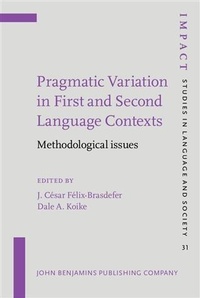
Pragmatic Variation in First and Second Language Contexts
Methodological issues
1st Edition
Published on 12. September 2012
X, 338 pages
978-90-272-7327-7 (ISBN)
Description

Departing from Schneider and Barron (2008), representing the emerging field of Variational Pragmatics, this volume examines pragmatic variation focusing on methods utilized to collect and analyze data in a variety of first (L1) and second (L2) language contexts. The objectives are to: (1) examine variation in such areas of pragmatics as speech acts, conventional expressions, metapragmatics, stance, frames, mitigation, communicative action, (im)politeness, and implicature; and (2) critically review central methodological concerns relevant for research in pragmatic variation, such as coding, ethical issues, qualitative and quantitative methods, and individual variation. Theoretical frameworks vary from variationist and interactional sociolinguistics, to variational pragmatics. This collection contains eleven chapters by leading scholars, including two state-of-the art chapters on key methodological issues of pragmatic variation study. Given the theoretical perspectives, methodological focus, and analyses, the book will be of interest to those who study pragmatics, discourse analysis, second language acquisition, sociolinguistics, corpus linguistics, and language variation.
More details
Other editions
Additional editions
J. Cesar Felix-Brasdefer | Dale Koike
Pragmatic Variation in First and Second Language Contexts
Methodological issues
Book
09/2012
John Benjamins Publishing Co
€104.94
Shipment within 10-15 days
Persons
Content
- Pragmatic Variation in First and Second Language Contexts
- Editorial page
- Title page
- LCC data
- Table of contents
- Acknowledgements
- Notes on contributors
- Introduction
- 1. Pragmatic variation: Aims and scope of the volume
- 2. Variation in linguistics research
- 3. Overview of the chapters in the volume
- References
- Chapter 1. Pragmatic variation by gender in market service encounters in Mexico
- 1. Introduction
- 2. Theoretical framework
- 2.1 Levels of pragmatic analysis and variation in commercial settings
- 2.2 Previous research on service encounters in commercial settings
- 3. Method
- 3.1 The market
- 3.2 Procedures for data collection and analysis
- 4. Results
- 4.1 Actional level: Making a request for service
- 4.2 Interactional level
- 4.3 Stylistic level
- 5. Discussion
- 5.1 Variation at the actional level
- 5.2 Variation at the interactional level
- 5.3 Variation at the stylistic level
- 5.4 Methodological issues
- 6. Conclusion
- References
- Appendix
- Chapter 2 Cross-cultural stances in online discussions
- 1. Introduction
- 2. Literature Review
- 2.1 Defining stance
- 2.2 Approaches to stance
- 3. Method
- 3.1 Procedures for data collection
- 3.2 Procedures for data analysis
- 3.3 Participants
- 4. Results
- 4.1 Cultural analysis
- 4.2 Grammatical analysis
- 4.3 Interactional analysis
- 5. Discussion
- 5.1 Cultural analysis
- 5.2 Grammatical analysis
- 5.3 Interactional analysis
- 5.4 Methodological issues
- 6. Conclusion
- References
- Appendix: Fall 2009 MIT/Brest Forum
- Chapter 3 Pragmatic variation in therapeutic discourse
- 1. Introduction
- 2. Review of literature and theoretical considerations
- 2.1 Some theoretical considerations about the therapeutic session
- 2.2 Conflict talk and its relevance to this study
- 2.3 Mitigation
- 2.4 Pragmatic variation (PV)
- 3. Data and methods
- 3.1 The participants
- 3.2 Data
- 3.3 Data analysis
- 4. Results
- 4.1 Qualitative analysis
- 4.1.1 Hedges/Bushes
- 4.1.2 Parenthetical verbs
- 4.1.3 Shields
- 4.1.4 Epistemic disclaimers
- 4.1.5 Tag questions
- 4.1.6 Diminutives
- 4.1.7 Proverbs and proverbial sayings: Other mitigating strategies
- 4.1.8 Other indirect devices: Guardar las apariencias ('to keep up appearances') (Placencia 1996)
- 4.2 Results: Quantitative analysis
- 5. Discussion
- 5.1 Methodological issues
- 6. Conclusion
- References
- Chapter 4. Disagreement and sociolinguistic variables
- 1. Introduction
- 2. English in China
- 3. Theoretical framework
- 3.1 Disagreement
- 3.2 Sociolinguistic variables and disagreement
- 3.3 Sociolinguistic variables and ELFP
- 3.4 The context
- 4. Method
- 5. Results
- 6. Discussion
- 7. Methodological issues
- 8. Pedagogical implications
- 9. Conclusions
- References
- Appendix A
- Appendix B
- Chapter 5 Variation in the pragmatic use of conventional expressions
- 1. Introduction
- 1.1 What are conventional expressions?
- 2. Framework
- 3. Methodology
- 3.1 Instrument
- 3.2 Participants
- 3.3 Analysis
- 4. Results
- 4.1 Variation at the speech act and strategy levels: same context, different speech acts, or pragmatic strategies
- 4.2 Variation at the actional level: Same speech act, different words
- 4.2.1 Variation across expressions
- 4.2.1.1 A case of high NS variation. Four scenarios resulted in 30% or greater difference between NS teachers and peers: Office, Get a ride, Puddle, and Movie. The greatest difference between NS teachers and undergraduates appears in Movie in which teenag
- 4.2.2 Variation within expressions
- 4.2.2.1 Lexical core. An extreme case of variation within an expression is the recurrence of a single word in the absence of a conventional expression. Although no single expression reaches the 50% mark in I6, the word mess is strongly associated with the
- 5. Discussion
- 5.1 Methodological issues
- 6. Conclusion
- References
- Appendix: Oral production task
- Part A instructions: Initiating utterances
- Part B instructions: Responding utterances
- Chapter 6. Variation in NS-learner interactions
- 1. Introduction
- 1.1 Frames and cognition
- 1.2 Frames and interaction
- 1.3 Frames and expectations
- 1.4 Changes in frames
- 1.5 Goals of the study and organization
- 2. Theoretical background
- 2.1 Communication, common ground, and frames of talk
- 2.2 The frame of institutional talk
- 2.3 The frame of personal talk
- 2.4 Expectations
- 2.5 Research questions
- 3. Method
- 4. Results
- 4.1 Interview dialogues: NS is initiator
- 4.2 Interview dialogues: Learner is initiator
- 4.3 Informal conversations
- 5. Discussion
- 5.1 Overall results
- 5.2 Methodological issues
- 6. Conclusions
- References
- Appendix 1: Notations used in the transcriptions (based in part on Atkinson & Heritage 1984)
- Chapter 7. Pragmatic variation in learner perception
- 1. Introduction
- 2. Theoretical framework
- 2.1 Retrospective verbal reports in ILP research
- 2.2 The speech act of requests
- 3. Method
- 3.1 Participants
- 3.2 Instrument and procedures for data collection
- 3.3 Data analysis
- 4. Results
- 4.1 Noticed or attended features of the situation (cognition)
- 4.1.1 Grammar and vocabulary
- 4.1.2 Sociopragmatic and pragmalinguistic knowledge
- 4.2 Development of pragmatic knowledge
- 4.3 Linguistic difficulties
- 5. Discussion
- 6. Implications for RVR methodology in ILP research
- 7. Conclusion
- References
- Appendix A
- Role Plays
- Extension
- Notes
- Appendix B
- Chapter 8. Variationist sociolinguistics, L2 sociopragmatic competence
- 1. Introduction
- 2. Background
- 2.1 Variationist sociolinguistics
- 2.2 Where indeed does the sociolinguistic variable stop?
- 2.3 Classroom-based synchronous computer-mediated discourse
- 2.4 French tu and vous
- 2.5 Summary of van Compernolle et al. (2011)
- 3. Data and method for the present study
- 4. Results
- 4.1 Distributional analysis
- 4.2 VARBRUL analysis of interrogatives
- 4.3 Partition analysis of interrogatives
- 4.4 Beyond statistics: Interactional patterns of (socio)pragmatic variation
- 5. Discussion
- 5.1 Methodological issues
- 6. Conclusion
- References
- Chapter 9. Research methods for describing variation in intercultural pragmatics
- 1. Taking a multi-method approach to research on L2 pragmatics
- 2. Defining pragmatics
- 2.1 Cross-cultural pragmatics
- 2.2 Intercultural pragmatics
- 3. Options for investigating intercultural pragmatics
- 3.1 Basic research design issues
- 3.1.1 Sampling
- 3.1.2 Range of pragmatics features sampled
- 3.1.3 Number of measures
- 3.2 Naturalistic data
- 3.2.1 Corpus data
- 3.2.2 Specially collected data
- 3.3 Elicited data
- 3.3.1 Role-play tasks
- 3.3.2 Discourse completion tasks
- 3.3.3 Judgment tasks
- 4. Data analysis
- 4.1 Issues of general concern
- 4.2 Data analysis in the language ability areas
- 5. Discussion and conclusions
- References
- Chapter 10 Between pragmatics and sociolinguistics
- 1. Pragmatic variation: Between scylla and charybdis?
- 1.1 The variationist sociolinguistic view
- 1.2 The variational pragmatics view
- 2. Sailing toward calmer waters
- 2.1 Operationalizing pragmatic notions for pragmatic variation research
- 2.2 Operationalizing macro-social factors for pragmatic variation research
- 3. Conclusion
- Acknowledgements
- References
- Chapter 11. Conclusions
- 1. Introduction
- 2. Methodological issues highlighted in the studies
- 2.1 Methodological issues of data collection
- 2.1.1 Quantitative studies
- 2.1.2 Qualitative studies
- 2.1.3 Quantitative/qualitative studies
- 2.1.4 Methodological issues of data representation
- 2.2 Methodological issues of data analysis
- 2.2.1 Quantitative studies
- 2.2.2 Qualitative studies
- 2.2.3 Quantitative/qualitative studies
- 3. Future studies and conclusions
- References
- Index
