

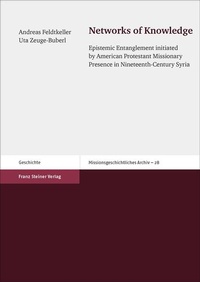
Networks of Knowledge
Epistemic Entanglement initiated by American Protestant Missionary Presence in Nineteenth-Century Syria
1st Edition
Published on 20. September 2018
208 pages
978-3-515-11974-0 (ISBN)
Description

American protestant missionaries, sent by the American Board of Commissioners for Foreign Missions, initiated transcultural knowledge to Ottoman Syria. This e-book focusses on the generation of that knowledge involving local people from 1820 until the end of the nineteenth century.
It includes the study of secularity, the formation of knowledge on topography and particularly biblical topography, networking between academic societies, the development of a font of type for printing in Arabic and the introduction of journals in Arabic language. The material and analysis presented illustrate how modernity became a global phenomenon and who "owns" modernity.
More details
Other editions
Additional editions
Andreas Feldtkeller | Uta Zeuge-Buberl
Networks of Knowledge
Epistemic Entanglement initiated by American Protestant Missionary Presence in Nineteenth-Century Syria
Book
09/2018
1st Edition
Franz Steiner Verlag
€52.00
Shipment within 5-7 days
Persons
Author
Andreas Feldtkeller, geb. 1961, Lehrstuhlinhaber für Religions- und Missionswissenschaft sowie Ökumenik an der Humboldt-Universität zu Berlin; Vorsitzender der Berliner Gesellschaft für Missionsgeschichte.
ISNI:
ISNI:
Uta Zeuge-Buberl studierte Evangelische Theologie in Tübingen, Beirut, Berlin und Wien, 2014 promovierte sie an der Universität Wien. Von 2011 bis 2015 war sie Mitarbeiterin im DFG-Projekt "Transatlantische Vernetzung von Institutionen des Wissens am Beispiel der Syria Mission des American Board", am Institut für Religionswissenschaften und Interkulturelle Theologie der Humboldt Universität zu Berlin. Seit 2015 arbeitet Uta Zeuge-Buberl in der Abteilung für Integration und Diversität des Magistrates der Stadt Wien. Ihre Forschungsschwerpunkte sind die Migration aus der arabischen Welt sowie der interreligiöse und christlich-muslimische Dialog.
ISNI:
ISNI:
Content
- Intro
- Inhaltsverzeichnis
- Preface
- Introduction
- Chapter 1: Negotiating a Third Space between Orders of Knowledge
- Secularity as a third space?
- The Ottoman Empire seen through the lens of an American paradigm
- Between neutrality and a Protestant religious framing
- The exclusion of denominational issues from the academic networks
- A vernacular approach: the wa?an
- From the "Syrian Protestant College" to the "American University of Beirut"
- Chapter 2: Research on Biblical Topography as a Model for Entangled Knowledge
- Introductory remarks
- Topographical research and missionary work
- Negotiating the cooperation between a biblical Scholar and a missionary
- Equipment for the excursions
- Keeping track of the journey
- Connecting vernacular knowledge to topographical research
- Writing the book "Biblical Researches in Palestine, Mount Sinai and Arabia Petraea"
- Further topographical research
- Transculturality and issues of epistemic power
- Chapter 3: Establishing Academic Networks in and between America, the Middle East and Europe
- Networks between individuals
- The ABCFM secretary getting involved in academic networking and research
- The initiators of the American Oriental Society and their relation to the ABCFM
- The concurrence of academic societies in Boston and Beirut
- The transcultural character of the Syrian Society of Arts and Sciences
- Rufus Anderson and Edward Robinson negotiating the design of the AOS
- Networking between academic societies in the United States, Syria, and Europe
- Chapter 4: The Art of Printing - A New Arabic Font to Satisfy the Taste of Arab Readers
- The establishment of the American press in Beirut.
- Striving for beauty in Arabic printing
- Connecting to Germany
- Bringing to Lebanon the ability to reproduce the new Arabic typeface
- Chapter 5: The Introduction of Periodicals to Arab Readers in Syria
- Majmu? Fawa?id (1851-1856)
- The missionaries' influence on the establishment of Syrian Christian periodicals
- From "Akhbar ?an Intishar al-Injil fi Amakin Mukhtalifa" to "al-Nashra al-Usbu?iyyah" (beginning 1863)
- "Kawkab al-Sobh al-Munir" and "Molhaq al-Nashra al-Usbu?iyya"
- Akhbar al-Tibbiyya and al-Tabib882F
- Summary
- Bibliography
- Archive Collections
- Periodical Sources (German, English)
- Periodical Sources (Arabic)
- Published Sources
- Unpublished Sources and Dissertations
- Web Sources
