

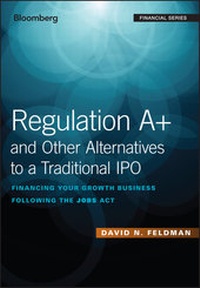
Regulation A+ and Other Alternatives to a Traditional IPO
Financing Your Growth Business Following the JOBS Act
1st Edition
Published on 18. January 2018
176 pages
978-1-119-41619-7 (ISBN)
Description

Understand Regulation A+ and other alternative funding methods
Regulation A+ and Other Alternatives to a Traditional IPO delves into the details of the new
SEC rules under the JOBS Act of 2012 to examine the benefits and pitfalls for entrepreneurs and investors. Written by the 'Godfather of Reg A+,' this book breaks down the complex details of Regulation A+ and other alternative funding methods to help small businesses determine how best to go public and raise capital. A traditional IPO comes with barriers that can be insurmountable for a small company seeking to enter the public markets; thus far, reverse mergers have provided a challenging 'back door' to the market, but Regulation A+ re-opens the front door to allow small cap companies to raise capital while keeping offering and compliance costs manageable in a way not possible with a traditional IPO. More complex than simple crowdfunding, yet just as accessible by all investors, Regulation A+ is a step up for entrepreneurs at any stage wanting to go public where Wall Street meets Main Street.
Straightforward explanations, smart strategy, and illustrative examples make this book an invaluable guide for those seeking to truly understand the nuances of Regulation A+ in order to work more effectively within its bounds.
* Understand how Regulation A+ differs from a traditional IPO and the early experience with this exciting new approach
* Examine the JOBS Act and the SEC's rules under Title IV
* Explore the past, present, and future of reverse mergers, special purpose acquisition companies (SPACs) and self-filings
* Discover new alternatives including new rules under Rule 504 and Regulation S
The new rules provide a faster, more streamlined, more cost-effective route to up to $50 million in capital, and offer companies more flexibility than ever. Every entrepreneur needs to know all available funding options, and Regulation A+ and Other Alternatives to a Traditional IPO provides essential guidance from the expert in the field.
Regulation A+ and Other Alternatives to a Traditional IPO delves into the details of the new
SEC rules under the JOBS Act of 2012 to examine the benefits and pitfalls for entrepreneurs and investors. Written by the 'Godfather of Reg A+,' this book breaks down the complex details of Regulation A+ and other alternative funding methods to help small businesses determine how best to go public and raise capital. A traditional IPO comes with barriers that can be insurmountable for a small company seeking to enter the public markets; thus far, reverse mergers have provided a challenging 'back door' to the market, but Regulation A+ re-opens the front door to allow small cap companies to raise capital while keeping offering and compliance costs manageable in a way not possible with a traditional IPO. More complex than simple crowdfunding, yet just as accessible by all investors, Regulation A+ is a step up for entrepreneurs at any stage wanting to go public where Wall Street meets Main Street.
Straightforward explanations, smart strategy, and illustrative examples make this book an invaluable guide for those seeking to truly understand the nuances of Regulation A+ in order to work more effectively within its bounds.
* Understand how Regulation A+ differs from a traditional IPO and the early experience with this exciting new approach
* Examine the JOBS Act and the SEC's rules under Title IV
* Explore the past, present, and future of reverse mergers, special purpose acquisition companies (SPACs) and self-filings
* Discover new alternatives including new rules under Rule 504 and Regulation S
The new rules provide a faster, more streamlined, more cost-effective route to up to $50 million in capital, and offer companies more flexibility than ever. Every entrepreneur needs to know all available funding options, and Regulation A+ and Other Alternatives to a Traditional IPO provides essential guidance from the expert in the field.
More details
Other editions
Additional editions
David N. Feldman
Regulation A+ and Other Alternatives to a Traditional IPO
Financing Your Growth Business Following the JOBS Act
Book
04/2018
Wiley
€47.00
Shipment within 15-20 days
Content
1 - Cover [Seite 1]
2 - Title Page [Seite 5]
3 - Copyright [Seite 6]
4 - Contents [Seite 9]
5 - Preface [Seite 13]
6 - Acknowledgments [Seite 17]
7 - Chapter 1: Why Go Public? [Seite 21]
7.1 - Advantages of Being Public [Seite 21]
7.1.1 - Access to Capital [Seite 21]
7.1.2 - Liquidity [Seite 22]
7.1.3 - Growth Through Acquisitions or Strategic Partnerships [Seite 23]
7.1.4 - Stock Options for Executives [Seite 23]
7.1.5 - Confidence in Management [Seite 24]
7.2 - Disadvantages of Being Public [Seite 24]
7.2.1 - Emphasis on Short-Term Results [Seite 24]
7.2.2 - Public Disclosure [Seite 25]
7.2.3 - Fraud and Greed (Even After Sarbanes-Oxley) [Seite 26]
7.2.4 - It's Expensive! [Seite 26]
7.2.5 - Public Companies Attract Lawsuits [Seite 27]
7.3 - Weighing the Pros and Cons [Seite 28]
7.4 - And so . . . [Seite 28]
8 - Chapter 2: Pre-2012: The History of Regulation A and the Death of Small-Company IPOs [Seite 30]
8.1 - Regulation A-Not Too Popular Before 2012 [Seite 30]
8.2 - Reg A Through the Years [Seite 32]
8.3 - Why Small Companies Struggled to Go Public Before the JOBS Act [Seite 34]
8.3.1 - Death of Small IPOs [Seite 34]
8.3.2 - Death of Reverse Mergers? [Seite 37]
8.4 - Reg A versus Private Offering Under Regulation D [Seite 38]
8.4.1 - Reg D Is Faster [Seite 39]
8.4.2 - Reg D Is Cheaper [Seite 39]
8.4.3 - Reg D Can Raise More than $50 Million [Seite 39]
8.4.4 - Reg D Rule 506 Limits Investor Status [Seite 39]
8.4.5 - Reg A Offers Liquidity [Seite 40]
8.5 - And so . . . [Seite 41]
9 - Chapter 3: The JOBS Act and Its Genesis [Seite 42]
9.1 - "Old" Regulation A [Seite 42]
9.1.1 - Limited Offering Amount and Mandatory Blue Sky [Seite 42]
9.1.2 - Simplified Disclosure and Reporting [Seite 42]
9.1.3 - Testing the Waters [Seite 43]
9.1.4 - U.S. and Canadian Companies Only [Seite 43]
9.1.5 - Nomenclature [Seite 43]
9.2 - Feldman First Proposes "Reg A+" at SEC Conference [Seite 44]
9.2.1 - History of the SEC Small Business Conference [Seite 44]
9.2.2 - The Seminal 2010 Conference [Seite 45]
9.3 - Development and Enactment of the JOBS Act [Seite 46]
9.3.1 - Making the Reg A+ Sausage [Seite 47]
9.3.2 - States Were Not Pleased [Seite 47]
9.4 - Other Key Elements of the JOBS Act [Seite 48]
9.4.1 - Title I: The IPO "On-Ramp" and Emerging Growth Companies [Seite 48]
9.4.2 - Title II: Advertising in Private Offerings Under Regulation D 506(c) [Seite 49]
9.4.3 - Title III: "Statutory" Crowdfunding [Seite 50]
9.4.4 - Title V: Flexibility to Remain Private [Seite 51]
9.5 - Reg A+ Title IV Language [Seite 51]
9.5.1 - Basic Provisions [Seite 51]
9.5.2 - Covered Securities and "Qualified Purchaser" [Seite 52]
9.5.3 - Study on the Impact of State Blue Sky Laws [Seite 53]
9.6 - And so . . . [Seite 53]
10 - Chapter 4: The SEC's Rules Under Title IV Regulation A+ [Seite 55]
10.1 - SEC's Reg A+ Rule Proposal [Seite 56]
10.1.1 - Eligibility [Seite 56]
10.1.2 - The Offering Statement [Seite 56]
10.1.3 - Post-Offering Disclosure: The Dawn of Light Reporting [Seite 59]
10.1.4 - Testing the Waters [Seite 61]
10.1.5 - Bad Actor Disqualification [Seite 62]
10.1.6 - Blue Sky Preemption and Qualified Purchaser Definition [Seite 62]
10.2 - Comment Process [Seite 63]
10.3 - Final Reg A+ Rules [Seite 63]
10.4 - States' Failed Lawsuit Against the SEC [Seite 66]
10.5 - And so . . . [Seite 67]
11 - Chapter 5: Offering Statement and Light Reporting Preparation [Seite 69]
11.1 - Offering Statement Preparation [Seite 71]
11.1.1 - Tier 2 Companies Planning Full Reporting [Seite 71]
11.1.2 - Tier 2 Companies Planning Light Reporting [Seite 71]
11.1.3 - Tier 1 Issuers [Seite 72]
11.1.4 - Issues Applicable to All [Seite 72]
11.2 - Light Reporting Preparation [Seite 74]
11.2.1 - Form 1-K [Seite 74]
11.2.2 - Form 1-SA [Seite 75]
11.2.3 - Form 1-U [Seite 76]
11.2.4 - Form 1-Z [Seite 76]
11.3 - Testing the Waters [Seite 77]
11.4 - And so . . . [Seite 78]
12 - Chapter 6: Early Experience with Regulation A+ [Seite 79]
12.1 - Who Is Utilizing Reg A+? [Seite 79]
12.1.1 - Real Estate Players [Seite 79]
12.1.2 - IPOs with No Underwriter [Seite 80]
12.1.3 - Traditional IPOs Utilizing Reg A+ [Seite 82]
12.1.4 - Hybrid-Wall Street Meets Main Street [Seite 83]
12.2 - Attractive Industries [Seite 85]
12.3 - And so . . . [Seite 86]
13 - Chapter 7: Potential Changes to Regulation A [Seite 87]
13.1 - OTC Markets Petition [Seite 87]
13.1.1 - Allow Reporting Companies to Utilize Reg A [Seite 88]
13.1.2 - Allow "At-the-Market" Offerings [Seite 88]
13.2 - Blue Sky Issues [Seite 89]
13.2.1 - Blue Sky Preemption of OTC Resale of Reg A Securities [Seite 89]
13.2.2 - State Notice Filings [Seite 90]
13.3 - Testing-the-Waters Issues [Seite 90]
13.4 - Other Issues [Seite 92]
13.4.1 - Raising the Limit [Seite 92]
13.4.2 - International Companies [Seite 94]
13.4.3 - Conforming to Registered Offerings [Seite 95]
13.5 - And so . . . [Seite 95]
14 - Chapter 8: Basics of Reverse Mergers [Seite 97]
14.1 - Overview of Reverse Mergers [Seite 98]
14.2 - IPOs versus Reverse Mergers [Seite 99]
14.2.1 - Advantages of a Reverse Merger versus an IPO [Seite 100]
14.2.2 - Disadvantages of a Reverse Merger versus an IPO [Seite 101]
14.3 - A Little History, Rule 419, and Subsequent Rulemakings [Seite 102]
14.3.1 - Adoption of Rule 419 [Seite 102]
14.3.2 - Aftermath of Adoption of Rule 419 [Seite 103]
14.3.3 - SEC 2005 and 2008 Rulemakings [Seite 105]
14.4 - The Importance of Due Diligence in Reverse Mergers [Seite 106]
14.4.1 - Messy Shells [Seite 106]
14.4.2 - Dirty Shells [Seite 107]
14.5 - And so . . . [Seite 107]
15 - Chapter 9: Troubled Industry: China, Seasoning Rules, Bogus Shells [Seite 109]
15.1 - The China Bubble Pops [Seite 110]
15.1.1 - Genesis of the China Phenomenon [Seite 110]
15.1.2 - Allegations of Fraud [Seite 112]
15.1.3 - Who Was Responsible? [Seite 113]
15.2 - The SEC Responds with Draconian Seasoning Rules [Seite 114]
15.2.1 - The Rules Are Adopted [Seite 114]
15.2.2 - Reaction to the Rules [Seite 115]
15.2.3 - Aftermath of Adoption of Seasoning Rules [Seite 116]
15.3 - Bogus Shells and Prosecutions [Seite 116]
15.4 - And so . . . [Seite 119]
16 - Chapter 10: The Future of Reverse Mergers [Seite 120]
16.1 - Reverse Merger, Then OTC Trading [Seite 121]
16.2 - Bypass Seasoning with $40MM Public Offering [Seite 122]
16.3 - Merger with an Operating Public Company [Seite 122]
16.4 - The Real Risks of Using Bogus Shells [Seite 124]
16.5 - The Future Supply and Cost of Shells [Seite 126]
16.6 - And so . . . [Seite 127]
17 - Chapter 11: Special Purpose Acquisition Companies (SPACs) [Seite 128]
17.1 - Introduction to SPACs: The GKN Experience [Seite 129]
17.2 - The First SPAC Resurgence-Bubble and Bust [Seite 131]
17.3 - SPACs' Recent Return [Seite 133]
17.4 - What Is the Future of SPACs? [Seite 134]
17.5 - And so . . . [Seite 136]
18 - Chapter 12: Self-Filings [Seite 138]
18.1 - How Do Shares of Stock Become Tradable? [Seite 138]
18.1.1 - Registration of Shares [Seite 138]
18.1.2 - Exemptions from Registration: Rule 144 [Seite 140]
18.2 - Self-Filing Through Form S-1 Resale Registration [Seite 141]
18.2.1 - Private Offerings During Registration [Seite 141]
18.3 - Mechanics of Form S-1 Self-Filing [Seite 142]
18.3.1 - Engaging Professionals [Seite 143]
18.3.2 - Identifying Shareholders [Seite 143]
18.3.3 - Preparing and Filing the Document [Seite 144]
18.3.4 - SEC (and FINRA) Comments and Revisions [Seite 144]
18.3.5 - Establishing a Trading Market [Seite 145]
18.4 - Self-Filing Through Form 10 Registration [Seite 146]
18.4.1 - Form 10 versus Form S-1 (Exchange Act versus Securities Act) [Seite 146]
18.4.2 - Filing Form 10 and Automatic Effectiveness [Seite 148]
18.4.3 - Developing a Market After Filing a Form 10 [Seite 148]
18.5 - And so . . . [Seite 148]
19 - Chapter 13: Other IPO Alternatives [Seite 149]
19.1 - Intrastate Exemption [Seite 150]
19.2 - Rule 504 [Seite 150]
19.3 - Regulation S [Seite 152]
19.4 - And so . . . [Seite 153]
20 - Chapter 14: The Experts Speak-A Look Ahead [Seite 155]
20.1 - Current Political and Economic Environment [Seite 156]
20.2 - Current Developments [Seite 157]
20.2.1 - Reg A+ Could Bring Back the Small-Cap IPO [Seite 157]
20.2.2 - Reg A+ Is Encountering Early Growing Pains [Seite 158]
20.2.3 - Reg A+ Can Be Improved [Seite 160]
20.2.4 - Reg A+'s Attractive Features Are Working [Seite 160]
20.2.5 - Reverse Mergers, SPACs, and Self-Filings Will Continue as Viable Alternatives [Seite 161]
20.2.6 - More Regulatory Changes from the SEC or Congress Would Be Welcome [Seite 162]
20.3 - And so . . . [Seite 163]
21 - About the Author [Seite 165]
22 - Index [Seite 167]
23 - EULA [Seite 176]
2 - Title Page [Seite 5]
3 - Copyright [Seite 6]
4 - Contents [Seite 9]
5 - Preface [Seite 13]
6 - Acknowledgments [Seite 17]
7 - Chapter 1: Why Go Public? [Seite 21]
7.1 - Advantages of Being Public [Seite 21]
7.1.1 - Access to Capital [Seite 21]
7.1.2 - Liquidity [Seite 22]
7.1.3 - Growth Through Acquisitions or Strategic Partnerships [Seite 23]
7.1.4 - Stock Options for Executives [Seite 23]
7.1.5 - Confidence in Management [Seite 24]
7.2 - Disadvantages of Being Public [Seite 24]
7.2.1 - Emphasis on Short-Term Results [Seite 24]
7.2.2 - Public Disclosure [Seite 25]
7.2.3 - Fraud and Greed (Even After Sarbanes-Oxley) [Seite 26]
7.2.4 - It's Expensive! [Seite 26]
7.2.5 - Public Companies Attract Lawsuits [Seite 27]
7.3 - Weighing the Pros and Cons [Seite 28]
7.4 - And so . . . [Seite 28]
8 - Chapter 2: Pre-2012: The History of Regulation A and the Death of Small-Company IPOs [Seite 30]
8.1 - Regulation A-Not Too Popular Before 2012 [Seite 30]
8.2 - Reg A Through the Years [Seite 32]
8.3 - Why Small Companies Struggled to Go Public Before the JOBS Act [Seite 34]
8.3.1 - Death of Small IPOs [Seite 34]
8.3.2 - Death of Reverse Mergers? [Seite 37]
8.4 - Reg A versus Private Offering Under Regulation D [Seite 38]
8.4.1 - Reg D Is Faster [Seite 39]
8.4.2 - Reg D Is Cheaper [Seite 39]
8.4.3 - Reg D Can Raise More than $50 Million [Seite 39]
8.4.4 - Reg D Rule 506 Limits Investor Status [Seite 39]
8.4.5 - Reg A Offers Liquidity [Seite 40]
8.5 - And so . . . [Seite 41]
9 - Chapter 3: The JOBS Act and Its Genesis [Seite 42]
9.1 - "Old" Regulation A [Seite 42]
9.1.1 - Limited Offering Amount and Mandatory Blue Sky [Seite 42]
9.1.2 - Simplified Disclosure and Reporting [Seite 42]
9.1.3 - Testing the Waters [Seite 43]
9.1.4 - U.S. and Canadian Companies Only [Seite 43]
9.1.5 - Nomenclature [Seite 43]
9.2 - Feldman First Proposes "Reg A+" at SEC Conference [Seite 44]
9.2.1 - History of the SEC Small Business Conference [Seite 44]
9.2.2 - The Seminal 2010 Conference [Seite 45]
9.3 - Development and Enactment of the JOBS Act [Seite 46]
9.3.1 - Making the Reg A+ Sausage [Seite 47]
9.3.2 - States Were Not Pleased [Seite 47]
9.4 - Other Key Elements of the JOBS Act [Seite 48]
9.4.1 - Title I: The IPO "On-Ramp" and Emerging Growth Companies [Seite 48]
9.4.2 - Title II: Advertising in Private Offerings Under Regulation D 506(c) [Seite 49]
9.4.3 - Title III: "Statutory" Crowdfunding [Seite 50]
9.4.4 - Title V: Flexibility to Remain Private [Seite 51]
9.5 - Reg A+ Title IV Language [Seite 51]
9.5.1 - Basic Provisions [Seite 51]
9.5.2 - Covered Securities and "Qualified Purchaser" [Seite 52]
9.5.3 - Study on the Impact of State Blue Sky Laws [Seite 53]
9.6 - And so . . . [Seite 53]
10 - Chapter 4: The SEC's Rules Under Title IV Regulation A+ [Seite 55]
10.1 - SEC's Reg A+ Rule Proposal [Seite 56]
10.1.1 - Eligibility [Seite 56]
10.1.2 - The Offering Statement [Seite 56]
10.1.3 - Post-Offering Disclosure: The Dawn of Light Reporting [Seite 59]
10.1.4 - Testing the Waters [Seite 61]
10.1.5 - Bad Actor Disqualification [Seite 62]
10.1.6 - Blue Sky Preemption and Qualified Purchaser Definition [Seite 62]
10.2 - Comment Process [Seite 63]
10.3 - Final Reg A+ Rules [Seite 63]
10.4 - States' Failed Lawsuit Against the SEC [Seite 66]
10.5 - And so . . . [Seite 67]
11 - Chapter 5: Offering Statement and Light Reporting Preparation [Seite 69]
11.1 - Offering Statement Preparation [Seite 71]
11.1.1 - Tier 2 Companies Planning Full Reporting [Seite 71]
11.1.2 - Tier 2 Companies Planning Light Reporting [Seite 71]
11.1.3 - Tier 1 Issuers [Seite 72]
11.1.4 - Issues Applicable to All [Seite 72]
11.2 - Light Reporting Preparation [Seite 74]
11.2.1 - Form 1-K [Seite 74]
11.2.2 - Form 1-SA [Seite 75]
11.2.3 - Form 1-U [Seite 76]
11.2.4 - Form 1-Z [Seite 76]
11.3 - Testing the Waters [Seite 77]
11.4 - And so . . . [Seite 78]
12 - Chapter 6: Early Experience with Regulation A+ [Seite 79]
12.1 - Who Is Utilizing Reg A+? [Seite 79]
12.1.1 - Real Estate Players [Seite 79]
12.1.2 - IPOs with No Underwriter [Seite 80]
12.1.3 - Traditional IPOs Utilizing Reg A+ [Seite 82]
12.1.4 - Hybrid-Wall Street Meets Main Street [Seite 83]
12.2 - Attractive Industries [Seite 85]
12.3 - And so . . . [Seite 86]
13 - Chapter 7: Potential Changes to Regulation A [Seite 87]
13.1 - OTC Markets Petition [Seite 87]
13.1.1 - Allow Reporting Companies to Utilize Reg A [Seite 88]
13.1.2 - Allow "At-the-Market" Offerings [Seite 88]
13.2 - Blue Sky Issues [Seite 89]
13.2.1 - Blue Sky Preemption of OTC Resale of Reg A Securities [Seite 89]
13.2.2 - State Notice Filings [Seite 90]
13.3 - Testing-the-Waters Issues [Seite 90]
13.4 - Other Issues [Seite 92]
13.4.1 - Raising the Limit [Seite 92]
13.4.2 - International Companies [Seite 94]
13.4.3 - Conforming to Registered Offerings [Seite 95]
13.5 - And so . . . [Seite 95]
14 - Chapter 8: Basics of Reverse Mergers [Seite 97]
14.1 - Overview of Reverse Mergers [Seite 98]
14.2 - IPOs versus Reverse Mergers [Seite 99]
14.2.1 - Advantages of a Reverse Merger versus an IPO [Seite 100]
14.2.2 - Disadvantages of a Reverse Merger versus an IPO [Seite 101]
14.3 - A Little History, Rule 419, and Subsequent Rulemakings [Seite 102]
14.3.1 - Adoption of Rule 419 [Seite 102]
14.3.2 - Aftermath of Adoption of Rule 419 [Seite 103]
14.3.3 - SEC 2005 and 2008 Rulemakings [Seite 105]
14.4 - The Importance of Due Diligence in Reverse Mergers [Seite 106]
14.4.1 - Messy Shells [Seite 106]
14.4.2 - Dirty Shells [Seite 107]
14.5 - And so . . . [Seite 107]
15 - Chapter 9: Troubled Industry: China, Seasoning Rules, Bogus Shells [Seite 109]
15.1 - The China Bubble Pops [Seite 110]
15.1.1 - Genesis of the China Phenomenon [Seite 110]
15.1.2 - Allegations of Fraud [Seite 112]
15.1.3 - Who Was Responsible? [Seite 113]
15.2 - The SEC Responds with Draconian Seasoning Rules [Seite 114]
15.2.1 - The Rules Are Adopted [Seite 114]
15.2.2 - Reaction to the Rules [Seite 115]
15.2.3 - Aftermath of Adoption of Seasoning Rules [Seite 116]
15.3 - Bogus Shells and Prosecutions [Seite 116]
15.4 - And so . . . [Seite 119]
16 - Chapter 10: The Future of Reverse Mergers [Seite 120]
16.1 - Reverse Merger, Then OTC Trading [Seite 121]
16.2 - Bypass Seasoning with $40MM Public Offering [Seite 122]
16.3 - Merger with an Operating Public Company [Seite 122]
16.4 - The Real Risks of Using Bogus Shells [Seite 124]
16.5 - The Future Supply and Cost of Shells [Seite 126]
16.6 - And so . . . [Seite 127]
17 - Chapter 11: Special Purpose Acquisition Companies (SPACs) [Seite 128]
17.1 - Introduction to SPACs: The GKN Experience [Seite 129]
17.2 - The First SPAC Resurgence-Bubble and Bust [Seite 131]
17.3 - SPACs' Recent Return [Seite 133]
17.4 - What Is the Future of SPACs? [Seite 134]
17.5 - And so . . . [Seite 136]
18 - Chapter 12: Self-Filings [Seite 138]
18.1 - How Do Shares of Stock Become Tradable? [Seite 138]
18.1.1 - Registration of Shares [Seite 138]
18.1.2 - Exemptions from Registration: Rule 144 [Seite 140]
18.2 - Self-Filing Through Form S-1 Resale Registration [Seite 141]
18.2.1 - Private Offerings During Registration [Seite 141]
18.3 - Mechanics of Form S-1 Self-Filing [Seite 142]
18.3.1 - Engaging Professionals [Seite 143]
18.3.2 - Identifying Shareholders [Seite 143]
18.3.3 - Preparing and Filing the Document [Seite 144]
18.3.4 - SEC (and FINRA) Comments and Revisions [Seite 144]
18.3.5 - Establishing a Trading Market [Seite 145]
18.4 - Self-Filing Through Form 10 Registration [Seite 146]
18.4.1 - Form 10 versus Form S-1 (Exchange Act versus Securities Act) [Seite 146]
18.4.2 - Filing Form 10 and Automatic Effectiveness [Seite 148]
18.4.3 - Developing a Market After Filing a Form 10 [Seite 148]
18.5 - And so . . . [Seite 148]
19 - Chapter 13: Other IPO Alternatives [Seite 149]
19.1 - Intrastate Exemption [Seite 150]
19.2 - Rule 504 [Seite 150]
19.3 - Regulation S [Seite 152]
19.4 - And so . . . [Seite 153]
20 - Chapter 14: The Experts Speak-A Look Ahead [Seite 155]
20.1 - Current Political and Economic Environment [Seite 156]
20.2 - Current Developments [Seite 157]
20.2.1 - Reg A+ Could Bring Back the Small-Cap IPO [Seite 157]
20.2.2 - Reg A+ Is Encountering Early Growing Pains [Seite 158]
20.2.3 - Reg A+ Can Be Improved [Seite 160]
20.2.4 - Reg A+'s Attractive Features Are Working [Seite 160]
20.2.5 - Reverse Mergers, SPACs, and Self-Filings Will Continue as Viable Alternatives [Seite 161]
20.2.6 - More Regulatory Changes from the SEC or Congress Would Be Welcome [Seite 162]
20.3 - And so . . . [Seite 163]
21 - About the Author [Seite 165]
22 - Index [Seite 167]
23 - EULA [Seite 176]
