

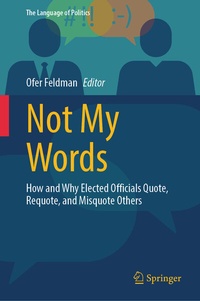
Not My Words
Description

This edited collection of studies brings together a number of internationally distinguished scholars to provide a comprehensive and detailed examination of the usage and function of quotations and citations in political rhetoric in a variety of countries around the globe, including North and South America, Europe, the Middle East, and Asia. Chapters consider quotations and citations as important (at times unavoidable) elements of argumentative and persuasive speech (and writing). They examine quotations, on the one hand, as forms of a direct way of providing evidence to support the speaker's (or writer's) arguments, statements, or assumptions, that their speech (or writing) is within an already established larger claim, enabling them to say (or write) something about it with authority. On the other hand, chapters maintain that quotations and citations can be also used as a powerful device to refute them. That is, the speaker will quote something in order to knock it down i.e., use it as a springboard to express doubts regarding the original utterance, to criticize, disagree, or ridicule the speaker, or to present the contradictory position. Contributions to this volume explore aspects related to the manner such quotations take place, the forms and genres of rhetoric that they enable, and their effect, as an important topic for political and social psychologists, as well as for communication and linguistics researchers who are interested in the study of the nature of contemporary politics. With only a handful studies systematically considering such aspects of political rhetoric and behavior, this anthology aims to bridge the gap in this area's scholarly knowledge, while delving into central features of political communication and persuasion and their effect in present-day societies.
More details
Other editions
Additional editions
Person
Ofer Feldman is Professor Emeritus of Political Psychology and Adjunct Researcher at Doshisha University, and an Affiliated Professor at the Center for Southeast Asian Studies, Kyoto University, Kyoto, Japan. His research centers on the psychological underpinnings of mass and elite political behavior in Japan. He holds a Ph.D. (majoring in social psychology) from the University of Tokyo , Japan. He is the author, editor, co-author, and co-editor of more than 25 books, the author of more than 100 journal articles, book chapters, and research reports, and more than 120 encyclopedia items, on issues related to political communication and persuasion, political leadership, and political culture. His work was published in English, Japanese, German, Spanish, Russian, and Romanian. His recent books include When Politicians Talk (edited, 2021), Adversarial Political Interviewing (edited, 2022), Politische Psychologie: Handbuch für Studium und Wissenschaft (2nd updated & extended edition, co-edited, 2022), Political Debasement (edited, 2023), Debasing Political Rhetoric (edited, 2023) and Political Humor Worldwide (edited, 2024). In 2021 he was elected Honorary Chair of the Research Committee on Political Psychology, International Political Science Association.
Content
Quotations as Devices of Political Persuasion and Argumentation: A Conceptual Introduction.- Quotations in Jordanian Parliamentary Discourse: A Pragma-Discourse Perspective.- Frequency, Sources, and Functions of Direct Quotations in Montenegrin Parliamentary Discourse.- Quotation Statements as a Linguistic Strategy in Japanese Parliamentary Questions.
