

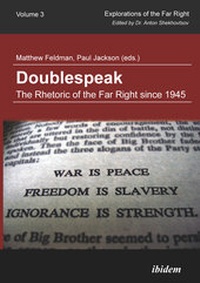
Doublespeak: The Rhetoric of the Far Right since 1945
The Rhetoric of the Far Right Since 1945
1st Edition
Published in March 2015
336 pages
978-3-8382-6554-4 (ISBN)
Description

This timely intervention exposes the euphemized language of the extreme right as a Trojan Horse of deception to re-gain greater influence on public policy. Since the end of the Second World War, the extreme right has been tactically using 'doublespeak', aping the language of liberal democracy. Attentive observation and accurate recognition of the extreme right pedigree means taking seriously their deliberately crafted slogans, symbols and themes. The essays in this book inquire into the extreme right's attempts at 'repackaging' contemporary ultranationalism to make it palatable to more mainstream European and American tastes.
Reviews / Votes
Interesting books address relevant issues, study largely neglected cases, or provoke further research by raising new questions with its answers to old ones. Doublespeak does all of this and more, making it an important contribution to the literature on the far right for scholars and students from a broad variety of academic disciplines.-Cas Mudde, University of GeorgiaMore details
Other editions
Additional editions
Matthew Feldman | Paul Jackson
Doublespeak: The Rhetoric of the Far Right since 1945
The Rhetoric of the Far Right Since 1945
Book
03/2014
1st Edition
ibidem
€39.90
Shipment within 10-15 days
Persons
Dr Matthew Feldman is a Reader in Contemporary History at Teesside University, a Senior Research Fellow at the University of Bergen, Norway, and a Senior Researcher with the Cantemir Institute, University of Oxford. Dr Paul Jackson is co-editor of Wiley-Blackwell`s online journal Compass: Political Religions, an editor of the Mapping the Far Right book series, and an Associate Editor of the Historicising Modernism book series.
Content
Introduction, by Matthew Feldman and Paul Jackson
Part 1. Manipulation of the Masses
1. 'Lingua Quarti Imperii': The Euphemistic in the Extreme Right, by Roger Griffin
2. Toxic Rhetoric: The Language of The Turner Diaries: A Novel, by Janet Wilson
3. 2083 -- a European Declaration of Independence: A License to Kill, by Paul Jackson
4. The Strategy of Discursive Provocation: A Discourse-Historical Analysis of the FPÖ's Discriminatory Rhetoric, by Ruth Wodak
Part 2. Western Europe and the USA
5. 'Teaching the Truth to the Harcore': The Public and Private Presentation of BNP Ideology, by Graham Macklin
6. Wavering Between Radical and Moderate: The Discourse of the Vlaams Belang in Flanders (Belgium), by Hilde Coffé and Jeroen Dewulf
7. Defending Dutch Freedom: The Far Right in the Netherlands: 1932--2012, by Koen Vossen
8. Far Right Rhetoric in the United States: A Carnival of Buncombe, by Leonard Weinberg
Part 3. Central, Southern, and Eastern Europe
9. A Cast Study of Anti-Semitism in the Language and Politics of the Contemporary Far Right in Germany, by Gideon Botsch and Christoph Kopke
10. 'Fascism for the Third Millennium': An Overview of Language and Ideology in Italy's CasaPound Movement, by Anna Castriota and Matthew Feldman
11. Anti-Semitism on the Curriculum: MAUP -- the Interregional Assumbly for Personnel Management, by Per Anders Rudling
12. Language of Authorities and Radical Nationalists, by Alexander Verkhovsky
Part 4. Afterword
12. Heroes Know Which Villains to Kill: How Coded Rhetoric Incites Scripted Violence, by Chip Berlet
Index
Part 1. Manipulation of the Masses
1. 'Lingua Quarti Imperii': The Euphemistic in the Extreme Right, by Roger Griffin
2. Toxic Rhetoric: The Language of The Turner Diaries: A Novel, by Janet Wilson
3. 2083 -- a European Declaration of Independence: A License to Kill, by Paul Jackson
4. The Strategy of Discursive Provocation: A Discourse-Historical Analysis of the FPÖ's Discriminatory Rhetoric, by Ruth Wodak
Part 2. Western Europe and the USA
5. 'Teaching the Truth to the Harcore': The Public and Private Presentation of BNP Ideology, by Graham Macklin
6. Wavering Between Radical and Moderate: The Discourse of the Vlaams Belang in Flanders (Belgium), by Hilde Coffé and Jeroen Dewulf
7. Defending Dutch Freedom: The Far Right in the Netherlands: 1932--2012, by Koen Vossen
8. Far Right Rhetoric in the United States: A Carnival of Buncombe, by Leonard Weinberg
Part 3. Central, Southern, and Eastern Europe
9. A Cast Study of Anti-Semitism in the Language and Politics of the Contemporary Far Right in Germany, by Gideon Botsch and Christoph Kopke
10. 'Fascism for the Third Millennium': An Overview of Language and Ideology in Italy's CasaPound Movement, by Anna Castriota and Matthew Feldman
11. Anti-Semitism on the Curriculum: MAUP -- the Interregional Assumbly for Personnel Management, by Per Anders Rudling
12. Language of Authorities and Radical Nationalists, by Alexander Verkhovsky
Part 4. Afterword
12. Heroes Know Which Villains to Kill: How Coded Rhetoric Incites Scripted Violence, by Chip Berlet
Index
