

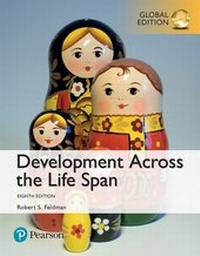
Development Across the Life Span, Global Edition
Description

A compelling blend of lifespan development research and applications
Development Across the Life Span provides a chronological overview of human development from the moment of conception through death, examining both the traditional areas of the field and more recent innovations. Author Robert Feldman focuses on how developmental findings can be can be applied meaningfully and practically, helping students to recognise the relevance of the discipline to their own lives. Thoroughly updated with the latest data and contemporary examples, the 8th Edition better engages students in key concepts via recent news items, timely world events, and contemporary uses of lifespan development.
The full text downloaded to your computer
With eBooks you can:
search for key concepts, words and phrases
make highlights and notes as you study
share your notes with friends
eBooks are downloaded to your computer and accessible either offline through the Bookshelf (available as a free download), available online and also via the iPad and Android apps.
Upon purchase, you'll gain instant access to this eBook.
Time limit
The eBooks products do not have an expiry date. You will continue to access your digital ebook products whilst you have your Bookshelf installed.
All prices
More details
Other editions
Additional editions
Person
Robert S. Feldmanis Professor of Psychology and Dean of the College of Social and Behavioral Sciences at the University of Massachusetts Amherst. A recipient of the College Distinguished Teacher Award, he teaches psychology classes ranging in size from 15 to nearly 500 students. During the course of more than two decades as a college instructor, he has taught both undergraduate and graduate courses at Mount Holyoke College, Wesleyan University, Virginia Commonwealth University, in addition to the University of Massachusetts.
Feldman, who initiated the Minority Mentoring Program at the University of Massachusetts, also has served as a Hewlett Teaching Fellow and Senior Online Teaching Fellow. He initiated distance learning courses in psychology at the University of Massachusetts.
Feldman also is actively involved in promoting the field of psychology. He is on the Board of Directors of the Federation of Associations in Behavioral and Brain Sciences (FABBS) and he also is on the Board of the FABBS FoundationA Fellow of both the American Psychological Association and the Association for Psychological Science, Professor Feldman received a B.A. with High Honors from Wesleyan University and an M.S. and Ph.D. from the University of Wisconsin-Madison.
Feldman is a winner of a Fulbright Senior Research Scholar and Lecturer award, and he has written more than 150 books, book chapters, and scientific articles. He has editedDevelopment of Nonverbal Behavior in Children(Springer-Verlag),Applications of Nonverbal Behavioral Theory and Research(Erlbaum), and co-editedFundamentals of Nonverbal Behavior(Cambridge University Press). He is also author ofChild Development, Understanding Psychology,andP.O.W.E.R. Learning: Strategies for Success in College and Life. His books have been translated into a number of languages, including Spanish, French, Portuguese, Dutch, Chinese, and Japanese.
His research interests include honesty and deception in everyday life and the use of nonverbal behavior in impression management, and his research has been supported by grants from the National Institute of Mental Health and the National Institute on Disabilities and Rehabilitation Research.
Feldman loves music, is an enthusiastic, if not-exactly-expert, pianist, and he enjoys cooking and traveling. He has three children, and he and his wife, a psychologist, live in western Massachusetts, in a home overlooking the Holyoke mountain range.
Content
1. An Introduction to Lifespan Development
2. The Start of Life: Prenatal Development
3. Birth and the Newborn Infant
PART 2 - INFANCY: FORMING THE FOUNDATIONS OF LIFE
4. Physical Development in Infancy
5. Cognitive Development in Infancy
6. Social and Personality Development in Infancy
PART 3 - THE PRESCHOOL YEARS
7. Physical and Cognitive Development in the Preschool Years
8. Social and Personality Development in the Preschool Years
PART 4 - THE MIDDLE CHILDHOOD YEARS
9. Physical and Cognitive Development in Middle Childhood
10. Social and Personality Development in Middle Childhood
PART 5 - ADOLESCENCE
11. Physical and Cognitive Development in Adolescence
12. Social and Personality Development in Adolescence
PART 6 - EARLY ADULTHOOD
13. Physical and Cognitive Development in Early Adulthood
14. Social and Personality Development in Early Adulthood
PART 7 - MIDDLE ADULTHOOD
15. Physical and Cognitive Development in Middle Adulthood
16. Social and Personality Development in Middle Adulthood
PART 8 - LATE ADULTHOOD
17. Physical and Cognitive Development in Late Adulthood
18. Social and Personality Development in Late Adulthood
19. Death and Dying
