

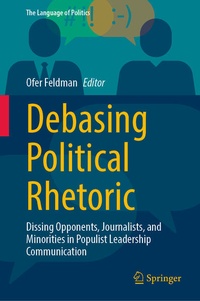
Debasing Political Rhetoric
Description

This book is a companion to Political Debasement: Incivility, Contempt, and Humiliation in Parliamentary and Public Discourse . It brings together interdisciplinary contributions to provide a comprehensive and detailed exploration of the nature, function, and effect of debasement language used by selected political leaders in Western and non-Western countries. Among them are Donald Trump (in the USA), Recep Tayyip Erdogan (Turkey), Rodrigo Roa Duterte (Philippines), Jair Bolsonaro (Brazil), Abe Shinzô (Japan), Pauline Hanson (Australia), Kyriakos Mitsotakis (Greece), Geert Wilders (the Netherlands), Beppe Grillo (Italy), and Santiago Abascal (Spain). Chapters focus specifically on the language of these leaders while examining debasement discourse from narrow and broad perspectives. The former includes the use of crude or abusive language (e.g., curses, obscenity, and swearing) to demean, humiliate, mock, insult, or belittle, based on the actual or perceived object or entity (e.g., race, religion, national, gender identity, or sexual orientation); the latter includes the use of devious or indirect irony, sarcasm, cynicism, ridicule, subtlety, and understatement to degrade and discredit other individuals or groups. The book represents the collective wisdom of scholars and researchers, experts in fields such as communication, political science, international relations, and social and political psychology. Cumulatively, the authors develop a global analysis of debasement discourse in societies from West to East and offer a cutting-edge approach to expand a framework assessing the role and effect of such rhetoric in contemporary politics.
Reviews / Votes
"The collections offer a rich methodological source of inspirations, with a variety of techniques that had been employed to gather and analyze adequate data, ranging from more traditional media material, TV news, transcripts of parliamentary sessions, interviews to more modern ones as social media platforms, which have played a crucial role in the political debasement rhetoric and politics in general. . provide insights into a wide array of countries . ." (Artur Cedzich, Res Rhetorica, Vol. 10 (3), 2023)More details
Other editions
Additional editions
Person
Ofer Feldman is Professor of Political Psychology and Behavior at the Faculty of Policy Studies, Doshisha University, Kyoto, Japan. His research centers on the psychological underpinnings of mass and elite political behavior in Japan, and he has extensively published journal articles and book chapters on issues related to political communication and persuasion, political leadership, and political culture. His books include Talking Politics in Japan Today (2004), The Psychology of Political Communicators (2019, edited with Sonja Zmerli), The Rhetoric of Political Leadership (2020, edited), When Politicians Talk: The Cultural Dynamics of Public Speaking (2021, edited), Politische Psychologie: Handbuch für Studium und Wissenschaft (2022, 2nd updated and expanded edition, edited with Sonja Zmerli), Politicians' Rhetoric: The Psychology of Words and Facial Expressions (2022, in Japanese, with Ken Kinoshita), Adversarial Political Interviewing: Worldwide Perspectives During Polarized Times (2022, edited), and Political Debasement: Incivility, Contempt, and Humiliation in Parliamentary and Public Discourse (2023, edited). In 2021, he was elected Honorary Chair of the Research Committee on Political Psychology, International Political Science Association.
