

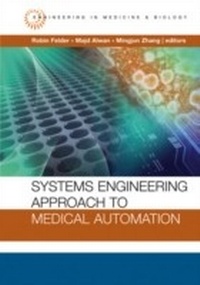
Systems Engineering Approach to Medical Automation
1st Edition
Published on 1. January 2008
320 pages
978-1-59693-165-7 (ISBN)
Description

Medical automation is an emerging area that is bringing the efficiency tools and methods developed by our most successful corporations to the practice of medicine. Presenting a new systems engineering approach to controlling medical processes, this cutting-edge resource shows you how to reduce time, cost, and errors by at least 50%. The book offers you a solid understanding of medical automation principles and the latest applications in the field. You discover how computers and devices can be used to schedule personnel and services, and help maintain a just-in-time, lean, and more affordable medical services. You learn how to automate your pharmacy and laboratory services for maximum profit and minimum turnaround time. Moreover, this forward-looking book helps you determine how nanotechnology is evolving to solve difficult medical challenges. This practical volume explains how hospitals are automating their pharmacy supply systems to reduce waiting time for medications and virtually eliminate mis-dosing, delayed dosing, or incorrect dosing of patients. The book also shows you how to automate your clinical laboratory, helping you decrease the need for rapid (or STAT) testing, eliminate the shortage of trained medical technologists, and increase profitability without the need to increase costs.
More details
Other editions
Additional editions
Majd Alwan | Robin Felder | Mingjun Zhang
Systems Engineering Approach to Medical Automation
Book
09/2008
Artech House Publishers
Unfortunately, price unknown
Available (delivery time upon request)
Content
- Systems Engineering Approach to Medical Automation
- Contents
- Preface
- Chapter 1: Introduction to Medical Automation
- 1.1 Introduction
- 1.2 The Need for Improved Process Management in Medicine
- 1.3 Knowledge Empowers Automation
- 1.4 Personalization of Medicine Enabled by Technology
- 1.5 Applications of Automation
- 1.5.1 Bar Coding, RFID, and Wireless Tracking
- 1.6 Summary and Conclusion
- References
- Chapter 2: Human Factors Issues with Automation
- 2.1 Human Factors
- 2.2 Human Factors in Healthcare
- 2.3 Automation
- 2.3.1 Advantages of Automation
- 2.3.2 Disadvantages of Automation
- 2.4 Creating More Effective Automation
- 2.5 Adaptive Automation
- 2.6 Conclusion
- References
- Selected Bibliography
- Chapter 3: Mathematical Modeling for Medical Automation
- 3.1 Introduction
- 3.1.1 Medical Automation
- 3.1.2 Modeling and Automation
- 3.2 Mathematical Modeling
- 3.2.1 Basic Approaches for Model Creation
- 3.2.2 Mathematical Modeling Techniques for Automation
- 3.3 Applications of Mathematical Modeling in Medical Automation
- 3.3.1 Modeling of Medical Robotics
- 3.3.2 Dynamics Modeling of Neutrophils Production from Stem Cells
- 3.3.3 Modeling of Biological Immune System
- 3.4 Discussion and Conclusion
- References
- Chapter 4: Contact Dynamic Simulation of Micro-/Nanoscale Manipulation for Medical Applications
- 4.1 Introduction
- 4.2 Modeling of Nanoscale System Dynamics
- 4.3 Modeling of Individual Forces
- 4.3.1 Van der Waals Force
- 4.3.2 Electrostatic Force
- 4.3.3 Contact Force
- 4.3.4 Sliding Friction Force
- 4.3.5 Rolling Friction Moment
- 4.4 Numerical Simulation
- 4.5 Simulation of the Manipulation of Stem Cell Inner Mass
- 4.6 Concluding Remarks
- References
- Chapter 5: Modeling and Mathematical Analysis of Swarms of Microscopic Robots for Medical Diagnostics
- 5.1 Microscopic Robots
- 5.2 Evaluating Collective Robot Performance
- 5.3 Modeling Behavior of Microscopic Robots
- 5.3.1 Fluid Flow and Geometry
- 5.3.2 Chemical Sensing
- 5.4 Task Scenario
- 5.4.1 Example Task Environment
- 5.4.2 Diffusion of Robots and Chemicals
- 5.4.3 Control
- 5.4.4 Analysis of Behavior
- 5.4.5 Detection Performance
- 5.5 Discussion
- Acknowledgments
- References
- Chapter 6: Medical and Biometric Identification for Pattern Recognition and Data Fusion with Quantitative Measuring
- 6.1 Introduction
- 6.2 Overview of Practical Approaches
- 6.2.1 Principal Component Analysis
- 6.2.2 Nonlinear Component Analysis
- 6.2.3 Independent Component Analysis
- 6.2.4 2-D Discrete Wavelet Transform
- 6.2.5 Image Processing Background [1, 5]
- 6.2.6 Image Registration Models
- 6.2.7 Area-Based Intramodality Registration: Cross Correlation and FourierTransform [29-36]
- 6.2.8 Feature-Based Multimodality Registration [26-28]
- 6.2.9 Image Fusion
- 6.3 Practical Implementation of Medical and Biometric System Identification
- 6.3.1 Linear and Nonlinear Component Analysis Approach
- 6.3.2 Independent Component Analysis Approach
- 6.3.3 2-D Discrete Wavelet Transform Approach
- 6.3.4 Intramodality Area-Based Registration and Fusion
- 6.3.5 Multimodality Feature-Based Image Registration
- 6.3.6 Optimal Fusion Based on Common Pixel Count Maximization
- References
- Chapter 7: Lab-on-a-Chip Automation of Laboratory Diagnostics: Lipoprotein Subclass Separation Automation
- 7.1 Introduction
- 7.2 Lipoprotein Subclass Assay
- 7.2.1 Classifications and Functions of Serum Lipoproteins
- 7.2.2 Cardiovascular Diseases Diagnosis
- 7.2.3 Current Technologies of Lipoprotein Subclass Assay
- 7.3 Lab-on-a-Chip Bio-Analyzer for HDL and LDL Subclass Separation
- 7.4 Automated Lipoprotein Subclass Separation
- 7.4.1 Robotic Liquid Handling for Sample Preparation
- 7.4.2 Software Automation
- 7.5 Experimental Results
- 7.5.1 Lab-on-a-Chip Assay of HDL Subclasses
- 7.5.2 Quantification of Total HDL Concentration
- 7.6 Discussion and Conclusion
- References
- Chapter 8: Clinical Laboratory Automation
- 8.1 Definition of Laboratory Automation
- 8.2 History of Clinical Laboratory Automation
- 8.2.1 Specimen Labeling
- 8.3 Definitions
- 8.3.1 Workstation
- 8.3.3 Total Laboratory Automation
- 8.3.2 Workcells
- 8.4 Pediatric Samples
- 8.5 Process Control
- 8.6 Automated Clinical Laboratory Efficiency and Quality Programs
- 8.7 Automated Centrifugation
- 8.8 Automated Decapping and Recapping
- 8.9 Automated Storage and Retrieval
- 8.10 Automated Aliquotting
- 8.11 Mobile Robotics
- 8.12 Point-of-Care Automation
- 8.13 System Integration
- 8.14 Summary and Conclusion
- References
- Chapter 9: Pharmacy Automation Technologies
- 9.1 Background
- 9.2 Technology and Automation: Hospitals
- 9.3 Effect of Automation on Efficiency in Hospitals
- 9.4 Effect of Automation on Medication Errors in Hospitals
- 9.5 Medication Administration Errors in Hospitals
- 9.6 Technology and Automation: Community Pharmacy
- 9.7 Effect of Automation on Dispensing Errors: Community Pharmacy
- 9.8 Examples of Problems with Automation That Can Affect Medication Safety
- 9.9 Conclusion
- References
- Chapter 10: Automation Technologies in the Operating Room
- 10.1 Introduction
- 10.2 Prosthetic Hip Surgery
- 10.3 AESOP
- 10.4 HERMES OR Control Center
- 10.5 Zeus
- 10.6 da Vinci
- 10.7 RP-7
- 10.8 The Future
- References
- Chapter 11: Health Care Supply Chain Automation
- 11.1 Introduction
- 11.2 Rationale for Healthcare Supply Chain Automation
- 11.3 History of Supply Chain Automation Technologies in Health Care
- 11.4 Supply Chain Automation Implementation
- 11.5 Future Possibilities
- References
- Chapter 12: Process Management Using Information Systems: Principles and Systems
- 12.1 Introduction
- 12.2 Process Management and Control: Definitions
- 12.2.1 Process and Business Process
- 12.2.2 Process Management
- 12.2.3 Workflow, Workflow Management, and Workflow ManagementSystem
- 12.2.4 Resources
- 12.3 System Architecture
- 12.4 Scheduling Workflow in Real Time
- 12.4.1 Introduction
- 12.4.2 Scheduling
- 12.5 Usable Software Languages
- 12.5.1 Platforms
- 12.5.2 Databases
- 12.5.3 Audit Trails
- Selected Bibliography
- Chapter 13: Telehealth and Telemedicine Technologies: Overview, Benefits, and Implications
- 13.1 Introduction
- 13.2 Status of and Implications for Rural Healthcare in America
- 13.3 Implications for Urban Healthcare
- 13.4 Correctional Populations
- 13.5 Serving the Elderly
- 13.6 Challenges to Telehealth: Reimbursement
- 13.7 Home Telehealth
- 13.8 Requirements for Telehealth Technologies
- 13.8.1 Acceptance and Usability of Advanced Technologies
- 13.8.2 Standardization and Interoperability
- 13.8.3 Backend IT Systems (EMR, EHR, PHR)
- 13.9 Conclusion
- References
- Chapter 14: Automated In-Home Patient Monitoring: Geriatric Care Application
- 14.1 Introduction
- 14.2 Model for Care Enabled by Ambient Intelligence
- 14.3 Requirements for Success
- 14.4 Example Passive Monitoring Systems
- 14.4.1 Activity Monitoring System
- 14.4.2 Passive In-Bed Vital Signs Monitor
- 14.4.3 Passive Floor Vibration-Based Fall Detector and Gait Monitor
- 14.4.5 Instrumented Walker for the Passive Monitoring of Gait and Balance
- 14.4.6 Summary of Field Pilot Results
- 14.5 Related Work
- 14.6 Conclusion
- References
- Chapter 15: Connected Medicine
- 15.1 Introduction
- 15.2 Applications
- 15.2.1 Expert Knowledge: Web Sites
- 15.2.2 Self-Help
- 15.2.3 SMS
- 15.2.4 Measuring Device Linked by PHA to Expert Systems
- 15.2.5 Medical Data on a SIM Card
- 15.2.6 Exercise and Rehabilitation
- 15.2.7 Links to Nutrition Information Expert Knowledge Systems
- 15.2.8 Epilepsy Alert
- 15.2.9 Body-Worn Sensors
- References
- Chapter 16: Information Technology Networks, Data Management, and Electronic Medical Records
- 16.1 Introduction
- 16.2 IT Networks for Medical Information Management
- 16.2.1 Online Medical Records Systems
- 16.2.2 Health IT Networks for the Private Practice
- 16.2.3 Picture Archiving Communications Systems
- 16.2.4 Assessing the Implementation Success and Maturity of Health IT Networks
- 16.2.5 Network Architectures
- 16.2.6 Bandwidth Requirements
- 16.2.7 Protocols
- 16.2.8 Security Considerations
- 16.2.9 Network Management
- 16.2.10 Storage Management
- 16.3 Data Management
- 16.3.1 Introduction
- 16.3.2 Architecture for Data Management
- 16.3.3 The Master Patient Index
- 16.3.4 Data Management Functions
- 16.3.5 Design Considerations
- 16.4 Electronic Medical Records
- 16.4.1 Introduction
- 16.4.2 Interoperability
- 16.4.3 Medical Terminology
- 16.4.4 Classification Systems
- 16.4.5 Health Level 7 (HL7) Standards for EMR/EHR
- 16.4.6 Longitudinal EHR
- 16.4.7 Web Services Standards
- 16.4.8 EMR/EHR Privacy and Security
- 16.4.9 The Personal Health Record
- 16.5 The Nationwide Health Information Network in the United States
- 16.5.1 Advantages of the NHIN
- 16.5.2 Implementing the NHIN: Implications for Healthcare IT
- References
- About the Editors
- List of Contributors
- Index
