

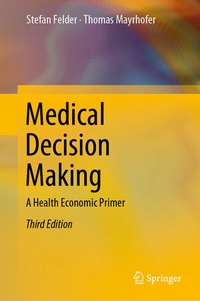
Medical Decision Making
Description

This textbook offers a comprehensive analysis of medical decision-making under uncertainty by combining test information theory with expected utility theory. The authors show how the parameters of Bayes' theorem can be combined with a value function of health states in order to arrive at informed test and treatment decisions in the face of diagnostic and therapeutic risks. Distinguishing between risk-neutral, risk-averse, and prudent decision-makers, they demonstrate the effects of risk preferences on medical decisions. Furthermore, they analyze individual and multiple tests as well as diagnostic models in which the decision-maker chooses the test outcome. The consequences of test and treatment decisions for the patient are encompassed by quality-adjusted life years (QALYs) and the standard economic model, which applies the willingness to pay for health approach. Lastly, non-expected utility models of choice under risk and uncertainty are presented. Although these models can explainsome of the test and treatment decisions observed, they are less suitable for normative analyses aimed at providing guidance on medical decision-making.
This third edition provides extensively revised versions of all chapters and reflects recent innovations in medical decision-making such as decision curve analysis. New chapters focus on the health economics of and revealed preferences in medical decisions. The book is intended for students of (health) economics and medicine as well as for medical decision-makers and physicians dealing with uncertainty in their test and treatment decisions.
More details
Other editions
Additional editions
Previous edition
Persons
Stefan Felder has been a Full Professor of Health Economics at the Department of Business and Economics and Director of the Basel Center for Health Economics, University of Basel, Switzerland, since 2011. He studied Economics and Sociology and received his Ph.D. and his venia docendi from the University of Bern, Switzerland. He worked and taught at the University of Western Ontario, Canada (1990/92), the University of Zurich, Switzerland (1992/1996), and the University of Fribourg, Switzerland (1993/95), before joining the Faculties of Medicine and Economics at the University of Magdeburg, Germany, in 1997. From 2008 to 2011, he was a Professor of Health Economics at the University of Duisburg-Essen, Germany, and from 2011 to 2015, Director of the German Health Economic Research Center CINCH in Essen. From 2013 to 2020, he was the Executive Secretary of the European Health Economic Association, President of the German Association of Health Economics (2017), and Presidentof the Swiss Society of Health Economics (2016-2020).
Thomas Mayrhofer is a Professor of Economics at Stralsund University of Applied Sciences, Germany, and a Lecturer at Massachusetts General Hospital and Harvard Medical School of Harvard University, USA. He studied Economics at the University of Magdeburg, Germany, and received his Ph.D. in Economics from the University of Duisburg-Essen, Germany. Before becoming a Professor in Stralsund in 2015, he worked at the German Health Economic Research Center CINCH in Essen and at Massachusetts General Hospital and Harvard Medical School of Harvard University, USA.
Content
Chapter 1. Introduction.- Chapter 2. Basic Tools in Medical Decision Making.- Chapter 3. Basic Tools in Economics: Preferences, Expected Utility, Risk Aversion and Prudence.- Chapter 4. Treatment Decisions.- Chapter 5. Test and Treatment Decisions.- Chapter 6. Prudence and Medical Decision Making.- Chapter 7. Optimal Strategy for Multiple Diagnostic Tests.- Chapter 8. The Optimal Cut-off of a Diagnostic Test.- Chapter 9. The Total Value of Information of a Test.- Chapter 10. The Economics of Medical Decision Making.- Chapter 11. Valuing Health and Life.- Chapter 12. Revealed Preference in Medical Decisions.- Chapter 13. Imperfect Agency and Non-Expected Utility Models.
