

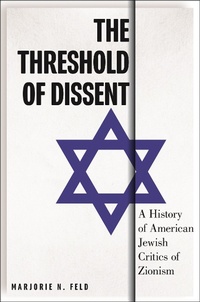
The Threshold of Dissent
A History of American Jewish Critics of Zionism
Published on 7. May 2024
277 pages
978-1-4798-2934-7 (ISBN)
Description

Explores the long history of anti-Zionist and non-Zionist American Jews
Throughout the twentieth century, American Jewish communal leaders projected a unified position of unconditional support for Israel, cementing it as a cornerstone of American Jewish identity. This unwavering position served to marginalize and label dissenters as antisemitic, systematically limiting the threshold of acceptable criticism. In pursuit of this forced consensus, these leaders entered Cold War alliances, distanced themselves from progressive civil rights and anti-colonial movements, and turned a blind eye to human rights abuses in Israel. In The Threshold of Dissent, Marjorie N. Feld instead shows that today's vociferous arguments among American Jews over Israel and Zionism are but the newest chapter in a fraught history that stretches from the nineteenth century.
Drawing on rich archival research and examining wide-ranging intellectual currents-from the Reform movement and the Yiddish left to anti-colonialism and Jewish feminism-Feld explores American Jewish critics of Zionism and Israel from the 1880s to the 1980s. The book argues that the tireless policing of contrary perspectives led each generation of dissenters to believe that it was the first to question unqualified support for Israel. The Threshold of Dissent positions contemporary critics within a century-long debate about the priorities of the American Jewish community, one which holds profound implications for inclusion in American Jewish communal life and for American Jews' participation in coalitions working for justice.
At a time when American Jewish support for Israel has been diminishing, The Threshold of Dissent uncovers a deeper-and deeply contested-history of intracommunal debate over Zionism among American Jews.
Throughout the twentieth century, American Jewish communal leaders projected a unified position of unconditional support for Israel, cementing it as a cornerstone of American Jewish identity. This unwavering position served to marginalize and label dissenters as antisemitic, systematically limiting the threshold of acceptable criticism. In pursuit of this forced consensus, these leaders entered Cold War alliances, distanced themselves from progressive civil rights and anti-colonial movements, and turned a blind eye to human rights abuses in Israel. In The Threshold of Dissent, Marjorie N. Feld instead shows that today's vociferous arguments among American Jews over Israel and Zionism are but the newest chapter in a fraught history that stretches from the nineteenth century.
Drawing on rich archival research and examining wide-ranging intellectual currents-from the Reform movement and the Yiddish left to anti-colonialism and Jewish feminism-Feld explores American Jewish critics of Zionism and Israel from the 1880s to the 1980s. The book argues that the tireless policing of contrary perspectives led each generation of dissenters to believe that it was the first to question unqualified support for Israel. The Threshold of Dissent positions contemporary critics within a century-long debate about the priorities of the American Jewish community, one which holds profound implications for inclusion in American Jewish communal life and for American Jews' participation in coalitions working for justice.
At a time when American Jewish support for Israel has been diminishing, The Threshold of Dissent uncovers a deeper-and deeply contested-history of intracommunal debate over Zionism among American Jews.
Reviews / Votes
Excellent, well-researched, well-written, and much needed. The story of American Zionism is a story that has been told many times, and yet it is a story that has yet to be told in its fullness. The Threshold of Dissent offers a historically based, well-argued and deeply important counter-narrative to the Zionist Consensus history, and evokes a serious conversation in re-thinking the history and trajectory of American Zionism. (Shaul Magid, Dartmouth College) Surveying the history of such dissent dating back to the 1880s and continuing through the wake of the October 7 Hamas attack, Feld persuasively shows that the post-WWII pro-Zionist consensus among American Jews was a facade projected by Zionist Jewish American leaders, who, after the Holocaust, believed that the state of Israel was 'essential for Jewish survival.' This meticulous study is a valuable contribution to ongoing debates over America's relationship with Israel. (Publishers Weekly) In clear, careful language, the author illustrates some of the major moments over the past century that have shaped Jewish beliefs about Zionism, anti-Zionism and non-Zionism. It's a history told with both rigor and compassion - two qualities that seem especially essential when embarking in conversation on such a fraught and contentious subject. - Leah Donnella (NPR) Written with dramatic verve and backed up with a plethora of evidence... [Feld is] a scholar who writes with historical acuity and human sensitivity. - Alan Wald (Against the Current) The Threshold of Dissent is a welcome addition to the literature on the politics of American Jews... Feld succeeds in her evident goal of providing contemporary Jewish activists with a usable past, one that, until recently, the annals of American Jewish history had not readily offered up. - Matt Berkman (H-Diplo)More details
Series
Language
English
Place of publication
New York
United States
Target group
Professional and scholarly
ISBN-13
978-1-4798-2934-7 (9781479829347)
Copyright in bibliographic data and cover images is held by Nielsen Book Services Limited or by the publishers or by their respective licensors: all rights reserved.
Schweitzer Classification
Other editions
Additional editions
Book
approx. 02/2027
New York University Press
€30.50
Not yet published
Person
Marjorie N. Feld is Professor of History in the History and Society Division at Babson College. She is the author of Lillian Wald: A Biography and Nations Divided: American Jews and the Struggle Over Apartheid.
