

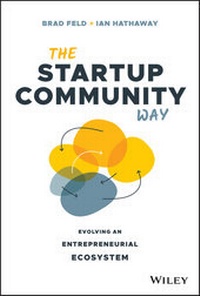
The Startup Community Way
Evolving an Entrepreneurial Ecosystem
1st Edition
Published on 25. June 2020
368 pages
978-1-119-61364-0 (ISBN)
Description

The Way Forward for Entrepreneurship Around the World
We are in the midst of a startup revolution. The growth and proliferation of innovation-driven startup activity is profound, unprecedented, and global in scope. Today, it is understood that communities of support and knowledge-sharing go along with other resources. The importance of collaboration and a long-term commitment has gained wider acceptance. These principles are adopted in many startup communities throughout the world.
And yet, much more work is needed. Startup activity is highly concentrated in large cities. Governments and other actors such as large corporations and universities are not collaborating with each other nor with entrepreneurs as well as they could. Too often, these actors try to control activity or impose their view from the top-down, rather than supporting an environment that is led from the bottom-up. We continue to see a disconnect between an entrepreneurial mindset and that of many actors who wish to engage with and support entrepreneurship. There are structural reasons for this, but we can overcome many of these obstacles with appropriate focus and sustained practice.
No one tells this story better than Brad Feld and Ian Hathaway. The Startup Community Way: Evolving an Entrepreneurial Ecosystem explores what makes startup communities thrive and how to improve collaboration in these rapidly evolving, complex environments.
The Startup Community Way is an explanatory guide for startup communities. Rooted in the theory of complex systems, this book establishes the systemic properties of entrepreneurial ecosystems and explains why their complex nature leads people to make predictable mistakes. As complex systems, value creation occurs in startup communities primarily through the interaction of the "parts" - the people, organizations, resources, and conditions involved - not the parts themselves. This continual process of bottom-up interactions unfolds naturally, producing value in novel and unexpected ways. Through these complex, emergent processes, the whole becomes greater and substantially different than what the parts alone could produce.
Because of this, participants must take a fundamentally different approach than is common in much of our civic and professional lives. Participants must take a whole-system view, rather than simply trying to optimize their individual part. They must prioritize experimentation and learning over planning and execution. Complex systems are uncertain and unpredictable. They cannot be controlled, only guided and influenced. Each startup community is unique. Replication is enticing but impossible. The race to become "The Next Silicon Valley" is futile - even Silicon Valley couldn't recreate itself.
This book:
* Offers practical advice for entrepreneurs, community builders, government officials, and other stakeholders who want to harness the power of entrepreneurship in their city
* Describes the core components of startup communities and entrepreneurial ecosystems, as well as an explanation of the differences between these two related, but distinct concepts
* Advances a new framework for effective startup community building based on the theory of complex systems and insights from systems thinking
* Includes contributions from leading entrepreneurial voices
* Is a must-have resource for entrepreneurs, venture capitalists, executives, business and community leaders, economic development authorities, policymakers, university officials, and anyone wishing to understand how startup communities work anywhere in the world
We are in the midst of a startup revolution. The growth and proliferation of innovation-driven startup activity is profound, unprecedented, and global in scope. Today, it is understood that communities of support and knowledge-sharing go along with other resources. The importance of collaboration and a long-term commitment has gained wider acceptance. These principles are adopted in many startup communities throughout the world.
And yet, much more work is needed. Startup activity is highly concentrated in large cities. Governments and other actors such as large corporations and universities are not collaborating with each other nor with entrepreneurs as well as they could. Too often, these actors try to control activity or impose their view from the top-down, rather than supporting an environment that is led from the bottom-up. We continue to see a disconnect between an entrepreneurial mindset and that of many actors who wish to engage with and support entrepreneurship. There are structural reasons for this, but we can overcome many of these obstacles with appropriate focus and sustained practice.
No one tells this story better than Brad Feld and Ian Hathaway. The Startup Community Way: Evolving an Entrepreneurial Ecosystem explores what makes startup communities thrive and how to improve collaboration in these rapidly evolving, complex environments.
The Startup Community Way is an explanatory guide for startup communities. Rooted in the theory of complex systems, this book establishes the systemic properties of entrepreneurial ecosystems and explains why their complex nature leads people to make predictable mistakes. As complex systems, value creation occurs in startup communities primarily through the interaction of the "parts" - the people, organizations, resources, and conditions involved - not the parts themselves. This continual process of bottom-up interactions unfolds naturally, producing value in novel and unexpected ways. Through these complex, emergent processes, the whole becomes greater and substantially different than what the parts alone could produce.
Because of this, participants must take a fundamentally different approach than is common in much of our civic and professional lives. Participants must take a whole-system view, rather than simply trying to optimize their individual part. They must prioritize experimentation and learning over planning and execution. Complex systems are uncertain and unpredictable. They cannot be controlled, only guided and influenced. Each startup community is unique. Replication is enticing but impossible. The race to become "The Next Silicon Valley" is futile - even Silicon Valley couldn't recreate itself.
This book:
* Offers practical advice for entrepreneurs, community builders, government officials, and other stakeholders who want to harness the power of entrepreneurship in their city
* Describes the core components of startup communities and entrepreneurial ecosystems, as well as an explanation of the differences between these two related, but distinct concepts
* Advances a new framework for effective startup community building based on the theory of complex systems and insights from systems thinking
* Includes contributions from leading entrepreneurial voices
* Is a must-have resource for entrepreneurs, venture capitalists, executives, business and community leaders, economic development authorities, policymakers, university officials, and anyone wishing to understand how startup communities work anywhere in the world
More details
Other editions
Additional editions
Brad Feld | Ian Hathaway
The Startup Community Way: How to Build an Entrepreneurial Ecosystem That Thrives
Evolving an Entrepreneurial Ecosystem
Book
07/2020
1st Edition
Wiley
€29.00
Shipment within 15-20 days
Persons
BRAD FELD has been an early-stage investor and entrepreneur for over 30 years. He is currently a partner at Foundry Group and is a co-founder of Techstars. In addition to his investing efforts, Brad runs the Anchor Point Foundation with his wife Amy Batchelor. Brad is a nationally recognized speaker on the topics of venture capital investing and entrepreneurship.
IAN HATHAWAY is an analyst, strategist, and writer. He has been an advisor and executive for leaders in technology, media, and finance on a range of innovation, strategy, and policy initiatives. He is a leading thinker and writer in the areas of entrepreneurship, innovation, cities, and the economy. Ian also advises and invests in startups in the United States and Europe.
IAN HATHAWAY is an analyst, strategist, and writer. He has been an advisor and executive for leaders in technology, media, and finance on a range of innovation, strategy, and policy initiatives. He is a leading thinker and writer in the areas of entrepreneurship, innovation, cities, and the economy. Ian also advises and invests in startups in the United States and Europe.
Content
Foreword 5
Dedication 6
Preface 7
1. Introduction 13
2. Why Startup Communities Exist 27
3. The Actors 42
4. The Factors 54
5. Startup Communities versus Entrepreneurial Ecosystems 65
Part II: Startup Communities as Complex Systems 76
6. Putting the System Back into Ecosystem 77
7. Unpredictable Creativity 90
8. The Myth of Quantity 103
9. The Illusion of Control 116
10. The Absence of a Blueprint 125
11. The Measurement Trap 137
Part III: From the Boulder Thesis to the Startup Community Way 153
12. Simplifying Complexity 154
13. Leadership is Key 170
14. Think in Generations 179
15. Diversity is a Feature, Not a Bug 187
16. Be Active, Not Passive 195
Part IV: Conclusion 204
17. Conclusion 205
Recap of the Book 206
Final Thoughts 210
Acknowledgements 213
Dedication 6
Preface 7
1. Introduction 13
2. Why Startup Communities Exist 27
3. The Actors 42
4. The Factors 54
5. Startup Communities versus Entrepreneurial Ecosystems 65
Part II: Startup Communities as Complex Systems 76
6. Putting the System Back into Ecosystem 77
7. Unpredictable Creativity 90
8. The Myth of Quantity 103
9. The Illusion of Control 116
10. The Absence of a Blueprint 125
11. The Measurement Trap 137
Part III: From the Boulder Thesis to the Startup Community Way 153
12. Simplifying Complexity 154
13. Leadership is Key 170
14. Think in Generations 179
15. Diversity is a Feature, Not a Bug 187
16. Be Active, Not Passive 195
Part IV: Conclusion 204
17. Conclusion 205
Recap of the Book 206
Final Thoughts 210
Acknowledgements 213
