

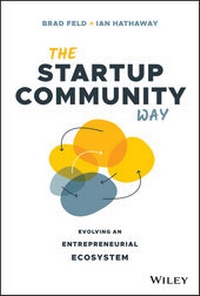
The Startup Community Way
Description

We are in the midst of a startup revolution. The growth and proliferation of innovation-driven startup activity is profound, unprecedented, and global in scope. Today, it is understood that communities of support and knowledge-sharing go along with other resources. The importance of collaboration and a long-term commitment has gained wider acceptance. These principles are adopted in many startup communities throughout the world.
And yet, much more work is needed. Startup activity is highly concentrated in large cities. Governments and other actors such as large corporations and universities are not collaborating with each other nor with entrepreneurs as well as they could. Too often, these actors try to control activity or impose their view from the top-down, rather than supporting an environment that is led from the bottom-up. We continue to see a disconnect between an entrepreneurial mindset and that of many actors who wish to engage with and support entrepreneurship. There are structural reasons for this, but we can overcome many of these obstacles with appropriate focus and sustained practice.
No one tells this story better than Brad Feld and Ian Hathaway. The Startup Community Way: Evolving an Entrepreneurial Ecosystem explores what makes startup communities thrive and how to improve collaboration in these rapidly evolving, complex environments.
The Startup Community Way is an explanatory guide for startup communities. Rooted in the theory of complex systems, this book establishes the systemic properties of entrepreneurial ecosystems and explains why their complex nature leads people to make predictable mistakes. As complex systems, value creation occurs in startup communities primarily through the interaction of the "parts" - the people, organizations, resources, and conditions involved - not the parts themselves. This continual process of bottom-up interactions unfolds naturally, producing value in novel and unexpected ways. Through these complex, emergent processes, the whole becomes greater and substantially different than what the parts alone could produce.
Because of this, participants must take a fundamentally different approach than is common in much of our civic and professional lives. Participants must take a whole-system view, rather than simply trying to optimize their individual part. They must prioritize experimentation and learning over planning and execution. Complex systems are uncertain and unpredictable. They cannot be controlled, only guided and influenced. Each startup community is unique. Replication is enticing but impossible. The race to become "The Next Silicon Valley" is futile - even Silicon Valley couldn't recreate itself.
This book:
* Offers practical advice for entrepreneurs, community builders, government officials, and other stakeholders who want to harness the power of entrepreneurship in their city
* Describes the core components of startup communities and entrepreneurial ecosystems, as well as an explanation of the differences between these two related, but distinct concepts
* Advances a new framework for effective startup community building based on the theory of complex systems and insights from systems thinking
* Includes contributions from leading entrepreneurial voices
* Is a must-have resource for entrepreneurs, venture capitalists, executives, business and community leaders, economic development authorities, policymakers, university officials, and anyone wishing to understand how startup communities work anywhere in the world
More details
Other editions
Additional editions
Persons
IAN HATHAWAY is an analyst, strategist, and writer. He has been an advisor and executive for leaders in technology, media, and finance on a range of innovation, strategy, and policy initiatives. He is a leading thinker and writer in the areas of entrepreneurship, innovation, cities, and the economy. Ian also advises and invests in startups in the United States and Europe.
Content
PREFACE
In 2014, I* was in Downtown Las Vegas. This location is not the glitzy sunset strip where most people spend time when they are in Las Vegas, but the historic business district that was undergoing a massive renovation under the leadership of Tony Hsieh, the founder of Zappos. Dead buildings were coming back to life, and Las Vegas no longer ended at Fremont Street.
UP Global, a nonprofit dedicated to building startup communities that is now part of Techstars, was having its annual summit. I was on the board of UP Global at the time and over 500 entrepreneurs from 70 countries were in attendance. Organizers from all over the world of the three UP Global programs-Startup Weekend, Startup Week, and Startup Digest-were meeting each other and participating in sessions about how to run their programs, build their startup communities, and spread the ethos of startups and innovation.
The event was in full swing with energy and excitement around startups in the air. While English was the dominant spoken language, the body language, discussions, and personal styles of the attendees gave the event an unmistakable international feel. The gathering was a diverse collection of people of all ages from around the globe.
I participated in a few discussions on startup communities, signed a bunch of copies of my book, Startup Communities, and smiled for an endless stream of selfies taken with community organizers from all over the world. The weather was hot, and the emotions were warm.
At the final evening gala, the buzz of the event was building to a climax for many participants. I was worn out from the previous two days, and stood, observing quietly, in a far corner of the giant banquet hall. Suddenly, a person I did not know came up to me and shouted over the din, "Thank you for changing my life!" while simultaneously putting a baseball cap on my head.
I responded with, "What did I do?"
The young man said, "Look at the hat!"
I took the cap off and saw that it was from a Startup Weekend in the Middle East. I saw tears in the eyes of the person who was now several inches away. Arms opened, and a big hug followed.
A 20-something from the Middle East and a 40-something American Jew, hugging in Downtown Las Vegas, bonding over startups and startup communities. A life changed. Well, two lives changed.
In the fall of 2008, Ben Casnocha, a longtime friend of mine, wrote an article for The American called "Start-up Town" that began with the following teaser:1
In the past 15 years, Boulder has gone from a little hippie college town to a little hippie college town also boasting an impressive and growing congregation of Internet entrepreneurs, early-stage venture capitalists, and bloggers. How did Boulder pull this off? And what can other cities, policymakers, and entrepreneurs who want to boost their own start-up quotient-and overall competitiveness at a local level-learn from Boulder's success?
When I saw the article, it reaffirmed a hunch I had about what was happening in Boulder around startups and entrepreneurship. People started talking about entrepreneurship as a way out of the Financial Crisis of 2007-2008 and the Great Recession that followed. Places, including Silicon Valley, New York, and Boston, were being described as "entrepreneurial ecosystems." In his article, Ben mentioned, "Silicon Valley, New York, Boston, and Boulder." Yes, Boulder.
Boulder is very different from Silicon Valley, New York, and Boston. It's a small town of around 107,000 people, with about 315,000 in the metro area of Boulder County. While it is only a 30-minute drive from Denver, which has a population of 700,000 (and a metro-area population of 2.9 million), in 2008, the two cities couldn't have been further apart from each other when it came to identity. Two recurring jokes that I have heard regularly since moving to Boulder in 1995 are "Boulder is 25 square miles surrounded by reality" and "to get between Boulder and Denver on US-36 you have to pass through a guard gate and an airlock." From my perspective, the entire population of Boulder could probably fit on a single city block of Midtown Manhattan, if you turned the office buildings into condos.
Over the next few years, I spent much time learning about entrepreneurial ecosystems, reading everything I could on innovation clusters, national innovation systems, innovation networks, and startup incubators. As Techstars, which I co-founded in 2006, started to expand, first to Boston, then to Seattle, and on to New York, I began seeing similar patterns-both positive and negative-in the way startup culture developed. By 2011, I formed a view on a new construct I started calling a "startup community." In 2012, I wrote and published Startup Communities: Building an Entrepreneurial Ecosystem in Your City.
I built the book around a concept I called the Boulder Thesis, a set of four principles that defined how to create a lasting and durable startup community. Shortly after Startup Communities came out, the Kauffman Foundation did a short video called "StartupVille" that did a phenomenal job of stating the Boulder Thesis.2 I did an extemporaneous, four-minute riff, Kauffman built a video around it, and "StartupVille" and my verbal description of the Boulder Thesis became the opening for many talks in the next few years on startup communities. Within a year, the phrase "startup communities" became the definitive phrase for the phenomenon while the premise that you could build a startup community in any city with at least 100,000 people became a mantra for entrepreneurs all over the world.
Ben wrote his article only 12 years ago, which isn't a very long time in StartupVille. If you have read Startup Communities, you know that the second principle of the Boulder Thesis is that "you have to have a long-term view-at least 20 years." Over time, I have adjusted that to be "you have to have a long-term view-at least 20 years from today," to emphasize the importance of both the startup community to a city and a long-term view for anyone involved in a startup community.
Several years ago, I became friends with Ian. We were first introduced in 2014 by our mutual friend, Richard Florida, and over the years, we communicated every so often to share ideas and chat about our respective work and writing. Among other things, I helped Ian develop content for a "Startup Cities" course he was teaching at New York University by offering my views on best practices for startup accelerators.3
In 2016, Ian was ready for a new challenge. At the time, his working life involved advising major tech and media companies by day, and spending his nights and weekends thinking about, writing about, and finding ways to work with startups and entrepreneurs. He reached out to me for advice about how he might better align his work around helping entrepreneurs. We began to explore ways we might collaborate directly and, after a few iterations, we ended up landing on co-authoring the book you are now reading.
By 2016, entrepreneurship was a worldwide phenomenon. The word unicorn no longer referred to a mythical beast, and the phrase "startup communities" was common. Ian came to Boulder to kickstart our work in the spring of 2017, and we started bouncing around ideas for this book.
In the United States, Donald Trump had just been elected president, and Britain had formally begun the process to leave the European Union. While that shouldn't have slowed us down, it caused us to take a step back and reflect on the dynamics of Western society. Ian had recently arrived in Boulder from London, where he had just witnessed Brexit firsthand as an American ex-pat. He arrived home to a very different type of political climate in the United States. There was something important, uncomfortable, and divisive going on. Against this backdrop we wanted the sequel to Startup Communities to be part of a broader solution, rather than a narrowly focused addition to fixing and evolving what I had written in Startup Communities in 2012.
Like many collaborations, it took some time for us to hit our stride. Ian did an enormous amount of research, consuming vast quantities of literature and studying a range of approaches to startup communities that had emerged in the previous five years. He talked to countless people building startup communities across the planet and he kept an open mind to everything he read and heard, including writing and ideas that criticized my approach of putting the entrepreneur at the center of things.4
Ian then sketched a first draft by mid-summer 2017, which, like all first drafts, we threw away. It was too conventional, and it didn't address a glaring problem. As Ian talked to more people, he realized there was an enormous divide between the approaches taken by entrepreneurs and others who were actively building startup communities and those taken by the range of actors who increasingly wanted to participate (e.g., universities, governments, corporations, and foundations).
While this disconnect was well-known, we decided that it was too easily explained away by saying that one group got it while the other didn't. This rationale creates antagonism, which causes a breakdown in meaningful collaboration-and that is why the problem persists. This simple explanation also turns out to be wrong. The real problem is...
